The Naked Truth: How Stripping Down Built My Self-Confidence


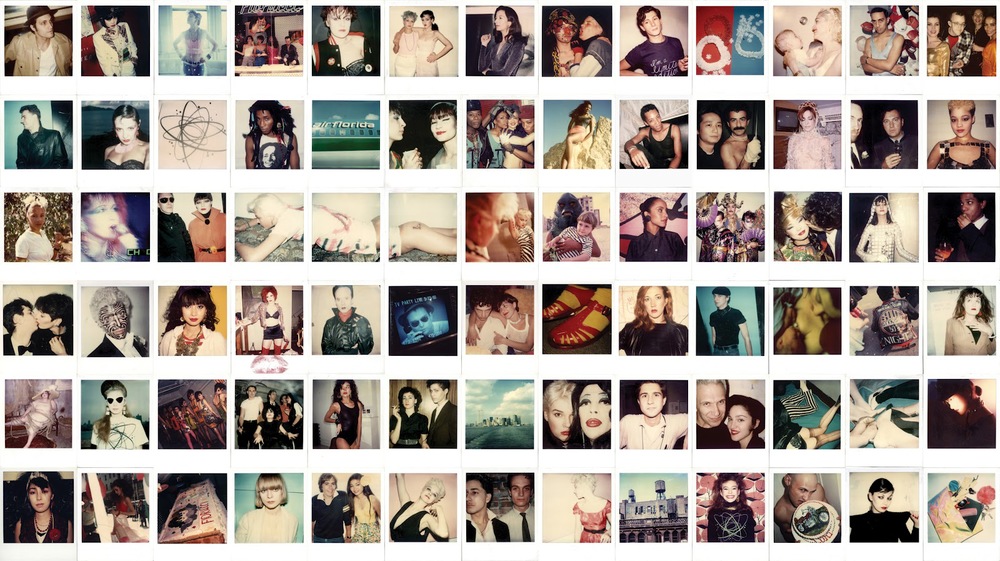
In my first foray into the world of Folsom Street East (the largest fetish block party on the East Coast), I didn’t know what to expect. A friend of mine had asked me to go with him. Upon our arrival, one of the first tents we encountered was of the Visual AIDS — an organization that utilizes art to provoke dialogue and supports HIV+ artists. A (very) handsome semi-naked man greeted us cheerfully and invited us to support the cause: “Do you want to take a Polaroid for Benjamin’s project?” I was in for the thrill of the ride and had promised myself I would let whatever happened, happen. We signed a waiver (which we didn’t read) and as we headed down the cue my friend started stripping down. Was there a memo I never got? We were in the middle of the street in broad daylight.

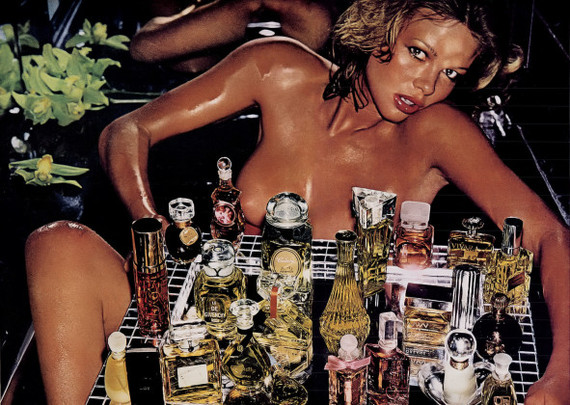
Being naked in public was basically my worst fear, coming to life. “Well, if you can go surfing, you can get naked in front of hundreds of people, it’ll be a nice test!” — I figured. I took my clothes off, leaving on only the skimpy jockstraps I was wearing. Onlookers immediately complimented me for keeping it classic and not branching out with one of those more recent, colorful designs. “Wow, the real sports jock, that’s hot!” Parents and their young children walked by as I laid my clothes down on the foldable table; it was all vonnegutesque.

I had never experienced such freedom. I had never felt so proud about myself, my sexuality, and my body, no matter how imperfect it is. Believe me, I was still petrified, but somehow, it clicked. I was finally able to accept my body image for what it is. I felt I could stop comparing myself to all the hot bodies I see in the gym, or the porn stars in the movies that everyone watches, but no one cares to admit. I felt like one of them, not apart from them. There was nothing so terrible about my figure. No, I don’t have a six pack, yes, there are muffin tops (perhaps from eating too many muffins), and my hair doesn’t always have the perfect wave, but that’s all me.

On my walk home, I wondered: Do these so-called “hot bodies” feel 100% confident about themselves? Or do they, too, sometimes look at people like me and find something they would like to have? Do they also compare and despair?

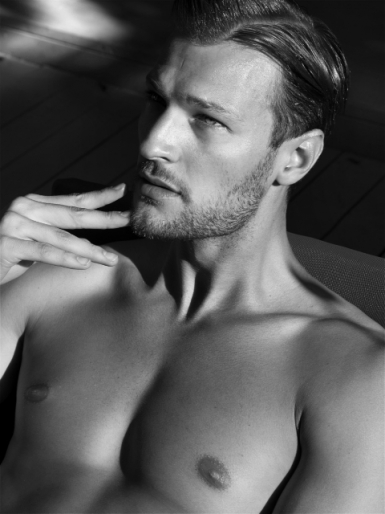
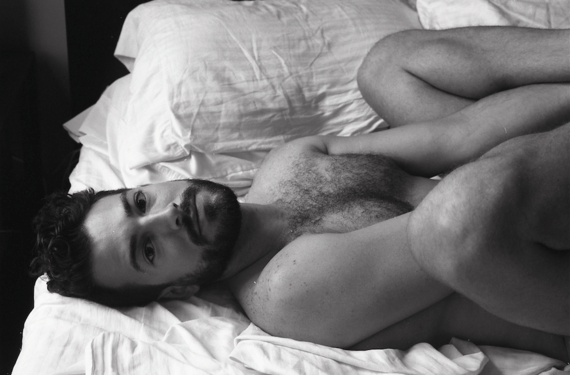
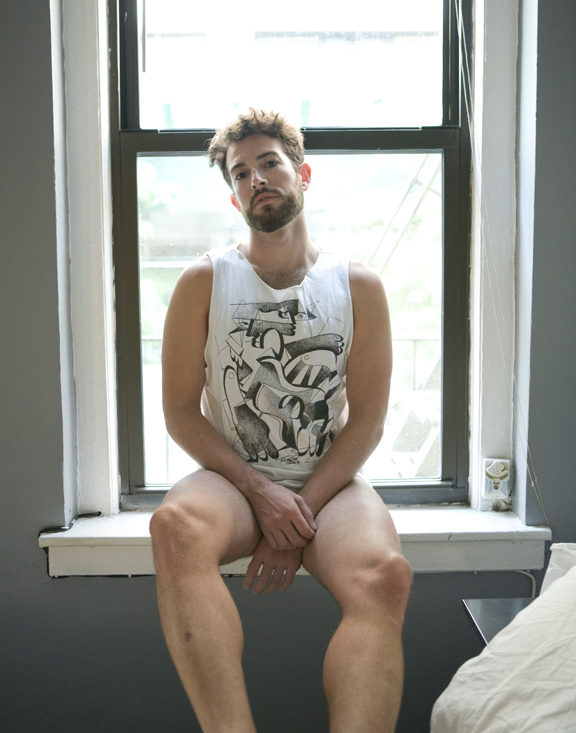
After turning down a couple of post-Folsom festivities (the polaroid shot was enough of a thrill), I could not stop thinking of how fun it was to let go of all my fears for that moment, to be (semi) naked in front of other people. I thought about Nodeth Vang, a photographer who had once asked if I would pose for him. “I love your hair and how you look in your apartment,” he said. I sent him a message; he was thrilled to hear from me. We set a date for our photoshoot. This was an opportunity to see myself as others see me. I wanted to discover how I looked on camera. No, I wanted to find out how I looked naked, on camera. I needed to know whether all my self-criticism was a reality or a fantasy.
2015-08-13-1439433981-5992932-IMG_2627.JPG

I will tell you that the photoshoot was one of the most exciting and sensual experiences I have ever had. I was in love with myself and my body for the first time in my life. I was completely comfortable naked in whatever scenario imaginable.

A few weeks passed, and I received an email from the artist from Folsom, Benjamin Fredrickson. I recalled he was a very sweet guy, talented too; “a real artist” I thought. His work had been shown in museums and art galleries, there was nothing gauche about it. Benjamin sent the polaroid from the fair to my friend and I. We were both happy with the result. The picture was adorable, not at all sleazy (as it could have been) and it absolutely captured our friendship and our relationship: two grown men who deeply cared (and perhaps had the hots) for each other. In the email, he ended with “if you would like to pose for another portrait, don’t hesitate to contact”. So I did.

Benjamin and I met for coffee one afternoon after work, we talked for over an hour and shared so many interests. He was definitely not a pervert, I felt safe. We set a date and time for our shoot, shook hands and went our separate ways. I couldn’t wait to contribute with him as an artist. I wanted to understand what different interpretations might arise from different shoots and artistic visions. Moreover, I wanted to feel that same thrill I’d felt before.

What happened for me that day was cathartic, I learned to let go of all the shame I had been carrying since my years as a fat kid, and just have fun. Benjamin put me in the most unexpected positions; I simply followed his lead. He told me to bend over, push my ass up, bend my legs over my head, stand up, sit down… I did it all! I felt complete serenity and connected with what those models must have felt when posing for Picasso. There is a connection that occurs, a fire that sparks in the eye of the artist and the way he thinks and interprets your beauty is so personal and unique to him. That is what I wanted to see in the film. At that moment I had no judgement; at that moment I was certain I would never feel ashamed of what I was doing. Whether those images ended in a magazine or an art show, it all made sense to me. At that moment I finally understood the difference between nudity for art and pornography. I know, this could unleash a long drawn-out conversation, but in my head it became simple and neither are bad or wrong — they simply are.

The last five years of my life have been all about self-acceptance and discovery, I’ve done things I never believed were possible. I learned surfing, I jumped from the top of a waterfall, I wrote a screenplay and I fell in love. Twice. Loving myself and my body, as it is, was probably my last threshold. I am happy to say I crossed it and will hopefully never go back again. First, I had to come out of the closet, then, I had to be accepted by my gay peers and live up to unrealistic beauty standards. Most of those standards however, lived in my head. Today all I want is to be real and happy. We are all different from each other, there is definitely room for everyone.

The New Revolution

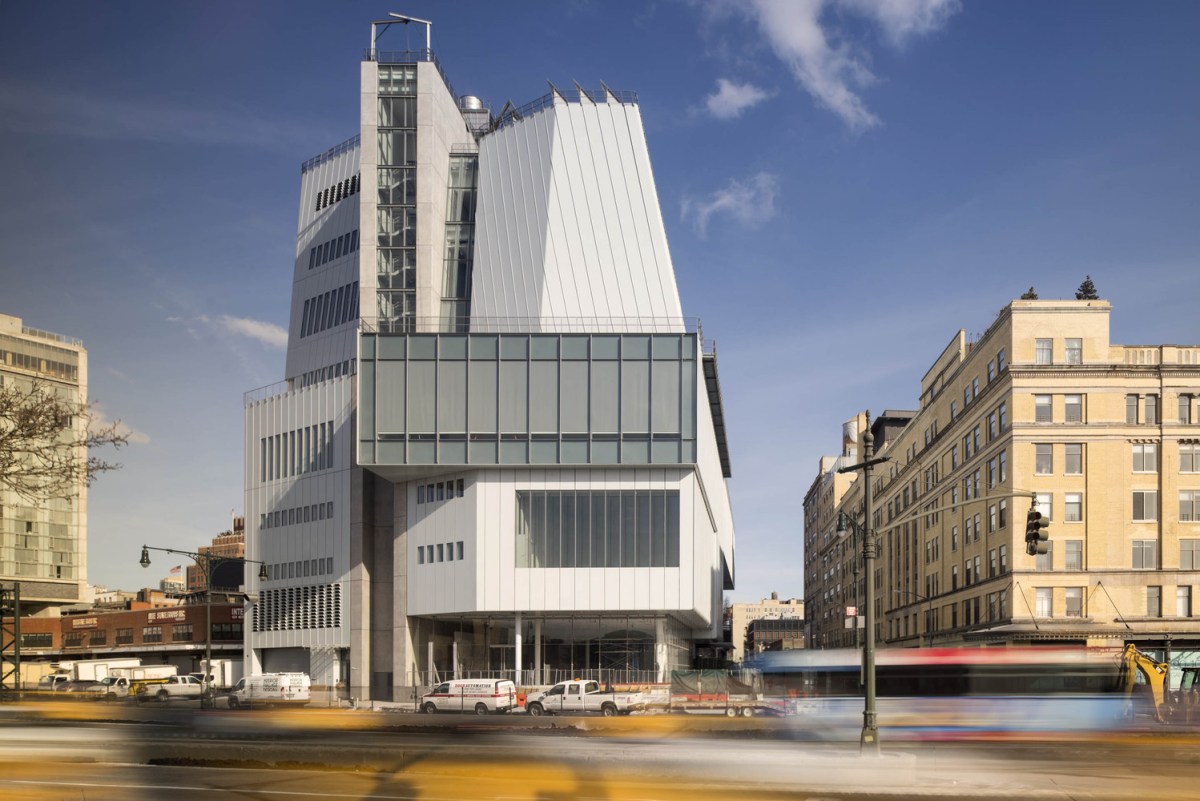
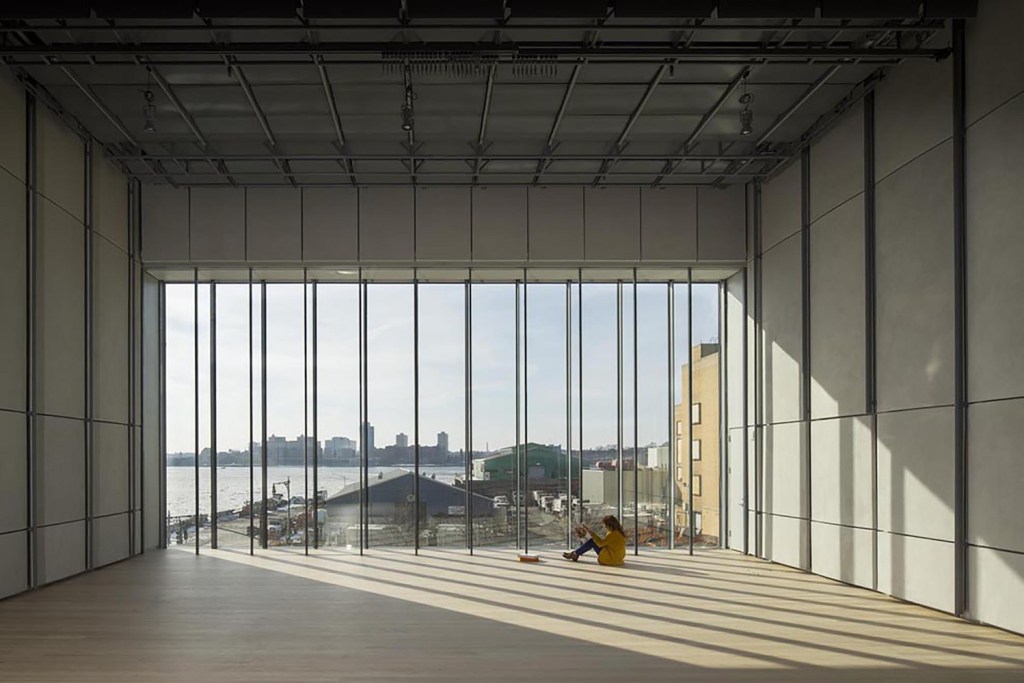
From a distance, it is difficult to know whether the new residence of the Whitney Museum of American Art is a ship, a factory or a hospital. Up close, the large windows that give the space a loft feel and open from east to west, offer a preview of what inhabits this interesting edification. The building created by Renzo Piano, one of the most celebrated architects of the moment, was received by differing opinions. Purist architectural critics with more negative views than others with a more open mind.

What everyone agrees, however, is that the new address of the celebrated museum follows the philosophy of its creation, of staying alive, interesting and involved with what is happening in the local culture. The arrival of the museum in the Meatpacking District helps to cement the idea that this region, next to Chelsea, is in fact the new mecca of art in New York.

In its fourth address since its creation in the 1930s, Whitney is used to controversy. In its conception, through the brilliant mind of the sculptor Gertrude Vanderbilt Whitney, the organization faced difficulties. This artist, who found the need to create a fund dedicated exclusively to living American artists, saw her donation of more than 500 works rejected by the Metropolitan Museum of Art. It was then that this visionary opened the museum’s first headquarters in the Greenwich Village. In the 1960s, after filling his second headquarters on West 54th Street, Marcel Breuer revealed the museum’s third headquarters and his masterpiece of brutalist architecture. Residents of the Upper East Side, Manhattan’s traditional neighborhood known for its art galleries and museums, reacted in horror. The architecture was then considered offensive and exclusive. The headquarters created by Breuer, however, quickly received cult status and remains today as one of the most important works of world architecture. 

In 1975 the entity’s collection had 2000 American works of art from all ages and its team employed around 100 employees. The museum’s total space was 3 thousand square meters, of which 715 were dedicated to its permanent collection. In 2014, Whitney needed to expand again. Today, this nationalist gem contains more than 21,000 works in its catalog and a team of more than 300 employees. The new space offers 2 thousand square meters for its permanent collection divided into two floors that are part of an impressive total of 6 thousand square meters of total space. Not to mention that the museum still intends to expand its domains to the quayside by the river, in front of its building and if necessary, it can still occupy its neighbor next door, a meat processing building built in the Shaker style, which in itself is an American icon.

This is not everything. What this museum created with a simple change of address was actually a revolution in the New York art scene. In the middle of a space crisis, the main museums of the city find themselves having to choose between historical and contemporary, new and old, dividing by categories and hiding from the public masterpieces that should be permanently accessible. The Metropolitan, historically more focused on classical art, has an impressive collection of contemporary art but does not have the space to display it. Moma, after two expansions, continues to face difficulties mainly due to the intense traffic of tourists in its tight corridors. What Whitney demonstrated with this change that cost 422 million dollars, and that art should not be exclusive. Its galleries offer American art, from all ages and artists alive and dead. If art is of quality, it has space in this museum without sacrifices in favor of space or obsolete theories.

With its vacant old building, Whitney made 3,000 square meters of space available for art in the city and the Metropolitan wasted no time and signed an eight-year contract with the organization. The Metropolitan’s contemporary art collection will now be transferred entirely to Whitney’s old address, keeping Breuer’s architectural work alive and inspiring new generations. Moma, on the other hand, took advantage of the unfortunate situation of its neighbor, the Folk Art Museum, inhabitant of another renowned building, and will expand. Moma will undergo a complicated expansion project that, when completed, will also house part of the collection of its neighbor that was less fortunate.

But back to Whitney, what happens at your new address? The museum now offers jaw-dropping views of the river and the entire city at its feet. The more airy environments also have an open air cafe, a restaurant, Untitled, by chef Michael Anthony (part of the group of renowned Danny Meyer) and all the works that inhabited dark deposits and can now see the light of day. 

The museum’s collection features more internationally recognizable pieces from artists such as Jackson Pollock, Edward Hopper, Willem DeKooning, Georgia O’Keefe, Andrew Wyeth and Jasper Johns to celebrity venues like Jacob Lawrence. Lawrence’s social realism portrayed on the panels of “The Great Migration” the shift of the American black population from farms in the south to urban areas in the north. His work of “dynamic cubism” continued to follow the daily battles that marked history, such as the civil revolution of the 1960s. The pop art of Warhol and Lichtenstein is an obvious and obligatory presence in this collection, as well as their contemporaries Jean Michel Basquiat, Cy Twombly and Donald Judd. 

The photographers Peter Hujar, David Wojnarovicz, Nan Goldin and Robert Mapplethorpe are also worth mentioning, having enough space to recall a moment in the history of this city where a sexual revolution was taking place surrounded by the AIDS epidemic. The photographic collection also includes works by Man Ray, ranging from Diane Arbus to Cindy Sherman, in addition to legendary names in world fashion photography such as Richard Avedon, Irving Penn, Cecil Beaton and the contemporary Bruce Weber. It is also worth mentioning the work of social photographer Walker Evans, one of the most influential artists of the 20th century. Evans recorded the harsh reality of everyday life during the great depression and continued to ignore ideals of the “American Dream” and exposing life as it is until his death in 1975.

Contemporary art is present extensively. Paul McCarthy, Julian Schnabel, Chuck Close, Richard Serra and Francesco Clemente are some of the artists who deserve to be mentioned and continue to produce relevant works in the international arena. Another contemporary that stands out here is the renowned abstract Frank Stella who has his first complete retrospective on display at this museum.

The exterior of this building offers a visit to works by Alexander Calder and also the colorful and interactive art of Mary Heilmann, which invites the visitor to sit and relax in one of the several terraces. A stop for fresh air is more than necessary while visiting this extensive collection that is as creative and varied as the ethnic and geographical origin of its artists. 

The cultural representation here presents the same diversity that this country has. Artists of English, Latin, Irish, Chinese, German or Italian origins, to name a few and from different religious backgrounds and practices, demonstrate exactly what makes up this country’s cultural strength. Even with all the difficulties presented by these differences, the museum remains neutral and inclusive, telling stories and reminding the visitor that the world is much more than a picture painted in oil but rather the sum of all the creative expressions that result from the daily human experience.

Vogue Spain, 2017

ANTI Management, the agency that defends all, but ALL, models

BY MARÍA CONTRERAS

JULY 10, 2017

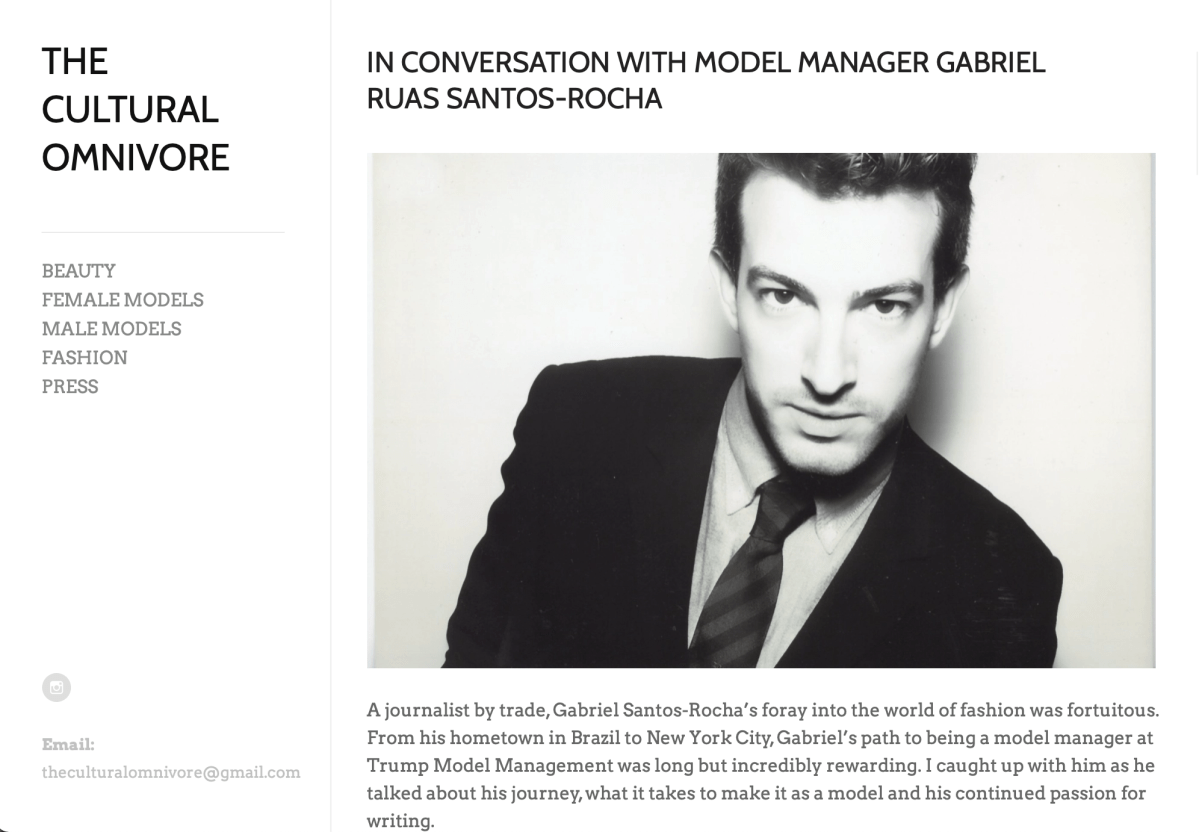
Booker Gabriel Ruas Santos Rocha is convinced that there are many things to improve in the fashion industry, and he doesn’t bite his tongue when it comes to listing them

The Brazilian Gabriel Ruas Santos Rocha is a veteran in the world of modeling agencies; he has been a booker at Marilyn, Ford, Elite and Trump Models, and since last March he is CEO of his own agency, ANTI Management, with which he has set out to improve the working conditions of his clients. Santos Rocha believes that the treatment of models has worsened alarmingly in recent years, and the origin of the problem is very clear: “When I started in this business the big agencies still belonged to families or individuals: Marilyn was directed by Marilyn, Ford was directed by the Fords, Beatrice had Beatrice… By crossing the doors of each agency you knew what their values were, the type of work they did and, most importantly, you knew who directed the show. But when they began to withdraw, most of the agencies were sold, and now most of our industry is managed by large faceless corporations in a way that would never have been accepted then.” And what exactly has changed? “Before we promoted careers and supervised everything our models did, from clothing lines to movies. That strengthened the agencies, and generated deeper relationships and careers longer. Some models took 2 to 5 years to get an important contract or make a name for themselves, but we never left them aside after the first season. But today models are often treated as if they were disposable dishes, and I totally disagree with that. I think that by returning the business to its roots, but in an updated and fresh way, we will recover some of the allure that this industry had and strengthen it.”

Your agency’s motto, “our models are our customers,” is a good indicator of the code of ethics that will govern ANTI Management. “The trend now is the power booker. Most agencies today care more about the clients of the models than about them. They are willing to do whatever it takes to take advantage of the money, and that is why – or because of their fears, or their ego… – they often make bad decisions on behalf of their models. Every day a supplier lowers their rates a little more, or adds hours of work without paying extra, or removes breakfast from the set; they do what is necessary to save, but what they do not understand, and what the agencies that bow to it do not understand either, is that this short-sighted vision is killing our industry, and not precisely little by little, but with enough speed. In addition, there is a level of pressure on the agents that escapes reason. If the numbers generated by the team do not meet the forecasts, there are consequences within the agency, so these have tripled the number of models they represent and are operating basically with a production chain mentality. But many of my colleagues forget that our original clients are the models; they forget that it is a privilege and an honor to represent any of these girls; they forget that they have placed their hopes, their dreams and their trust in us, and they also forget that they are the ones who pay our salaries, which is a very important lesson that I learned in Marilyn.”

“Anything you can imagine has happened in this industry,”

Gabriel Ruas Santos Rocha

Over the years, Gabriel has witnessed abuses and injustices towards models, but prefers not to go into details. “Anything you can imagine has happened in this industry,” he limits himself to saying. His last stage in Trump Model Managament was especially hectic; several media echoed an alleged boycott against the agency in retaliation for Trump’s policies and statements as president, and numerous employees and models – Gabriel among them – left the ship. How much truth is there in what is told? “As they say, I refer to the tests,” he points out. What happened to that agency was truly unfortunate. But the past is there, we have all gone ahead and surely in time we will manage to get something positive out of that time. Although it wasn’t really easy at all.”

Headquartered in New York, ANTI already has more than 70 models – many of them, from Trump Models – including Shirley Mallmann or Milana Keller. The agency will not divide them by categories (that is, there will not be the typical tabs of Man, Woman, New Faces, Legends …) to multiply their possibilities and not limit their potential: “For the moment I call it the Anti-Division, but the name could change. I don’t believe in labels, and I think that no model should have to conform to a ‘table’ or a ‘division.‘” The agency also defends an inclusive philosophy that embraces diversity: “Among our models there are gays, lesbians, trans, blacks, Chinese, Jews or Christians. Our job is to represent the talent we believe in with our best abilities, and that begins by respecting who each of them is individually. If we erase labels, we eliminate stigmas, and we are able to see people for who they really are and, consequently, to do a much better job in promoting them.”

On his personal Instagram account, Santos Rocha defines himself as a “writer, model booker and shit shaker.” What else are you determined to shake? “Everything. Believe me, no one can stop me. I always say that all I have is a huge mouth and no shame. And it’s the truth.” We just checked it.

Link to the article here.

Nylon, 2017

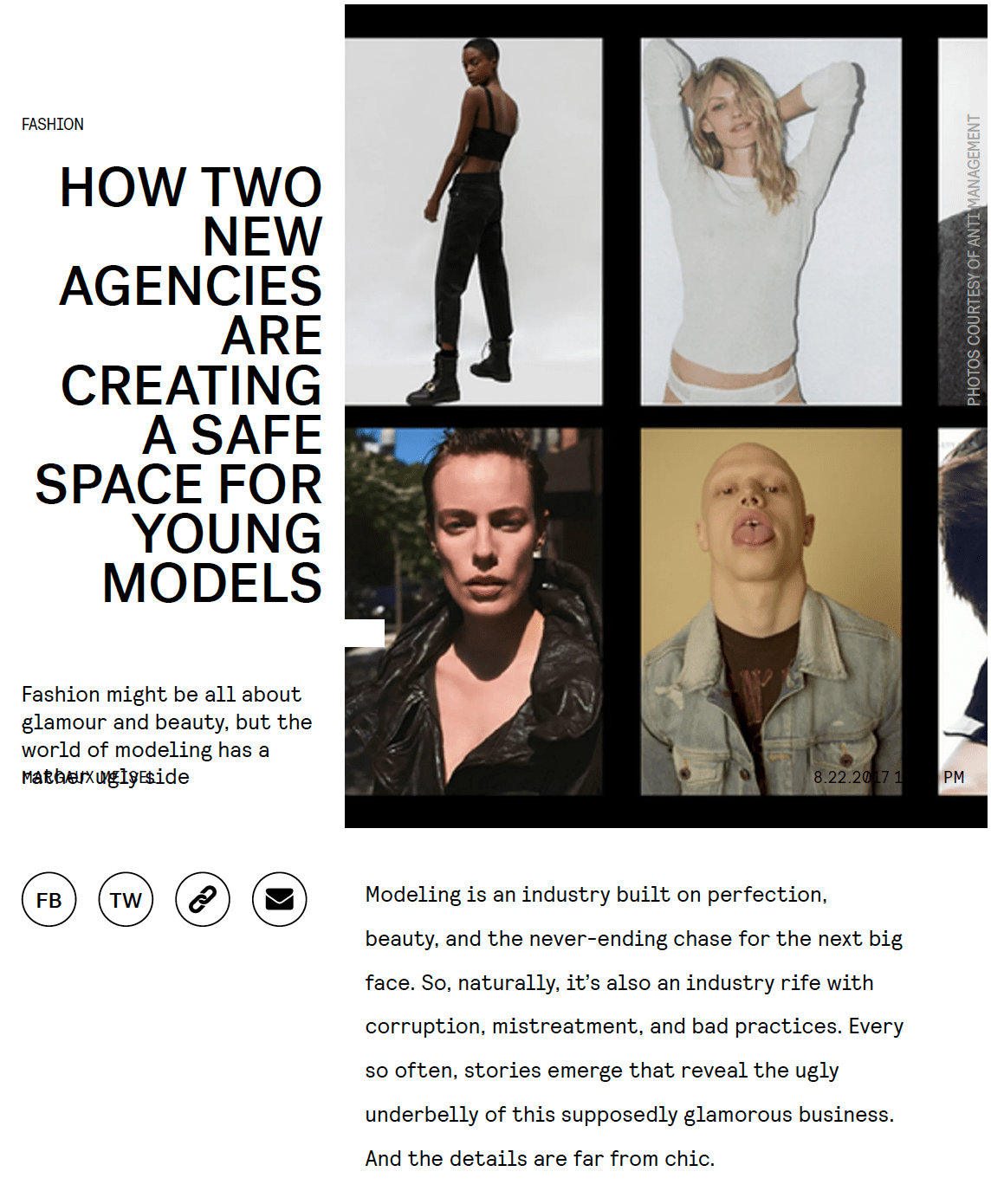
HOW TWO NEW AGENCIES ARE CREATING A SAFE SPACE FOR YOUNG MODELS

Fashion might be all about glamour and beauty, but the world of modeling has a rather ugly side

MARGAUX MEISEL

Modeling is an industry built on perfection, beauty, and the never-ending chase for the next big face. So, naturally, it’s also an industry rife with corruption, mistreatment, and bad practices. Every so often, stories emerge that reveal the ugly underbelly of this supposedly glamorous business. And the details are far from chic.

“I was once shooting a lookbook where the stylist, helping me dress, used this chance to feel my body much more than necessary, and continued to do so throughout the entire shoot,” model Fernanda Ly revealed in March. And in another case, nearly 150 models were locked in a dark stairwell for hours at a time during a casting in February. There was also the time a Danish model was dropped from a show for having a “bloated stomach” and “bloated face” in May. Needless to say, mistreatment in the modeling industry is a tale as old as time. 

Even today, when it’s encouraged to be outspoken on social media about once-taboo topics, it’s difficult for models to expose the abuse they’ve weathered—especially if they want to continue to book profitable jobs. “Models, more than others, censor themselves in fear of losing critical jobs. As a result social media has become their soapbox, but many are still reluctant to voice their own frustrations,” Models.com wrote in an exposé that answered the question, “How Should a Model Be Treated?”

While there isn’t one simple answer to that complex question, there are a number of champions out there who have dedicated their careers to reforming the industry, one job at a time. There’s esteemed casting director James Scully, who uses his position to promote diversity and Sara Ziff, the founder of the Model Alliance, who fights for fair treatment and equal opportunity in the industry.  

Then there are agencies, the companies that models rely on as a point of communication between the fashion brands employing them—they handle money, negotiate contracts, and generally manage the careers of these runway regulars. One would assume that the business-minded agencies would have the best intentions for their clients, but that’s not always the case. Instead, agencies tend to focus on the financial interests of the agency itself.

“As the years passed and I learned more about the business, it became increasingly apparent that the scales were tipped,” explained Gabriel Ruas Santos Rocha, a former agent at the erstwhile Trump Model Management who left to start his own firm this spring. 

With years of experience on the management side, Rocha left the plagued agency founded by POTUS (which had become notorious for less than ideal treatment of its models, including illegal immigration practicesblatant financial exploitation, and cramped model apartments that were “like a sweatshop”) to start Anti Management. His intention was to overhaul the treatment of models, across the board, offering them a space where their careers could be fostered and their personalities could be preserved. That included addressing the way bookers treat models and improving the efficacy in which the men and women he represents get paid. 

Just a few months old, Anti Management is already garnering attention for not separating models into boards, the usual practice of dividing models into categories such as curvy, men’s, new faces, and so on. That means bookers at Anti work with all types of models, across all types of jobs, from commercial print to runway shows. Further, Anti doesn’t distinguish trans models from the rest; there’s no label signifying their change in gender, as they simply are who they are. As Rocha puts it, he wants all of his models to be treated equally.

He offered a simple example of how this organizational setup can benefit both his models and the fashion clients. “If Tommy Hilfiger calls in today needing 15 different types of models of all ages and races, they will only need to speak with one booker, and this one booker will offer them the whole set of possibilities.” 

Some of Anti’s biggest faces include two Brazilian top models Shirley Mallmann and Fabiana Saba, plus Madisin Bradley and the famously androgynous Elliott Sailors. The agency has also taken chances on models that don’t tick all the boxes of conventional beauty. Take Bice, for example. At only 5’8″, he’s far shorter than the average male model, but he also rocks an ethereal and otherworldly look, a result of alopecia universalis, an autoimmune disease which has left him entirely bald—including his eyelashes and eyebrows.

“[He] was turned away by every single modeling agency in and out of town, but Bice really showed us all how perseverance and talent stand out no matter how tall you are. InterviewHeroIris Covet Book, and Vogue are some of the editorials he’s booked since joining us at Anti,” Rocha boasted.

Rocha also encourages his talent to embrace their interests outside of modeling. Whether that’s honing a DJing skill, like Eric Chong, studying at Pratt Institute, like David Pesin, or chasing a passion for cooking with cannabis, like Fabio Nunes, he wants to make sure that the Anti Management models are a well-rounded bunch who can find fulfillment in all areas of their lives. 

But Anti Management isn’t the only agency making a difference. Across the pond, Linden Staubhas emerged as a mother agency (the firm that exclusively sponsors models and promotes them out to booking agencies) that takes the title of mother to heart. In fact, Tara Davies and Esther Kinnear Derungs have adopted a company-wide policy of empowering women, from their London office.

“In a nutshell, we see our models as human beings, not as a business commodity. We put our models’ welfare in front of our business targets, often investing in them financially and at the same time trying to keep their costs down because we do not feel it is right for a young woman to start her career with thousands of pounds’ worth of debt,” Kinnear Derungs told us. 

To maintain that promise, the models represented by Linden Staub are paid the day after a job is complete, regardless of when the client submits payment—which can often be months later. 

“Linden Staub models are empowered by financial independence. By knowing when they will be paid, they are able to lead more independent lives,” explained Kinnear Derungs. The two co-founders also make sure to educate their models with an accounting demo, teaching them how to navigate the world of payments, fees, and taxes, providing these young professionals with vital fiscal knowledge. 

The agency was started in March 2016 with just four girls; they now represent 11 international models, including Georgie Taylor and Lydia Atchison, and have 75 new faces in development. And though they’re small, the firm is mighty, having landed gigs for their girls at top brands such as Vivienne Westwood, Burberry, Gucci, Ralph Lauren, Dolce & Gabbana, and Michael Kors.

And similarly to Anti Management, they understand cultivating a model beyond her runway walk and her social media following. “Above all, we try to preach the importance of downtime, of doing things that feed your soul, not just your Instagram,” Davies said. 

Though there’s still plenty of reform to go, in terms of models being treated right, paid on time, and not discriminated against for their race or gender, at least a few members of the industry are stepping up. And that is one leap toward a healthier fashion industry that is pretty, inside and out. 

Check out the original post here.

Daily Mail, 2017

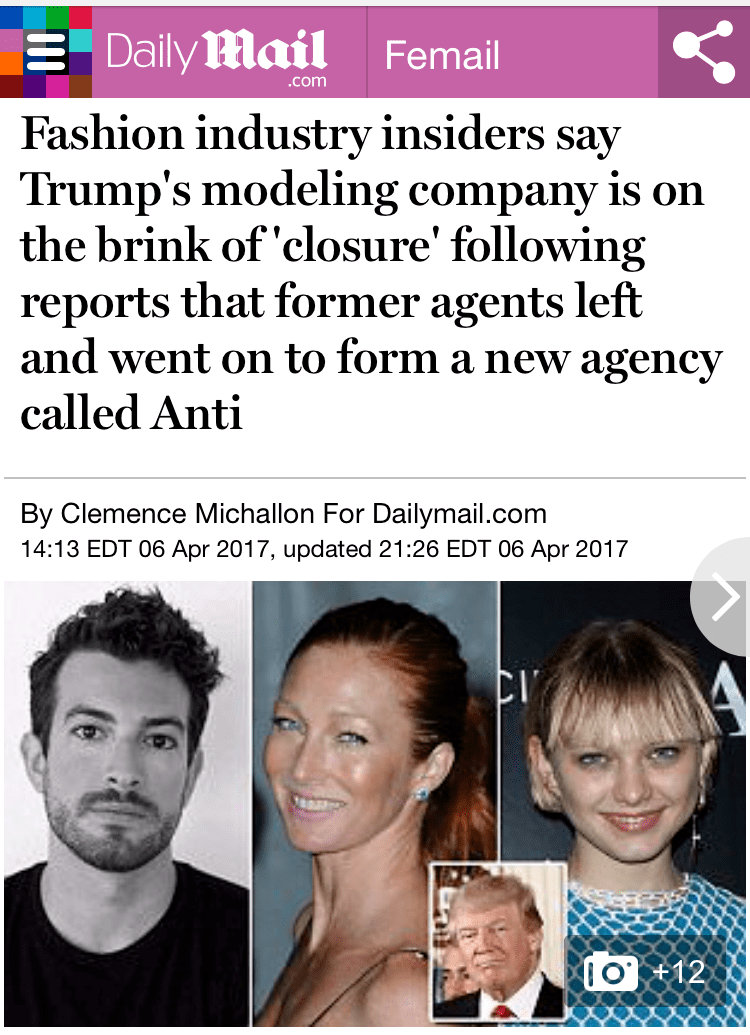
Agent at Trump’s modeling company leaves to form his own all-inclusive agency named ANTI, along with other former staffers – but insists it’s NOT a dig at his ex-employer

By CLEMENCE MICHALLON FOR DAILYMAIL.COM

PUBLISHED: 14:12 EST, 5 April 2017 | UPDATED: 19:45 EST, 5 April 2017

A former manager at Donald Trump‘s modelling company has launched his own inclusive agency, giving the new brand the intriguing name of Anti – but insists the name is not a dig at his former employer and current President.

Gabriel Ruas Santos Rocha, who worked at the New York-based Trump Model Management (also known as Trump Models) for five years, is one of several employees and models who have left the mogul’s venture in the wake of his political career.

Trump Models began in 1999 and eventually gained attention for its ‘legends’ section, which has included famous names such as Jerry Hall, Carol Alt and Ali Macgraw.

But some of the models signed by Trump’s agency began facing backlash last year, during the tycoon’s political campaign, Rocha told Refinery 29.

‘They’d arrive on set and people would say, “Oooh, you’re from Trump [Models]? How dare you,” or “Why are you still with them?” ‘ he told the website.

‘The girls would explain how hard we worked for them, how much they trusted us, and how we never made them feel unsafe: They were constantly harassed by employees on shoots, especially by other models.’

Anti, Rocha’s new agency, opened for business last week. It currently has four agents, some of whom used to work at Trump Models, Refinery 29 reported. The new agency’s models include Trump Models alums as well. 

The new company has recruited more than 20 models so far, including Brazilian beauty Shirley Mallmann, who used to be represented under Trump Models’ ‘legends’ section.

Anti announced last week the veteran model had joined its ranks.

Rocha, however, insisted that he doesn’t intend to take a stance against his former agency, and said the name Anti refers to another meaning of the word taken from the Merriam-Webster dictionary, which defines it as ‘serving to prevent, cure, or alleviate’.

Anti has made its values known and advertises itself as a champion of diversity and integrity on its website. It intends to represent models of all races, abilities and sizes.

The company has also opted not to divide its models into traditional categories, such as ‘plus-size’ or ‘new faces’, so as not to limit their opportunities to one particular market.

Prior to Rocha’s departure, model Maggie Rizer left Trump’s agency just two days before the presidential election, explaining she didn’t want to be associated with the mogul’s name regardless of the outcome.

‘As a woman, a mother, an American and a human being, I cannot wake up Wednesday morning being the least bit related to the Trump brand; win or lose,’ she wrote in an Instagram post announcing her decision.

‘I owe it to myself and to my children to proudly stand up for what I believe in and that is a world where Donald Trump has no voice for the future of our country.’

Former Trump Models booker Patty Sicular has also left the company to create her own agency, IconicFocus. On its roster are two models who formerly graced the tycoon’s company’s ‘legends’ section: Carmen Dell’Orefice and Beverly Johnson.

Anti intends to have a complete office set up in New York City’s Soho neighborhood in September, and wants to have 150 models signed on by the next New York Fashion Week.

Link for the article here.

I-D, 2017

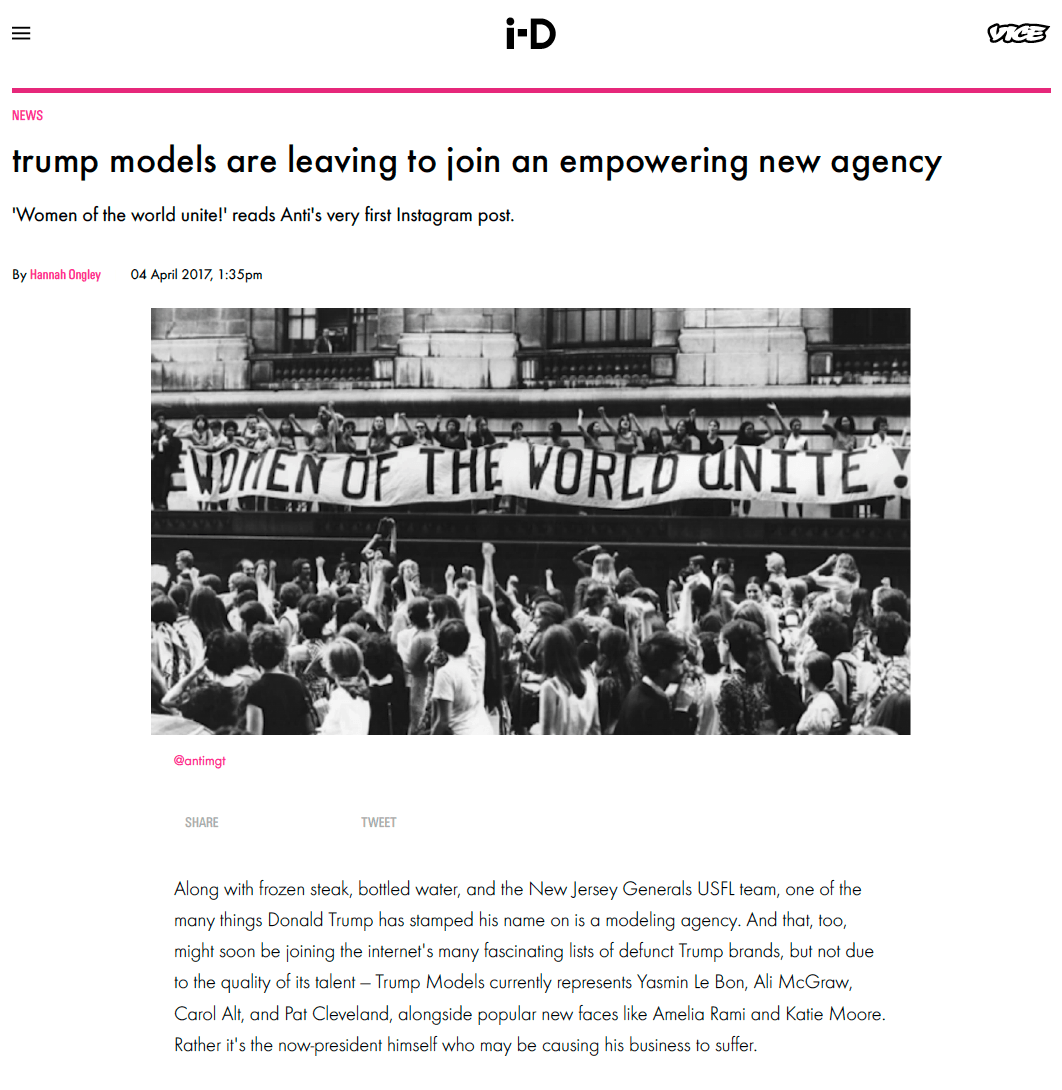
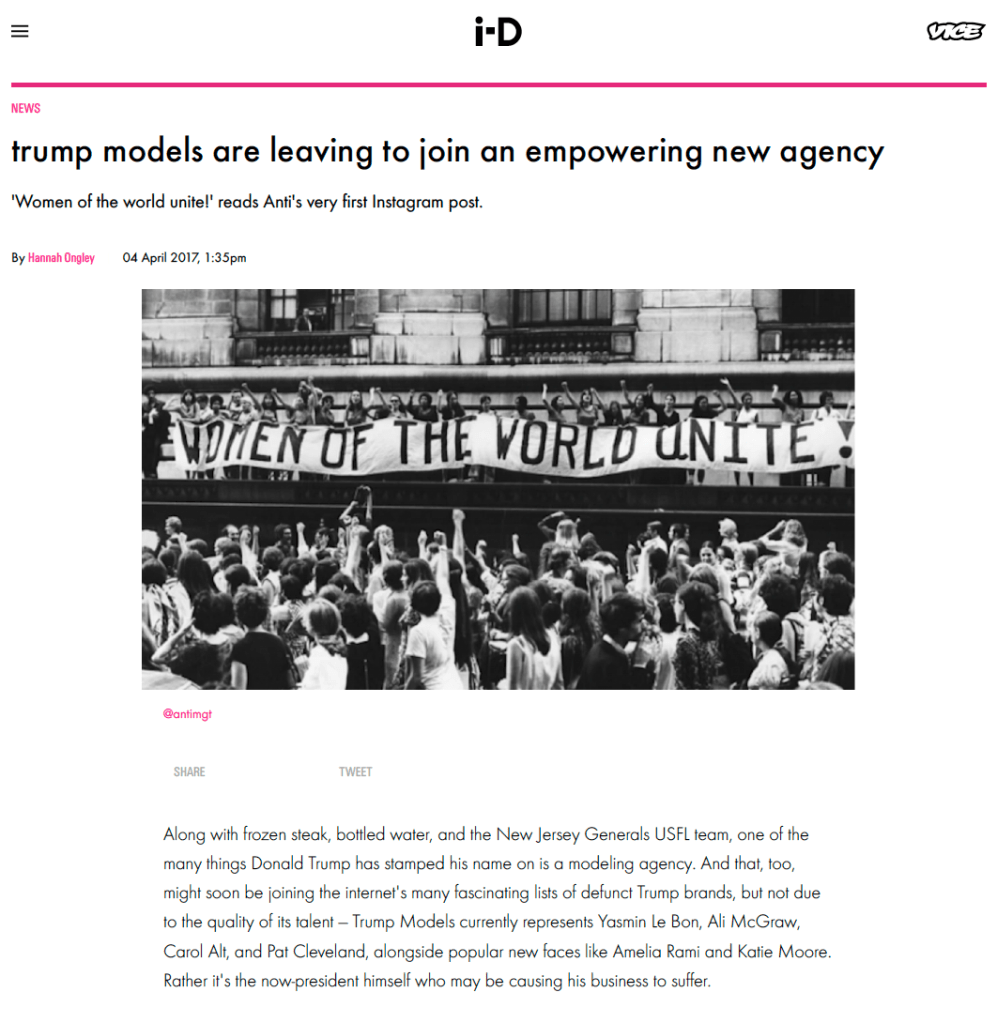
trump models are leaving to join an empowering new agency

‘Women of the world unite!’ reads Anti’s very first Instagram post.
NEWS|By Hannah Ongley|04 April 2017, 1:35pm

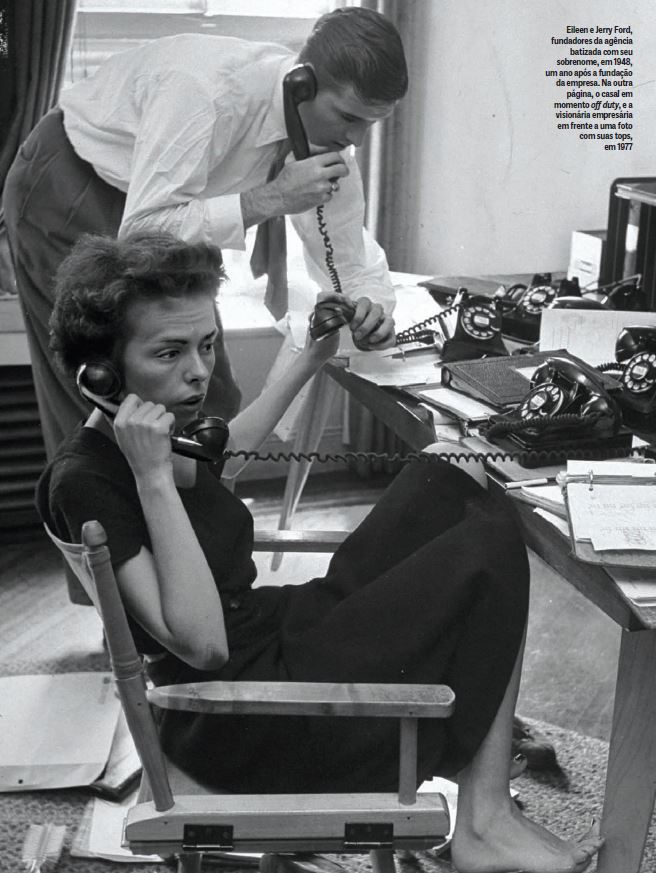
Along with frozen steak, bottled water, and the New Jersey Generals USFL team, one of the many things Donald Trump has stamped his name on is a modeling agency. And that, too, might soon be joining the internet’s many fascinating lists of defunct Trump brands, but not due to the quality of its talent — Trump Models currently represents Yasmin Le Bon, Ali McGraw, Carol Alt, and Pat Cleveland, alongside popular new faces like Amelia Rami and Katie Moore. Rather it’s the now-president himself who may be causing his business to suffer.

The Washington Post‘s Robin Givhan reports that Gabriel Ruas Santos-Rocha, a former manager at Trump, has left to start his own venture, Anti Management. And he’s taking many models with him. Anti recently launched Twitter and Instagram accounts announcing that they were open for business. “New models, for a new agency,” reads Anti’s website. “Stay tuned, while a new ANTIsite is being built.” The Instagram account reads, “Our Clients Are Our Models.”

In an email to the Post, Santos-Rocha said he wasn’t actively trying to sabotage Trump. “I want my models to be nurtured and treated fairly and that their talents are utilized as part of their career,” he said, adding that the industry was “undergoing massive changes.” But this is only the latest instance of Trump Models suffering election-related hardship.

In November, industry vet Maggie Rizer announced that she was leaving the agency, writing on Instagram just days before the election, “As a woman, a mother, an American, and a human being, I cannot wake up Wednesday morning being the least bit related to the Trump brand.” Top booker Patty Sicular left around six months ago to found IconicFocus, and reports circulated during a very political fall/winter 17 New York Fashion Week that industry insiders were boycotting Trump Models. According to Givhan, “industry insiders say the hemorrhaging is substantial.” 

I-D Magazine 2017

The Washington Post, 2017

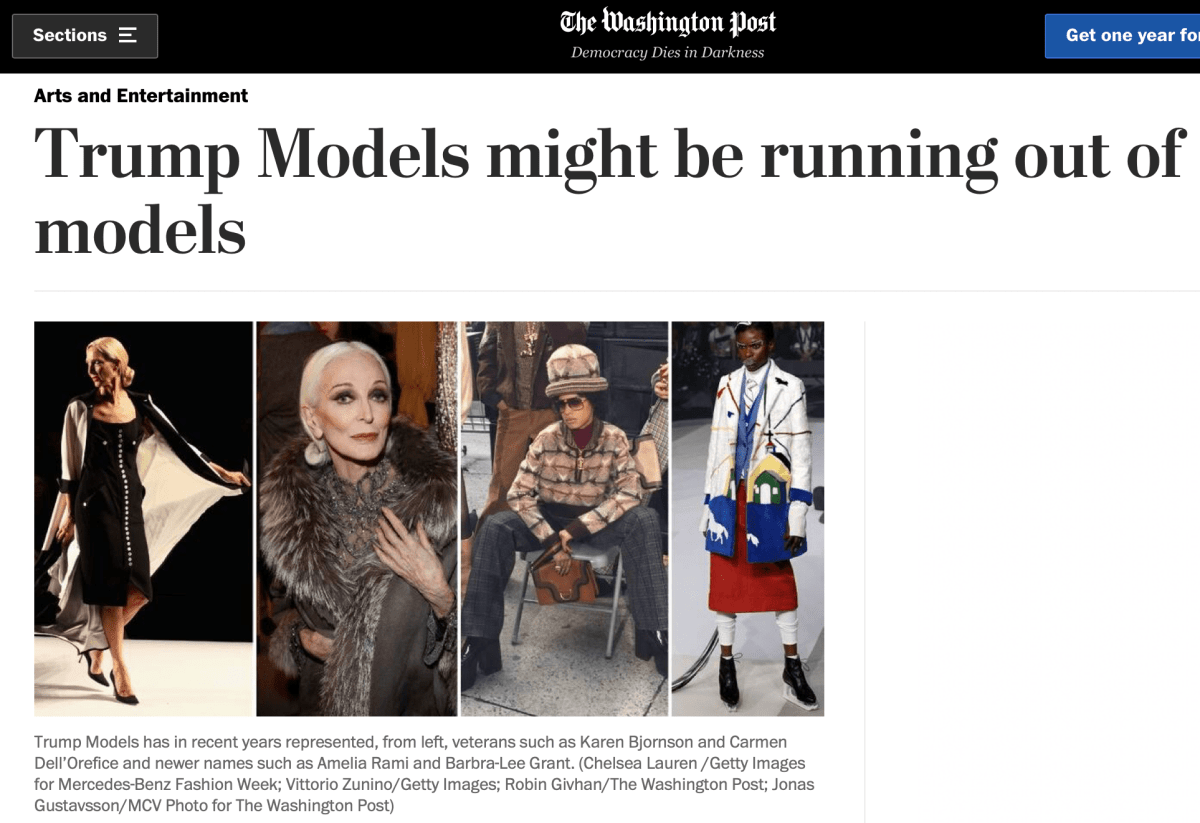
Trump Models Might be Running Out of Models

By Robin Givhan

April 3, 2017 at 9:29 a.m. PDT

Trump Models appears to be slowly disappearing.

A former manager at the New York company founded by President Trump has left the company to launch a new agency called Anti Management — and is taking with him many of the women who were once on the Trump Models roster.

Its Twitter feed went live March 14, boasting the motto, “Our clients are our models.” And it debuted on Instagram wrapped in a message of women’s empowerment.

Founder Gabriel Ruas Santos-Rocha explained in an email that “the modeling industry is undergoing massive changes” and that he felt the time was right to execute his vision for a new firm. “I want my models to be nurtured and treated fairly and that their talents are utilized as part of their career.”

As for the exodus from Trump Models, he said, “I did not start an agency with the intent of taking someone out of business. Outside of that I have no comments.”

Defections from Trump Models began last year as Trump’s political rhetoric became ever more heated. About six months ago, another one of the agency’s top bookers, Patty Sicular, left. She had worked with the models in the agency’s “legends” division — older, high-profile women with established reputations in the industry — and several of them joined her at the new company she founded, Iconic Focus. They include former Halston model Karen Bjornson and Beverly Johnson, who in 1974 was the first African American model to appear on the cover of American Vogue. Sicular declined to comment on her departure.

Just before the November election, veteran model Maggie Rizer announced her departure from the agency in an Instagram post, directly linking her exit to concerns about Trump’s politics.

“As a woman, a mother, an American and a human being,” she wrote, “I cannot wake up Wednesday morning being the least bit related to the Trump brand.”

Trump Models was created in 1999. From the beginning, it was often overshadowed by the real estate mogul’s tabloid-fueled, larger-than-life image, noted James Scully, a veteran runway casting director. At one point, the company simply called itself T Models.

Trump Models never launched a new model into stardom, industry observers say. But its legends division — which once included Jerry Hall, Veronica Webb and Karen Alexander — was well respected, said longtime stylist Freddie Leiba, who often worked with Sicular.

Early this year, as designers turned their runway shows into political protests, shoppers boycotted the Ivanka Trump brand, and Seventh Avenue debated whether it would work with the new first lady, some in the fashion industry also discussed a snubbing of Trump Models.

Yet Trump Models still was able to boast that several models on its roster walked in high-profile runway shows during New York Fashion Week, according to its website and social media accounts, including the fall 2017 collections of Marc Jacobs and Thom Browne. (Amelia Rami, who was in Jacobs’ show and appears on the Trump Models website, was actually booked through her European agency, MP Management, according to a booker there.)

Exactly how many models have left Trump Models, and how many remain, is unclear. Santos-Rocha would not specify how many he had taken with him. But industry insiders say the hemorrhaging is substantial. While the Trump Models website remains active, a number of the models still listed on it are known to have jumped ship.

On Monday morning, the main telephone numbers for Trump Models were not accepting calls.

Link to the Article Here

The New York Times, 2016

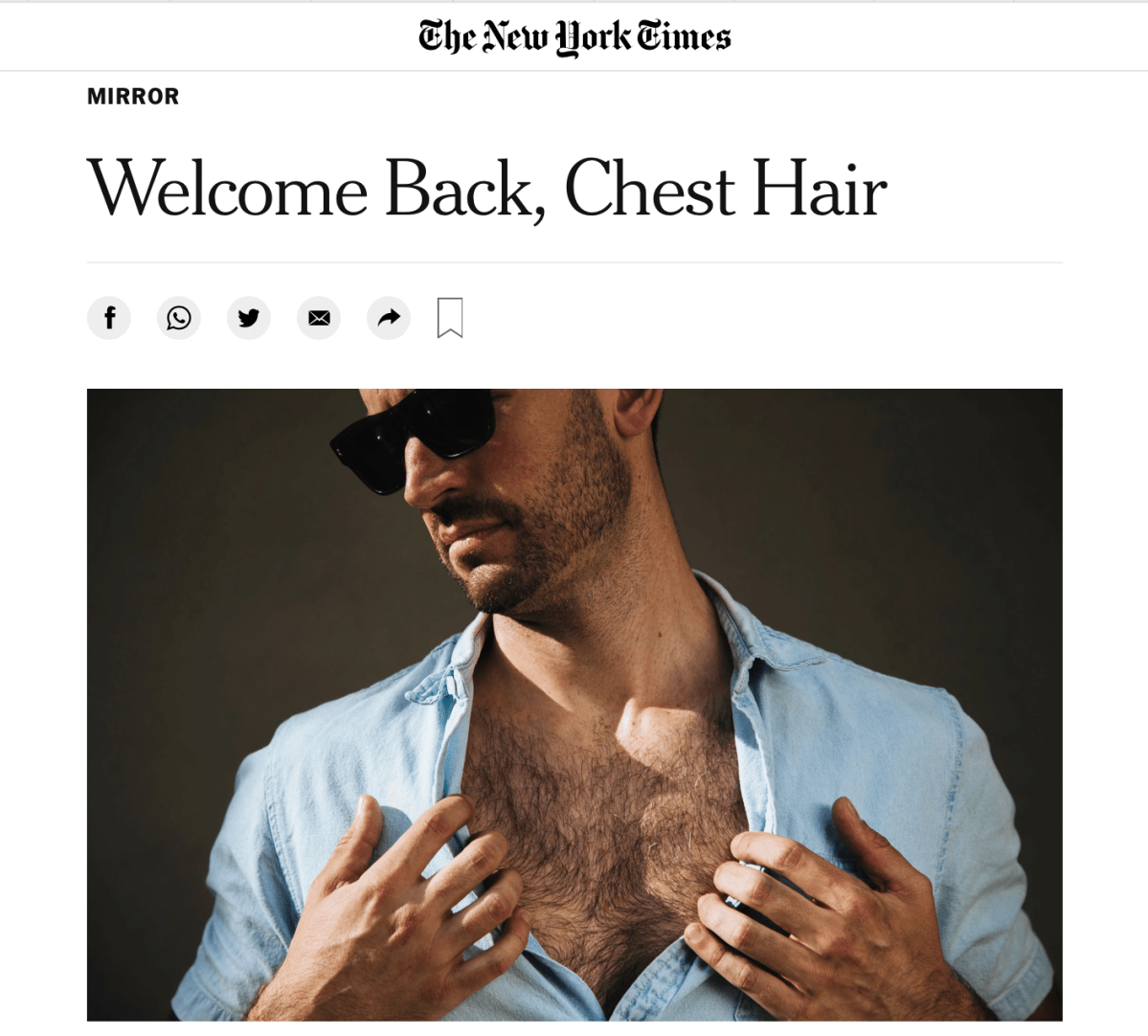
Welcome Back, Chest Hair

Eric Shoemaker, who works in public relations in Los Angeles, has moved on from the waxed look.
Eric Shoemaker, who works in public relations in Los Angeles, has moved on from the waxed look. Credit…Brinson & Banks for The New York Times

By Max Berlinger

  • May 3, 2016

Shortly after he finished college, Eric Shoemaker, a 34-year-old Los Angeles-based public relations executive, allowed his chest hair to grow out. “I don’t know if it was my age or becoming comfortable with myself,” he said, “but the thought of getting waxed — which makes your hair follicles bleed and you get ingrown hairs — you have to ask who you’re doing it for.”

Mr. Shoemaker’s decision came more than a decade after those touchstone Calvin Klein ads, featuring a smooth-torsoed Mark Wahlberg (then known as Marky Mark), popularized the hairless look, which was further endorsed in the next decade by the hit TV show “Queer Eye for the Straight Guy.”

Similarly, Gabriel Santos-Rocha, a 31-year-old model manager, stopped depilating roughly eight years ago, in his early 20s. “I thought that the ideal body had no hair,” he said. But frustration with all the upkeep nudged him back to his natural state. “I hated dealing with the maintenance and the stubble and the itching that came with it,” Mr. Santos-Rocha said.

The response to his furry physique has been positive. “I’ve never noticed anyone not liking my body hair,” he said.

For a new generation, the overly groomed body appears to be falling out of favor. “We’re seeing a return to ’70s fashion,” said Tim Bess, an analyst at the trend forecasting agency the Doneger Group. “The late ’60s and early ’70s were about freedom, the hippie movement, having lots of hair.”

Mr. Shoemaker at the pool in his apartment complex in West Hollywood, Calif.
Mr. Shoemaker at the pool in his apartment complex in West Hollywood, Calif. Credit…Brinson & Banks for The New York Times

Mr. Bess cited Lindsey Buckingham of Fleetwood Mac — with his unbuttoned shirts and thatch of chest hair — as a prototype, adding that the preened look seems dated. “It gets a little too perfect, too mannequin-looking,” Mr. Bess said.

Christopher Oldstone-Moore, the author of the 2015 book “Of Beards and Men” and a senior lecturer at Wright State University, in Ohio, believes that an increasingly urban and digitized life has left some men “disconnected from their masculinity.”

“There are different ways to connect to your organic masculinity,” Dr. Oldstone-Moore said. “Hair is one way to do it.”

An unkempt body is a perhaps unforeseen corollary of the lumberjack look that has long since peaked in certain Brooklyn circles. Even the brand 2(x)ist, known for its sleekly textured models, has opted to show its underwear on the hairy frame of Nyle DiMarco, a recent winner of “America’s Next Top Model.”

Tom Speight, the brand’s president, said, “We’ve seen everything from man-buns to full beards go mainstream in recent seasons, and we want to reflect that rugged, a tad unpolished, yet approachable look.”

As with most things, it is probably not a bad idea to be wary of extremes. “I think we’re going to have to walk slowly,” Mr. Bess said. “Because if you go too far with it, it can look a little Neanderthal-y.”

Continue following our fashion and lifestyle coverage on Facebook (Styles and Modern Love), Twitter (StylesFashion and Vows) and Instagram. A version of this article appears in print on May 6, 2016, Section D, Page 6 of the New York edition with the headline: A Trend That’s Altering the Manscape.

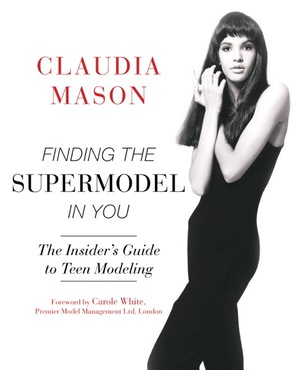
Becoming a Supermodel with the Help of a Supermodel

Yearly thousands of young kids reach out to modeling agencies in the hopes of becoming a model. They call, send pictures and letters in the mail, show up unannounced at the agency’s doorsteps, and call relentlessly to follow up, hoping to find a place in the spotlight. These girls and boys have no guidance or frame of reference. With that in mind, supermodel Claudia Mason, one of the members of that elite group of girls who made a name for themselves in the 90’s (alongside Claudia Schiffer, Naomi Campbell and Christy Turlington); decided to lend a hand. With the new book “Finding the Supermodel in You – An Insider’s Guide to Teen Modeling”, Mason draws from her experiences as a model, breaking down the entire profession bit by bit.

Other than articles found online briefly describing the inner works of an agency, a model’s career, or modeling schools, there’s very little objective and helpful information that can be obtained to help in a model’s pursuit. Not only that, but modeling schools who are supposed to guide and manage aspiring models, many times are no more than a very expensive source of useless advice. These companies seem to be more concerned with padding their bank accounts rather than honestly selecting talent that has potential for a career in a very selective industry.

Claudia speaks from experience, from many years of trial and errors in which she navigated pretty much every scenario a model wannabe can dream of. Mason’s tips range from what type of clothing to wear when meeting agents and clients, to what foods to eat and which beauty products to pick at the drugstore.

Claudia’s career started when she was only fifteen years old. This native New Yorker was a dance student and professionally trained by some of the best the Big Apple had to offer. After her health prevented her from moving forward with her dream of being a professional dancer, fate took her for a spin. One afternoon after school, Claudia was approached by a model agent who saw potential in the young girl. Claudia’s first modeling job was with the legendary photographer Richard Avedon, who repeatedly brought her back for other shoots throughout the years. Mr. Avedon shot Claudia for multiple Vogue covers and editorials, various campaigns for Versace, among others. Claudia was “One of the Most Beautiful Women in the World“ according to her Revlon ad. This was the late eighties. Concerned with her studies, Claudia’s parents put a break on her career until she finished school.

By the time she returned to the scene at age 18, the nineties were in full swing and Claudia fit right in the middle of that famous supermodel group. The credits attached to her name speak for themselves: campaigns for brands like Fendi, Louis Vuitton, Christian Lacroix, Gianfranco Ferre, Gianni Versace and Versace Jeans; magazine covers for titles such as Vogue, W, Harper’s Bazaar, Cosmopolitan, Elle and Mademoiselle and an enviable list of photographers which includes Steven Meisel, Steven Klein, Helmuth Newton, Irving Penn, Bruce Weber, Patrick Demarchelier and Mario Testino to name a few. Her list of runway shows would be far too extensive to mention, but it’s no less iconic. Claudia Mason had arrived!

As this girl’s career progressed from model to supermodel, Claudia started integrating some of her other passions into her bookings. Mason dove into acting as well as TV hosting, which landed her the top position on Mtv’s “Fashionably Loud“, a cross between fashion and music in one TV show. Her acting brought her awards in theater and many positive reviews by top critics. Upon her return to New York in 2010, amidst bookings with Katie Grand for Love Magazine and Vogue Russia, Claudia began to refocus her energy and work on a plan for her next career phase.

The tireless supermodel decided this was the time to give back to the world some of the good things she earned. She turned a negative health scare into a positive action and joined the American Stroke Association as a spokesperson, bringing awareness to an issue that affects men and women of all ages around the globe. On that same year she also began developing a TV show, which is currently in pre-production. Somehow, in the middle of all this, she still found time to work in movies and write a book – this, her biggest passion project.

In her guide to teen modeling, Claudia hopes to shed some light on matters that have been obscure to most people. She has no problems speaking out about health issues and drugs, topics that have always surrounded the modeling profession in the eye of the media. The model considers herself lucky for being able to work and still be close to home and her family, a luxury that most girls can’t afford. She also found a team that supported and protected her every step of the way.

With this book, Claudia is a part of her reader’s team. The author keeps things simple, the goal is not to pontificate, but to maintain an open dialog. Mason created check lists for the young girls and approached the industry’s top professionals to make sure that her reader would receive the best information available from every area of the business.

Claudia’s career is a brilliant example of fortitude and creativity. Here is a woman who was never afraid to brake boundaries and try new approaches. Because of that Claudia was able to live out all her dreams. Now Claudia enters a new phase, one that is more mature but not less exciting, one that aims to bring the dreams of many aspiring models to reality too.

Article originally published in The Huffington Post Books, April 2016

The Hopeless State of Brazil

During a recent visit to Porto Alegre, my hometown in Brazil, I went to the supermarket for groceries. As my turn at the checkout approached my phone rang and I launched into an animated conversation, in English, with my American boyfriend. Suddenly I felt a presence around me. As I looked up from the groceries I was placing on the belt I saw eyes peering at me. The bagging boy whispered something inaudible to the neighboring check out girl and I decided it would be best to end the call. I said hello, in Portuguese, to the cashier who had her eyes wide staring at me. She answered with a murmur. After she finished checking my items she did not give me the final amount aloud, as they usually do, but pointed to the screen while staring back at me, as if her life was in danger. I gave her exact change and all of a sudden the woman behind me in line tapped my shoulder.

“I’m sorry to bother, but why are there so many Americans in town?” She asked in good english, as I anticipated.

The three surrounding registers and the bagging boys all stared at us, anxiously waiting for an answer. I told her I am in fact a local who lives abroad, visiting my family. That did not suffice.

“Why on earth would you come here?” Asked the checkout girl.

“Where do you live?” Inquired the next one.

“Are you really spending the holidays HERE!?” questioned the boy.

The general consensus was that I had lost my mind.

“Why would you come back here?” The question lingered with me several days after that.

I had not been to Brazil in several years. The recent developments of my country’s political and economic state frightened me, not to mention a spike in violence that has not been witnessed in nearly twenty years. The type of violence that affects all layers of the population from housekeepers, taxi drivers and waiters to CEO’s, TV personalities and everyone in between is a petty violence. They steal because they want your Tupperware with food, to feed their hunger; or your cellphone to trade for crack. Sometimes, more regularly than not, they’ll kill for a chunk of change, they don’t know any other way. It’s a lawless state.

National magazines print stories covering a mass exodus of Brazil nationals attempting to build their lives on solid ground in North America or Australia. Hell, anywhere but there. It’s a hopeless state.

The population revolts and takes to the streets. The government, corrupt all the way to the top, buys votes, steals money and rips to shreds an economy built strong over the course of two decades. There is no education, no healthcare and no public safety to speak of. Brazil is today a country with no infrastructure, but it’s still a beautiful country. Brazil has insurmountable beauty, incredible fun and joy to offer. Tourism may very well be it’s last threshold and hope.

I left Brazil in the pursuit of a dream, several years ago at the height of its economic boom. Americans would look at me in shock wondering why would I ever want to abandon such a paradise especially when the country was performing so well. Truth be told, I had serious doubts that the mentality of the population and its politicians had changed so rapidly. Unfortunately, I was right.

Today from where I stand, I see several people I know plotting an escape plan. I see several people I don’t know having to sell homes they never actually moved into because they aren’t able to keep up with inflation and interest rates. Brazil has in less than a decade created a real estate bubble of gargantuan proportions, similar to the one that took the United States half a century to build up. Brazil’s bubble is bursting, what’s worse, the little hope Brazilian citizens had in the future of its country is gone. The population stopped believing in the system, more than that, the population stopped believing in the population. The citizens of Brazil stopped believing they are in fact the decision makers, they stopped believing that they are in fact capable of affecting change.

The people of Brazil are so afraid of losing the bread crumbs the government throws at them, that they keep quiet. No one sues the government because they already know the judiciary will not push their suit forward. One alone, may be weak, but what about the hundreds of thousands of people who suffered together at the hand of President Collor and still have not received a penny back since 1992? Why aren’t all these people banding together to fight the country for the money that is rightfully theirs? Because the people lost faith in the people. The people are afraid of the people. It’s a snowball effect that allows for the Brazilian government to stay its course of thievery and impunity.

The impoverished population who had no access to decent homes, or any credit for that matter, all of a sudden saw the hands of bankers and lenders opening up. Suddenly families of six who shared a one-room home had flat-screens, laptops and nicer clothes. These families were immediately elevated to the status of middle class. But elevated by whom? The government, who saw fit to show the world how rapid change was possible in Brazil. It was all an illusion.

When the government believes it’s more important for the people to have material possessions (and debt) instead of education and access to healthcare, there is definitely a strong misconception. When the population becomes so desperate that they have to steal food from their fellows standing at bus stops in order to feed themselves, the country enters a dark age. My feeling upon returning to Brazil was of anguish, and this feeling was shared with every person I came in contact with during my trip. The disappointment of seeing firsthand what it’s like for people to turn against each other because their government is busy spending the people’s money on better homes and vacations for themselves is painful, it’s revolting.

I wish I could pose a solution to these issues, but I can hardly wrap my head around the problems of Brazil. For the moment I offer my thoughts and hope for better days. This country has stood in the dark for much longer than it’s seen the light. It’s time to change.

Originally published in The Huffington Post / WorldPost, Feb 2016

The Hopeless State Of Brazil

During a recent visit to Porto Alegre, my hometown in Brazil, I went to the supermarket for groceries. As my turn at the checkout approached, my phone rang, and I launched into an animated conversation, in English, with my American boyfriend. Suddenly, I felt a presence around me. As I looked up from the groceries I was placing on the belt, I saw eyes peering at me. The bagging boy whispered something inaudible to the neighboring check-out girl, and I decided it would be best to end the call. I said hello, in Portuguese, to the cashier who had her eyes wide, staring at me. She answered with a murmur. After she finished checking my items, she did not give me the final amount aloud, as they usually do, but pointed to the screen while staring back at me, as if her life was in danger. I gave her exact change, and all of a sudden, the woman behind me in line tapped my shoulder.

“I’m sorry to bother, but why are there so many Americans in town?” She asked in good English, as I anticipated.

The three surrounding registers and the bagging boys all stared at us, anxiously waiting for an answer. I told her I am, in fact, a local who lives abroad, visiting my family. That did not suffice.

“Why on earth would you come here?” Asked the checkout girl.

“Where do you live?” Inquired about the next one.

“Are you really spending the holidays HERE!?” questioned the boy.

The general consensus was that I had lost my mind.

“Why would you come back here?” The question lingered with me several days after that.

I had not been to Brazil in several years. The recent developments of my country’s political and economic state frightened me, not to mention a spike in violence that has not been witnessed in nearly twenty years. The type of violence that affects all layers of the population, from housekeepers, taxi drivers, and waiters to CEO’s, TV personalities, and everyone in between, is petty violence. They steal because they want your Tupperware with food, to feed their hunger, or your cellphone to trade for crack. Sometimes, more regularly than not, they’ll kill for a chunk of change; they don’t know any other way. It’s a lawless state.

National magazines print stories covering a mass exodus of Brazilian nationals attempting to build their lives on solid ground in North America or Australia. Hell, anywhere but there. It’s a hopeless state.

The population revolts and takes to the streets. The government, corrupt all the way to the top, buys votes, steals money, and tears to shreds an economy built strong over the course of two decades. There is no education, no healthcare, and no public safety to speak of. Brazil is today a country with no infrastructure, but it’s still a beautiful country. Brazil has insurmountable beauty, incredible fun, and joy to offer. Tourism may very well be its last threshold and hope.

I left Brazil in the pursuit of a dream several years ago at the height of its economic boom. Americans would look at me in shock, wondering why I would ever want to abandon such a paradise, especially when the country was performing so well. Truth be told, I had serious doubts that the mentality of the population and its politicians had changed so rapidly. Unfortunately, I was right.

Today, from where I stand, I see several people I know plotting an escape plan. I see several people I don’t know having to sell homes they never actually moved into because they aren’t able to keep up with inflation and interest rates. Brazil has in less than a decade created a real estate bubble of gargantuan proportions, similar to the one that took the United States half a century to build up. Brazil’s bubble is bursting, what’s worse, the little hope Brazilian citizens had in the future of its country is gone. The population stopped believing in the system, more than that, the population stopped believing in the population. The citizens of Brazil stopped believing they are in fact the decision makers, they stopped believing that they are in fact capable of affecting change.

The people of Brazil are so afraid of losing the bread crumbs the government throws at them, that they keep quiet. No one sues the government because they already know the judiciary will not push their suit forward. One alone, may be weak, but what about the hundreds of thousands of people who suffered together at the hand of President Collor and still have not received a penny back since 1992? Why aren’t all these people banding together to fight the country for the money that is rightfully theirs? Because the people lost faith in the people. The people are afraid of the people. It’s a snowball effect that allows for the Brazilian government to stay its course of thievery and impunity.

The impoverished population who had no access to decent homes, or any credit for that matter, all of a sudden saw the hands of bankers and lenders opening up. Suddenly families of six who shared a one-room home had flat-screens, laptops and nicer clothes. These families were immediately elevated to the status of middle class. But elevated by whom? The government, who saw fit to show the world how rapid change was possible in Brazil. It was all an illusion.

When the government believes it’s more important for the people to have material possessions (and debt) instead of education and access to healthcare, there is definitely a strong misconception. When the population becomes so desperate that they have to steal food from their fellows standing at bus stops in order to feed themselves, the country enters a dark age. My feeling upon returning to Brazil was of anguish, and this feeling was shared with every person I came in contact with during my trip. The disappointment of seeing firsthand what it’s like for people to turn against each other because their government is busy spending the people’s money on better homes and vacations for themselves is painful, it’s revolting.

I wish I could pose a solution to these issues, but I can hardly wrap my head around the problems of Brazil. For the moment I offer my thoughts and hope for better days. This country has stood in the dark for much longer than it’s seen the light. It’s time to change.

How Models Taught Me it is OK to Miss Home

One of my assignments on fourth grade was to read a book about a girl who traveled abroad on an exchange student program. This was a thoroughly engaging tale of chasing independence, dealing with language barrier, new cultures and experiencing feeling homesick for the first time. After the class had read the book and turned in the essays, the school arranged for the author to come in to give a lecture. The girl was probably no more than ten years our senior and had attended our school. I had a transcendental experience, it was the first time I had met someone who had actually left home and gone some place else. Everything started to make sense to me. Everything, but the idea of feeling homesick.

“Why would she be crying just because she wasn’t home?” I didn’t get it. To me, getting out should feel more like a blessing than a curse. There was nothing wrong with my family or my upbringing, but I felt a longing for life abroad ever since I can remember. It made no sense and I could not explain it, I only knew how I felt.

A few years later, when I was eighteen, I finally got my first opportunity to go somewhere. I didn’t exactly make it out of Brazil but I was moving from Porto Alegre to São Paulo, which was significant. I was the first in my family to take such a big step and one of my first friends to go anywhere, for good. Think of it as moving from Charleston to New York. It was huge!

I remember dealing with models who were very young (but not much younger than I was), most of them between 14 and 16 years old. Many girls adjusted well to the life in the biggest metropolis of Brazil, pounding the pavement trying to make it in the world of modeling. A few others however, had terrible bouts of depression and loneliness and broke down quickly. Every now and then a girl would come into the office crying and desperate to get on the phone with her mother, just because she missed her parents or felt overwhelmed by the size of the city. I couldn’t relate with that feeling. I never cried, I never felt separated, I never felt distant. I was happy. What could be better than pursuing a career in one of the best modeling agencies in the world?

The first few months in my new city went by smoothly. I had to travel down south a couple of times to gather more of my belongings, so I still maintained a fairly close connection with my family. I didn’t have a place of my own, I was couch surfing with a friend of a friend until I figured things out. The distance from where I was staying to work was enormous. I had to take two buses and the journey could last anywhere from 45 minutes to an hour, and that’s not counting the late nights. The neighborhood was not only dangerous but the buses took longer than usual, as they ran more infrequently. As the challenges grew I began to understand, to a small degree, what some of those girls might have felt too.

Many years have passed since those first months in Sao Paulo. I now live in New York and find myself experiencing unique layers of emotional pain. It’s been three years since the last time I’ve been home. A series of events kept me from making the trip back from New York, including a break up, a green card and a new apartment. Life happened and before I knew it I found myself feeling anxious and irritable. I became an emotional wreck. I watch cartoons and I cry, the Lipitor commercials come on TV and I cry, I listen to music and I cry, heck, even Homeland has been making me cry. I have become a running joke among the people who know me.

I send Christmas cards with corny pictures of me and my cat, I write letters, I FaceTime. I used to denounce the holidays; now I love them. These days I celebrate tradition, and all I long for is a home of my own. For this person, who always believed in being independent and in belonging to the world, it’s quite a change. Could I be homesick?

Through a very painful process of shedding layers of pride and old resentments I believe I finally got to a point where I am able to accept my roots for what they are. I can finally admit that indeed I do miss home and all the drama that can be attached to it. My life may not be in the south of Brazil, but that doesn’t mean I have to abandon it all behind.

I’ve grown to admire and enjoy some of the traditions from my home country and state. I am proud of our beautiful sunsets, the tree-lined streets, the quality of life, the cultural vain that beats stronger than in most parts of that country. I celebrate the gaucho culture, our funny musical accent and even our orange (or is it red?) taxi cabs.

Being home is an opportunity to remember, recharge and reconnect. Going back gives me the chance to look at how far I’ve come and how capable I am of chasing dreams and goals that sometimes feel unsurmountable. When I’m homesick I realize that all those things were possible because of where I came from. The fact that I came from a reality so distant from the goals I was looking to achieve made me even more resilient. Home may be difficult, but it’s unlike any other place I’ve been to. Home is provincial, but it’s where some of my most special memories and connections are. As I age and experience life on life’s terms, I also realize that home is always going to be the place I turn to for reference and support, no matter where I end up.

Originally published in THE HUFFINGTON POST on Novemeber, 2015

How Models Taught Me it is OK to Miss Home

One of my assignments in fourth grade was to read a book about a girl who traveled abroad on an exchange student program. This was a thoroughly engaging tale of chasing independence, dealing with a language barrier, new cultures, and experiencing feeling homesick for the first time. After the class had read the book and turned in the essays, the school arranged for the author to come in to give a lecture. The girl was probably no more than ten years our senior and had attended our school. I had a transcendental experience; it was the first time I had met someone who had actually left home and gone somewhere else. Everything started to make sense to me. Everything, but the idea of feeling homesick.

“Why would she be crying just because she wasn’t home?” I didn’t get it. To me, getting out should feel more like a blessing than a curse. There was nothing wrong with my family or my upbringing, but I felt a longing for life abroad ever since I could remember. It made no sense, and I could not explain it; I only knew how I felt.

A few years later, when I was eighteen, I finally got my first opportunity to go somewhere. I didn’t exactly make it out of Brazil, but I was moving from Porto Alegre to São Paulo, which was significant. I was the first in my family to take such a big step and one of my first friends to go anywhere, for good. Think of it as moving from Charleston to New York. It was huge!

I remember dealing with models who were very young (but not much younger than I was), most of them between 14 and 16 years old. Many girls adjusted well to life in the biggest metropolis of Brazil, pounding the pavement trying to make it in the world of modeling. A few others, however, had terrible bouts of depression and loneliness and broke down quickly. Every now and then, a girl would come into the office crying and desperate to get on the phone with her mother, just because she missed her parents or felt overwhelmed by the size of the city. I couldn’t relate to that feeling. I never cried, I never felt separated, I never felt distant. I was happy. What could be better than pursuing a career in one of the best modeling agencies in the world?

The first few months in my new city went by smoothly. I had to travel down south a couple of times to gather more of my belongings, so I still maintained a fairly close connection with my family. I didn’t have a place of my own; I was couch surfing with a friend of a friend until I figured things out. The distance from where I was staying to work was enormous. I had to take two buses, and the journey could last anywhere from 45 minutes to an hour, and that’s not counting the late nights. The neighborhood was not only dangerous, but the buses took longer than usual, as they ran more infrequently. As the challenges grew, I began to understand, to a small degree, what some of those girls might have felt too.

Many years have passed since those first months in São Paulo. I now live in New York and find myself experiencing unique layers of emotional pain. It’s been three years since the last time I was home. A series of events kept me from making the trip back from New York, including a breakup, a green card, and a new apartment. Life happened, and before I knew it, I found myself feeling anxious and irritable. I became an emotional wreck. I watch cartoons, and I cry; the Lipitor commercials come on TV, and I cry; I listen to music, and I cry; heck, even Homeland has been making me cry. I have become a running joke among the people who know me.

I send Christmas cards with corny pictures of my cat and me, I write letters, I FaceTime. I used to denounce the holidays; now I love them. These days I celebrate tradition, and all I long for is a home of my own. For this person, who always believed in being independent and in belonging to the world, it’s quite a change. Could I be homesick?

Through a very painful process of shedding layers of pride and old resentments I believe I finally got to a point where I am able to accept my roots for what they are. I can finally admit that indeed I do miss home and all the drama that can be attached to it. My life may not be in the south of Brazil, but that doesn’t mean I have to abandon it all behind.

I’ve grown to admire and enjoy some of the traditions from my home country and state. I am proud of our beautiful sunsets, the tree-lined streets, the quality of life, the cultural vain that beats stronger than in most parts of that country. I celebrate the gaucho culture, our funny musical accent and even our orange (or is it red?) taxi cabs.

Being home is an opportunity to remember, recharge and reconnect. Going back gives me the chance to look at how far I’ve come and how capable I am of chasing dreams and goals that sometimes feel unsurmountable. When I’m homesick I realize that all those things were possible because of where I came from. The fact that I came from a reality so distant from the goals I was looking to achieve made me even more resilient. Home may be difficult, but it’s unlike any other place I’ve been to. Home is provincial, but it’s where some of my most special memories and connections are. As I age and experience life on life’s terms, I also realize that home is always going to be the place I turn to for reference and support, no matter where I end up.

The Fashion Photographer Who Became Prince Charming

This is one of those cases of which came first – the chicken or the egg? For Alexi Lubomirski the answer will be different to that of most people. You may have been acquainted with his charming persona for the last decade, as the photographer who shoots celebrities and top models for publications such as Harper’s Bazaar, GQ and Allure. But the famed photographer with good looks of a male model, or even perhaps Prince Charming, is in fact a real prince. More specifically, His Serene Highness Prince Alexi Lubomirski of Poland. So which came first, the photographer or the Prince?

As hard to picture as it is, His Serene Highness’ current address is not a castle, but a New York city apartment and his story is nothing close to a fairy tale. Lubomirski has been familiar with his title since the tender age of 11, but only recently made it public. The revelation of his heritage came to him as a surprise and a shock, as the young child was coming to terms with his nobility, his mother was also responsible for explaining that other than the title, there was not much left to show for a royal life. No castles, no crown and no pomp, but in fact, there was a lesson to be learned. “If you are to be a prince in today’s world, you have to be a prince in your heart and in your actions.” That was the advice his mother passed on to him, when the family lived in Africa.

Alexi was born in London to his Peruvian mother and Polish father. At the age of seven, he moved to Botswana with his birth mother and English stepfather. Perhaps it was this eclectic mix that transformed Lubomirski into the creative force that he is today. His mother wanted him to become an international lawyer, but she never stopped him from pursuing his artistic endeavors, which earlier in his life included painting.

It was his stepfather who gave him his first camera at the age of 11. During his teenage years at school in Oxford, Lubomirski spent his free weekends doing odd jobs waiting tables, gardening and bartending in order to save up money to travel. His serious interest in photography developed whilst traveling in Peru during a gap year at college.

His interest later shifted from social commentary to narrative based photography during his studies at University of Brighton in the UK. It was shortly after finishing his studies that he was introduced to Mario Testino, whom he assisted for the next four years whilst living between Paris and London. Towards the end of his time with Testing, Katie Grand, a British fashion journalist and stylist, approached Lubomirski to shoot for The Face, and later for Harper’s Bazaar US.

Since then Lubomirski has become an established name within the fashion industry with an impressive client list, shooting for such publications as Harper’s Bazaar UK, Vogue Germany, Vogue Russia, Vogue Spain, Vogue China, Vogue Nippon and Wonderland.

He has also become a firm favorite with celebrities and has shot cover stars such as Charlize Theron, Gwyneth Paltrow, Natalie Portman, Jennifer Lopez, Jennifer Aniston, Julia Roberts, Nicole Kidman and Scarlett Johansson to name but a few. In 2008, Lubomirski had his first exhibition, ‘Transit’, a mixed media commentary on television culture, comprised of pre-conceived film stills, at Milk Gallery in New York.

For his recent book ‘Princely Advice for a Happy Life’, Alexi’s goal was to put down in paper concepts that are passed on from generation to generation, encompassing anything from good manners and chivalry to courage, honor and romance. The book was a personal project which would serve as a gift to his firstborn son. It was an illustrator friend of the photographer who encouraged Lubomirski to get it published. The illustrator was charmed by the advice contained in the pages and saw necessity for the youth of today to have a tool to learn from. After two years of insistence on the part of his friend, Alexi finally agreed and thus was published a very princely (and personal) book of etiquette. The book itself is evidence of Alexi’s own advice; all proceeds from the sales are donated to the charity Concern Worldwide, proving that the line “show appreciation for your blessings in life, by blessing others with gifts of kindness” is not just something to fill a page in a book, but something to be lived by.

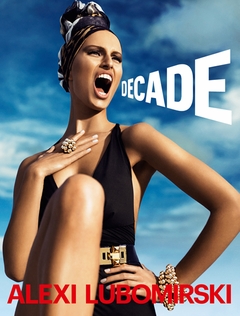
Decade by Alexi Lubomirski

The Prince was well taught and by living the principles passed on to him as a young man, he was able to become this larger-than-life photographer, whose career seems much greater than the ten years documented in his other book “Decade”. This, a collection of highlights of the photographer’s work, goes far beyond the 250 images contained in the tome. The photography book was conceived during hurricane Sandy, while Lubomirski was stranded at home without much else to do, and later on with the help of Alex Gonzalez, who fine tuned a theme which focused on the elegance of women, showing them in the way this photographer knows best – classic, happy and confident.

The images range from actresses like Lupita Nyongo, Kate Winslet and Cate Blanchett to supermodels including Karolina Kurkova. When asked about the difference between shooting actresses and models, the photographer states that “a model will shoot in whatever direction you want, while celebrities impose more boundaries as they are not hiding behind a character.”

So one could assume that shooting celebrities would be a challenge, but not for Lubomirski. “I learned to give actresses a story line and let them act it out. Kate Winslet for instance, uses her body as a tool and has such a mastery of it, it was the most incredible thing I’ve ever seen. The way she moves her ankle and her shoulder and the entire body conveys an emotion, it’s remarkable. Models and actresses are both special in their own way.”

Having had such a wide range and so many experiences it’s difficult not to ask the obvious question of who has been his favorite subject to shoot? The answer is the most charming and unexpected: “My wife, for sure, when I take pictures of her I feel like I’m writing poetry. Perhaps this will be an entirely different book in the future.”

Article originally published in The Peninsula Magazine, Fall 2015

Huffington Post, 2015

Gabriel Ruas Santos Rocha Spills What its Really Like to be a Model Agent

By Shawn Reinoehl, Contributor

Fashion Photographer With A New Approach To Fashion/Editorial Blogging.

10/20/2015 11:21am EDT 

New York, London, Milan and Paris; what do these cities have in common? They are the epicenter where fashion comes to life on the runways. Designers, models, editors, influencers, all come together to make it happen twice a year for fashion week. One of the key players that sets trends and pushes boundaries in the modeling business is the agent that represents models at top modeling agencies around the world.

Gabriel Ruas Santos Rocha is a senior agent at Trump Models and he has graced the fashion industry with his creative eye, sharp mind, and tenacity in the way he envisions what a model should envelop. If that means whether they’re tall, thin, curvy, or has that editorial look that hasn’t been seen before, Gabriel and other agents around the world have an influence on what is in, or out. I had the opportunity to ask Gabriel questions about fashion, modeling, trends, and what this whole process of fashion means to him and everyone else that can’t get enough of fashion.

Shawn Reinoehl What does fashion mean to you?
Gabriel Rocha Fashion is an art form, it is more than making clothes, it’s a way of expressing oneself, telling stories, showing personalities. Creating fashion is not just about putting out a dress on a runway.

SR How did you get involved with modeling agencies? 
GR A girlfriend of mine who was asked to meet with Marilyn Agency to be a model didn’t want to go by herself, so she asked me to tag along. I met the director of the agency and after that meeting we would occasionally run into each other. One day I got a call from her asking if I wanted to join their team; she said she felt my personality would be a good fit for the agency. I was intrigued, so I went for that meeting and 13 years later, I’m still in the business.

SR Of the models you’ve worked with, who are some of your favorites?
GR I have represented many great ones but I have to say some of the most inspiring models are probably Michelle Alves, Maggie Rizer, Julia Nobis, Shirley Mallmann and Caroline Ribeiro. Those girls are real muses to me.

SR Your favorite fashion era and why? 
GR Aesthetically I love the 70’s, there was so much going on at that time, from disco to glam rock and the looks were so elaborate and bold, it was a totally exciting time period for fashion in general. I also love where we are today, because it’s sort of a “best of” generation. We’ve been borrowing the best things from each previous decade and tweaking it to make it a little more modern and I like that. I like that pretty much everything is accepted, it’s all about embracing a look with confidence.

SR Who are your top three designers? 
GR At the moment Dries Van Noten, Givenchy and Celine. Ever, I would include McQueen, when he was still around and also John Galliano, he is an absolute genius!

SR How long have you been in the fashion industry? 
GR Thirteen years, but it feels like nothing!

SR In the fashion world, fresh is a must, what trends have you seen with the way models look?
GR when I started, the trend in beauty was between Brazilian and Russian models, very beautiful and sexy girls. Slowly after that the trend shifted a little bit more towards girls who looked a little bit like birds, meaning, big eyes, pointy nose, little chin, more of a round face, you know… Then it became a little bit more all American and pretty, like, the girl next door, reminding me a little bit of the 90’s when girls were just stunning and appeared more like someone you would want to be friends with. I particularly loved the grunge period in the late 90’s, I think fashion was very exciting at that time.

SR Are there super models today, or was that a product of the 90’s?
GR Yes, there are definitely supermodels today. The industry went through a period when there weren’t any, perhaps Gisele Bundchen was the only one around, for nearly a decade, but slowly they came back. I think at the moment some of the girls who could be compared with the original supermodels are Joan Smalls and Karlie Kloss.

SR Is skinny still in? 
GR Skinny is still in, very much so – but healthy too; skinny and healthy.

SR If a girl wanted to become a model what are some requirements she must meet in order to become one? 
GR 5’9 height, hips below 35 inches, good skin and good genes, self-confidence and patience, lots of patience.

SR What’s next in your career? 
GR I’d like to make bigger contributions to the industry and perhaps guide aspiring models and agents in a broader spectrum, away from the booking table and out in the universe.

SR If you could be on a TV show or reality show which show would it be? 
GR Oh, anything that Nigella Lawson could be involved in, I think she is absolutely fabulous!

SR What inspires you? 
GR Creativity and open-mindedness in others, that always gives me desire to do more and create new things.

SR Top three fashion photographers you adore?
GR I will stick with ones who are alive: Steven Meisel, Daniel Jackson, Lachlan Bailey and Ryan McGinley.

SR Where do you see fashion going in the next few years? 
GR Oh I haven’t a clue!

SR What projects are you working on?
GR At the moment I am working on a project that tells stories from the industry with a fresh perspective, should be out by next year.

SR When are you the busiest at your job? 
GR For me the most stressful times are the ones preceding the fashion season, when we have to make sure everything is organized for what’s about to take place, in line with strategy and brand development. 

SR What’s your favorite season?
GR Autumn, no doubt!

SR Do you see plus models replacing the thin girls on the runways? 
GR No, but I like that they’re more present each day.

You will find the original Huffington Post interview here.

On Beating the Taboo of Spirituality and Creating a Better Life

Spirituality is taboo. No matter how open minded we are, there’s a glimpse of a thought that prevents us from launching into the topic as we would about a TV show or a play. Whether we hold back to assess the situation and those around us, there is always that voice that whispers “proceed with caution” in the back of our heads.

Over the years I’ve seen spirituality expressed around me in many different ways. It was this flora of beliefs and practices that helped me find my own expression. I’ve found that people make their connection through religion, meditation, music, dance, support groups and study, to name a few. All of the aforementioned fascinate me for the way that each person builds their own individual relationship with something that is greater and more powerful than themselves. The sum of these examples have touched me in different ways.

I have never considered myself a religious person. I grew up in the south of Brazil, an area predominantly Catholic. My grandmother enrolled me in Sunday school, I was confirmed, joined the Boy Scouts and all that stuff that most kids don’t like to be associated with. I didn’t love those obligations, but I didn’t hate them either. The stories from the bible fascinated me. It was such a different world from the one I lived in. The 10 commandments baffled me. Not stealing? I get it, but some of that stuff just didn’t seem realistic to the 10-year-old version of myself.

Around that same time I met Berenice, my first English teacher. Berenice was Jewish, something completely new to me. I asked her questions, poked around and soon discovered that many of my classmates (in the Catholic school I attended) were Jewish too. I grew fascinated by their rituals and culture; moreover, I was fascinated by the sense of community they possessed. I immediately wanted to be one of them.

One of our religion class teachers, Pedro, was the epitome of cool, and the precise opposite of all other religion teachers, who were middle-aged nuns. Pedro brought his guitar to class, sang songs and created a stimulating environment in which we were invited to ask questions. In his classes we learned more not only about Catholicism, but all religions: Buddhism, Judaism, Islamism, the Amish and everything in between. Suddenly, all of us were engaged

Some 20 years later I ran into Pedro at my younger brother’s school, during soccer practice. My former teacher was still the same, dreadlocks and guitar included. I was surprised, he recognized me immediately. We caught up briefly and he told me he was let go from that job not long after I left that school. Polite, funny and sensitive as always, he didn’t go into details but I can speculate that perhaps his open minded beliefs and creative methods were a bit much for a traditional institution.

From those classes I remember becoming very aware about a sense of “destiny” and how life is full of coincidences. I also recollect not exactly understanding those feelings. I didn’t understand the purpose of prayer either. I didn’t get what sacrifice of one’s will for that of others meant. All I know is I always believed there was a force in charge of everything, making sure things happened according to a master plan. The problem was I never felt at ease. At one point I felt as if my life was spinning so fast that I was going to fall.

Around 2010, when I was in fact very close to falling, something clicked. My health had deteriorated and my career was collapsing. I had an immense sense of loneliness in New York and was completely afraid. I was then introduced to meditation. My friend told me about his spiritual practice and we launched into discussions about religion. To my surprise he had none, he was agnostic. My friend however, believed that he was in a spiritual path, and that all humans had a connection of the soul. Although agnostic he got on his knees to pray, daily. He did not pray to God, his prayers consisted of words of gratitude for his blessings, but also for all the negative experiences in his life. Those experiences taught him to push through, be stronger, and learn from mistakes.

It was from a simple conversation that the spark lit up a flame and I found myself no longer in the dark. There was hope. I started reading about different spiritual practices and learned to say more yes than no. Begrudgingly I started praying (not knowing what to, but I did it anyway), on my knees, as taught by my grandmother. I would then sit in silence and meditate; or at least I tried to. First for two minutes, than for five, and now sometimes I go for twenty.

Everything has changed and my practice has not remained linear. I’ve said prayers that belong to different religions, merely because I admired the meaning behind the words. I’ve studied different spiritual beliefs, like the Kabbalah, and I found a way back to myself through yoga, which if you had asked me before, I would have told you it was but a fashion trend.

I found that in the stillness of when I am alone I’m granted the answers I didn’t even know I was looking for. I discovered that there can be many different paths that lead to the same destiny, and I can get there a lot more peacefully if I have a spiritual connection. Whether my pursuit is in religion, meditation, or yoga, that’s all irrelevant. We all can connect within when we need answers or even if we simply want to feel re-energized. Millions of people on this planet can’t be wrong, if they have a spiritual practice that works for them then who am I to argue? Exploring different spiritual paths doesn’t take much time, it shouldn’t really cost any money and no one’s ever died from having too much spirituality and serenity in their lives.

Originally published in The Huffington Post – GPS for the Soul, October, 2015

On Beating the Taboo of Spirituality and Creating a Better Life

Spirituality is taboo. No matter how open-minded we are, there’s a glimpse of a thought that prevents us from launching into the topic as we would about a TV show or a play. Whether we hold back to assess the situation and those around us, there is always that voice that whispers “proceed with caution” in the back of our heads.

Over the years, I’ve seen spirituality expressed around me in many different ways. It was this flora of beliefs and practices that helped me find my own expression. I’ve found that people make their connection through religion, meditation, music, dance, support groups and study, to name a few. All of the aforementioned fascinate me for the way that each person builds their own individual relationship with something that is greater and more powerful than themselves. The sum of these examples have touched me in different ways.

I have never considered myself a religious person. I grew up in the south of Brazil, an area predominantly Catholic. My grandmother enrolled me in Sunday school, I was confirmed, joined the Boy Scouts and all that stuff that most kids don’t like to be associated with. I didn’t love those obligations, but I didn’t hate them either. The stories from the bible fascinated me. It was such a different world from the one I lived in. The 10 commandments baffled me. Not stealing? I get it, but some of that stuff just didn’t seem realistic to the 10-year-old version of myself.

Around that same time I met Berenice, my first English teacher. Berenice was Jewish, something completely new to me. I asked her questions, poked around and soon discovered that many of my classmates (in the Catholic school I attended) were Jewish too. I grew fascinated by their rituals and culture; moreover, I was fascinated by the sense of community they possessed. I immediately wanted to be one of them.

One of our religion class teachers, Pedro, was the epitome of cool, and the precise opposite of all other religion teachers, who were middle-aged nuns. Pedro brought his guitar to class, sang songs and created a stimulating environment in which we were invited to ask questions. In his classes we learned more not only about Catholicism, but all religions: Buddhism, Judaism, Islamism, the Amish and everything in between. Suddenly, all of us were engaged.

Some 20 years later I ran into Pedro at my younger brother’s school, during soccer practice. My former teacher was still the same, dreadlocks and guitar included. I was surprised, he recognized me immediately. We caught up briefly and he told me he was let go from that job not long after I left that school. Polite, funny and sensitive as always, he didn’t go into details but I can speculate that perhaps his open minded beliefs and creative methods were a bit much for a traditional institution.

From those classes I remember becoming very aware about a sense of “destiny” and how life is full of coincidences. I also recollect not exactly understanding those feelings. I didn’t understand the purpose of prayer either. I didn’t get what sacrifice of one’s will for that of others meant. All I know is I always believed there was a force in charge of everything, making sure things happened according to a master plan. The problem was I never felt at ease. At one point I felt as if my life was spinning so fast that I was going to fall.

Around 2010, when I was in fact very close to falling, something clicked. My health had deteriorated and my career was collapsing. I had an immense sense of loneliness in New York and was completely afraid. I was then introduced to meditation. My friend told me about his spiritual practice and we launched into discussions about religion. To my surprise he had none, he was agnostic. My friend however, believed that he was in a spiritual path, and that all humans had a connection of the soul. Although agnostic he got on his knees to pray, daily. He did not pray to God, his prayers consisted of words of gratitude for his blessings, but also for all the negative experiences in his life. Those experiences taught him to push through, be stronger, and learn from mistakes.

It was from a simple conversation that the spark lit up a flame and I found myself no longer in the dark. There was hope. I started reading about different spiritual practices and learned to say more yes than no. Begrudgingly I started praying (not knowing what to, but I did it anyway), on my knees, as taught by my grandmother. I would then sit in silence and meditate; or at least I tried to. First for two minutes, than for five, and now sometimes I go for twenty.

Everything has changed and my practice has not remained linear. I’ve said prayers that belong to different religions, merely because I admired the meaning behind the words. I’ve studied different spiritual beliefs, like the Kabbalah, and I found a way back to myself through yoga, which if you had asked me before, I would have told you it was but a fashion trend.

I found that in the stillness of when I am alone I’m granted the answers I didn’t even know I was looking for. I discovered that there can be many different paths that lead to the same destiny, and I can get there a lot more peacefully if I have a spiritual connection. Whether my pursuit is in religion, meditation, or yoga, that’s all irrelevant. We all can connect within when we need answers or even if we simply want to feel re-energized. Millions of people on this planet can’t be wrong, if they have a spiritual practice that works for them then who am I to argue? Exploring different spiritual paths doesn’t take much time, it shouldn’t really cost any money and no one’s ever died from having too much spirituality and serenity in their lives.

Meet the Man who Changed the Face of Advertising in America

When you hear the name William Helburn, it will probably not mean anything to you. Unless you were part of the advertising industry in the Mad Men era or a fashion insider, Bill (as he’s called by friends and colleagues) would have flown under your radar. Contemporary to other greats like Richard Avedon, Lilian Bassman, and Irving Penn, Mr. Helburn’s career started right after the war. Mr. Helburn shot faces like Dovima, Dorian Leigh, and Jean Patchett for various publications, including Harper’s Bazaar and Time Magazine. In the book Seventh and Madison (Thames & Hudson), the reader is introduced to this key character of a long-gone era, in which the United States lived what was probably the most exciting and innovative time in advertising.

This photographer never spent much time building an editorial brand. “I never made a point to put my name under my pictures; I was working mainly in advertising, and unlike magazine editorials, you never get credit for that work,” Bill explains with no regrets. “I worked a lot, I was successful, people liked me, and I made a lot of money.”

Mr. Helburn didn’t really care about branding himself, so why suddenly have a retrospective of his work at the peak of his 90 years of age? “I have no idea, this is such a nuisance!” he laughs, “these people who followed my work, approached me and said they were interested in what I created, and said they felt the world should know who I am.” Bill agreed with the proposition but was skeptical that they would be able to put a book together with the little material he had saved over the years. “I threw away three-quarters of the work I did, anything that wasn’t approved [to run] went to the trash, I didn’t know people were gonna come back and make a book about me.”

What Robert and Lois Lilly (authors of the tome) saw was the indelible mark this photographer had left in the advertising industry. Helburn was making images that were outside the box and popped from the pages of the magazines and billboards, bringing new excitement to the ads he was hired to shoot. He was the only advertising photographer who was as trendy as the fashion photographers, roaming the world with top models and celebrities and putting them in new and unexpected situations for the sake of selling a product differently.

Never before would a fashion photographer shoot a car advertisement, and that’s exactly what Bill did. “I made it more interesting. I wasn’t showing the engine like most ads were. I had a model in the picture, and I made that car sexy.” And Bill gets excited every time he is invited to talk about his work. “I made advertising a little more fashionable. They would give me layouts, and I’d shoot that, but then I’d also do what I wanted to do, and more often than not they’d pick my idea over the layout.” That was how models ended up with cruise ships in their hair, standing atop street signs, or naked in the middle of a snowstorm. Shock value was something this artist knew all about.

In times when the world talks endlessly about new media and the end of printed matter, it’s valid to wonder what made such a successful photographer change from shooting stills to moving image. Eventually, Mr. Helburn saw the expansion of television as a new medium and moved on to shoot commercials. “That was the way the world was going, advertising was spending more money on TV, so I started doing that,” explains Bill. And he did that from the 80s up until the early 90s when he finally retired to enjoy his success and spend time with the family.

For someone who seemed so passionate about his work, one is left wondering if he keeps up with new advertising campaigns and magazines. The answer comes as quickly as the click of a shutter. “I couldn’t care less, I don’t keep track of it at all, I just want to enjoy life!” And that he does, with no regrets, only happy memories. “Doing this book… it’s rewarding, they rediscovered me,” concludes the master.

Article originally appeared in The Huffington Post, VVV Magazine, and The Peninsula Magazine.

The Legends Interview

legend |ˈlejənd| noun

an extremely famous or notorious person, especially in a particular field.

Picture this: between Pat Cleveland (who’s career started in the 1970’s) and Hannah Ferguson (who started in 2012), there are five decades of legendary careers in the modeling industry. One would think that for some of these women, things would have slowed down, but they don’t ever stop working. Frederique Van der Wal runs the most successful floral business in the world, Carol Alt hosts a daily show on Fox News, Claudia Mason is about to embark on a book tour and Pat Cleveland is also writing a book of her own in between photoshoots and runway shows. Hannah Ferguson, while young in the business, had hardly any days off since she broke the internet in the infamous Carl’s Jr. commercial, alongside Paris Hilton.

The irony is that neither of these women seem to see themselves as legends. “I don’t know what a legend is” says Carol Alt while the makeup artist works on final touches before the shoot. Strangely, Ms. Alt is one of the models for which the term “supermodel” was created to describe. “To me, if the image stays long after the person is gone, that is legendary” she completes.

The aforementioned women may not be “gone”, but their images will forever linger. These careers surpassed the runways and magazine covers, occupying the movie screens, televisions and even theater stages around the world. Additionally, each of them has a hand in some sort of humanitarian work, paying all the good they received forward. Whether they care to admit it or not, they have all created a legacy of their own.

Relive the Glamorous Excess of the 1970s in a New Book

Authors Mauricio and Roger Padilha have a way of unearthing subjects. In their previous books, the duo brought to light the work of renowned artists Stephen Sprouse and Antonio Lopez, both legendary in their own right. Their most recent tome, GLOSS (Rizzoli, 2015), is no different. The monograph covers for the first time the work of photographer Chris Von Wangenheim, one of the terrible three, which included two other iconic names in photography: Helmut Newton and Guy Bourdin. Unlike Newton, who insinuated an action about to take place, or Bourdain, who captured a moment after it had happened, Chris caught the scene as it was unfolding in an unapologetic and, at times, shocking manner.

Mr. Von Wangenheim was perhaps one of the most provocative photographers of all time. From the late 1960’s all the way into 1981, when he died in a car accident, this artist captured the glam and excess of that era. Sex, violence, danger, and vice were caught by the lens of his camera and put on display on glossy pages of magazines as fashion editorials for VogueHarper’s Bazaar, or Interview. The photographer also imprints his vision in fashion campaigns for iconic brands such as Christian Dior, Valentino, and Calvin Klein.

The new book includes more than 200 images, some legendary, some unknown. The suggestive narratives are as inspiring now as they were then and continue to impress the industry. Almost every person who works in fashion is familiar with the iconic images of Lisa Taylor and Christie Brinkley being bitten by dobermans, or the singer Grace Jones posing semi-naked among panthers.

Mr. Von Wangenheim’s work might have faded with his passing, but it wasn’t forgotten. With this book, the Padilhas hope to bring back one of the most celebrated fashion photographers of the 1970’s and keep him in the forefront of fashion, a place from where he never should have left.

Bright Lights, Big City

The city of lights, romance and pastry, Paris is one of the world’s most effervescent cultural centers. The French capital sizzles and yet remains gentle in a beautiful paradox that allows you to live fast and party hard, while simultaneously inviting you to sit at one of its many immaculate parks to listen to music or read your afternoon away. The beauty of Paris is not in the bustling tourist attractions, but in the hidden corners and intimate settings. True, some of the most notable spots, such as the Louvre or the Trocadero still remain breathtaking, although somewhat impersonal. It was in the peaceful gardens of the Jardin des Plantes that I found my footing. After I realized that privacy was possible, even in the most public of places, I decided I’d take my time, soaking it all in.

No city in Europe makes me feel more comfortable and at home than I do in Paris. I understand this may seem odd, given the unfortunate fame the French have for their unpleasantness. I don’t find that to be true. Yes, they are ‘to the point’ and, yes, they can sometimes be honest to a fault, but I’ve learned over the years that part of what makes them so wonderful, are those exact things. They know everything; they are the best at everything; they have the best taste in everything. So what? No wonder they have some of the best food and wine in the world, not to mention art, literature, film and music. The French really got it all right – if it wasn’t for all the dog poo splattered around the city sidewalks and the occasional strikes, it would be the perfect place.
Whether in the seediness fun of the Pigalle or at the top of the hill at the Sacre Coeur – my favorite church in the world, which says a lot for someone who’s not religiously inclined – there was always an opportunity to stop at a hidden store, buy inconspicuous art and chat with the locals about what could be a great spot for dinner in the area, away from the extreme prices of the known locales.

L’Entrecote remains one of my favorite restaurants within Paris. Introduced to me during my first trip, it’s a French gem and normally my first stop whenever I’m in town. After standing in a long line out in the street (yes, it’s that popular), you’re invited to sit down in a busy room, filled with vibrant chatter and delicious smells. However, no menu is ever presented; for a flat rate, you’re served L’Entrecote’s famous cut of meat with the secret mouth watering sauce, accompanied by fries and a salad. At the end of your meal, you’re given the choice of a dessert and the check. Just like that, in and out, no time is wasted, and it’s a fascinating thing to watch. This restaurant is such a big hit that it currently has three locations in Paris and even one in New York.

If my mood for dinner, however, is for a scene, I will most likely be seen at Cafe Ruc or Ginger. These two restaurants attract the core of the fashion industry. During Fashion Week, it’s an invitation to encounter some of the biggest top models dining alongside their agents and fashion editors from magazines from all around the world. For lunch, another restaurant favorite of mine that never disappoints is L’Avenue. Steps away from the Hotel Plaza Athene and smacked in between stores like Dior, Chanel, Ferragamo, Celine and the headquarters of Givenchy, this is the spot to have lunch in between fashion shows. The tables on the sidewalk are the most sought after and certain ‘fashionistas’ have been known to spend north of four hours there sipping champagne and nibbling on strawberries. For a quick and very traditional French lunch, I adore Le Castiglione, also one of Grace Coddington’s favorites. The overall environment of Le Castiglione is lovely and the food cooked to perfection. Only a few steps away from Place Vendome, the jewelry central of Europe, where one of the most infamous jewelry heists took place a few years ago, thus turning this location into one of the most well guarded on the planet. Also located at this square is the famed Hotel Ritz — where the gliteratti gather and serves as temporary home to everyone from Anna Wintour to Beyonce.

Not all, however, needs to shine to be incredible. The fabulous burger joint, Ferdi, prepares what to me is one of the best burgers in the world. This cozy restaurant is a locally, well-known institution where patrons are hosted (or turned away) by the colorfully temperamental owner, which to me is the entire charm of the place. The Olsen twins, as well as the Delevigne sisters, have been spotted at Ferdi on several occasions and given their stamp of approval. After finishing the burger, it’s always a good idea to make a quick stop at Colette to pick up some of their exciting limited edition items. The store is design-heaven; just the right size and packed with all that matters in the fashion world – here, you can’t go wrong. If your appetite in turn, is for something a little more mainstream do not skip the classic Printemps, Le Bon Marche or Galleries Lafayette, which are the most famous and large scale French department stores. In the afternoon, a visit to the Hotel de Crillon for coffee proves to be a wise and regal choice. If that’s not appealing, head to the Madeleine square and pick up some delicious tea at the iconic teahouse, Mariage Freres – my personal favorite is the Marco Polo blend.

Shopping may not be your focus (if you’re anything like me), and, in that case, my top suggestion is the museum of the Orangeries at the edge of the Tuilleries Garden. More intimate than some of its counterparts, this museum holds masterpieces like Monet’s Waterlilies among many other impressionists and post-impressionists masters like Cezanne, Matisse, Modigliani, Sisley and Renoir. In case there’s time (and patience) for the mainstream, do not skip the Dorsay and the Pompidou. A very important addition to Paris’ cultural portfolio is the incredible Louis Vuitton Foundation. Designed by Frank Gehry, this new icon of modern architecture and the arts sits in the Bois de Boulogne, known for its mansions and leafy streets. It’s in this very neighborhood that the musician Lenny Kravitz lives and is known to host the occasional intimate party in which the pantheon of the fashion, music and film industry gather.

While in the subject of parties, the Paris nightlife is not to be missed, some of the most exciting times I’ve had at night were there. It was at the club L’Arc that for several years the designer Riccardo Tisci hosted names like Liv Tyler, Gisele Bundchen and Mariacarla Boscono at parties for Givenchy. The most recent and exciting club to open its doors was David Lynch’s Club Silencio. Hidden deep underground, Club Silencio has a variety of rooms and hallways, while also playing host to the an exciting group of characters in the most extreme outfits seen anywhere.

While in Paris, a wild night is not always a requirement for a good time, as can be experienced at the ever-classic Hotel Costes, where a toast to a glass of champagne is mandatory. For a cooler, and more relaxed environment, my all time favorite evening appointment is at the restaurant Derriere, which is fashioned as a house. You may sit for dinner at a bedroom or in a living room, you may even end up in the dining room! If all else fails, you can hang out at the bar or in the patio and play some ping-pong with the iconic and irreverent fashion editor Carlyne Cerf de Dudzeele, a fan of this spot who is always up for a good time and some laughter.

Of the more traditional touristic spots, I try to never skip visits to the Notre Dame cathedral during mass hours; the smell of incense and the echoing of the words in french are ever inspiring. The Luxembourg Garden always takes my breath away and just before I head back to the hotel to change for the evening, a quick drink or a cup of coffee at Cafe de Flore is essential. Before you leave Paris, whether you go to their cafe at Champs Elysees or to a kiosk at the airport, don’t forget to pick up a box of macaroons from Laduree to gift to some of your favorite people back home. These colorful delicacies are a French institution.

Allow yourself to be immersed in the local culture, stroll through the bridges and the streets observing every detail and every sign. Look for the markings on buildings that might show you the former homes of luminaries like Proust, Balzac or Victor Hugo. Take all of its essence and history in and maybe then you will fall in love just as much as I did. In the classic words of Cole Porter; “I love Paris, every moment of the year”.

Column featured in ONNE MAGAZINE – May 2015

La La Land

The plane touched down and excitement filled the air. This was my first trip to Los Angeles, a place that existed in my dreams and was about to become a reality. The fast pace of the freeways, the palm trees – everywhere, just like the movies. My first experiences there were fun – but underwhelming. The excessive time in traffic really brought me down. I am the type of person who’s really a sucker for human connection, so to be in a place where people basically don’t utilize sidewalks unless they’re getting to their car or from the car to a building, was really jarring. Not only that, but where were all the celebrities that allegedly lived here? I mean, if people are constantly in their cars, how do you ever see them? 

My friend, who was married to a paparazzo suggested that he’d take me on a tour to show me all the houses, where all the celebs lived. Off we went, and I got to see wall after wall, gate after gate, door after door, and still, no celebrities. And no houses either. It was the most disheartening process. My dreams were being crushed. Even the paparazzi chase after James Marsden I got to witness seemed boring. Where was Julia Roberts when you needed her? 

And then, there was the nightlife, or should I say, there wasn’t. A place where clubs are required by law to close at 2a.m.? Seems excessive, but it’s the truth. I was simply not having any of it. Granted, during the day, the parks, the mountains, the beaches, all wonderful, really – the quality of life, I imagined, top of the line. If you disregard the gray fog of pollution that covers the city, of course. But all good, isn’t there pollution everywhere? Who knows, you tell yourself the fattest lies when you want to believe in certain things.

I had not given up, I was certain that LA had to be that magical place from the movies, with all the cheap glamour and phenomenal black-tie parties, packed with celebrities pretending to have a good time. That’s the place I longed for, a place of make belief.

On the following year, I was invited to attend an Oscar party, perhaps the most sought after invitation of awards season. This was a private affair, at the house of a major pop icon, no press (or cameras and social media) were allowed and the guest list was tight, only 200 of the biggest and hottest talent in the world were invited, along with some key Hollywood players. I could not believe that I was in, this was an honor. I felt as if my opportunity had finally arrived, to truly experience LA at its best, on its most important night of the year, Oscar night.

The city buzzed, all along Sunset Boulevard and wherever else there was a key party taking place, traffic was intense. None of it mattered, because the party I was attending would only really get packed after everyone was done posing for pictures at Elton John’s or Vanity Fair, this was the party where they came to throw their hair back and really have fun.

Fun was had. Oprah Winfrey grabbed me by the arm on a twirl, most likely thinking I was someone else, and very quickly moved on to pay attention to Tom Cruise. Sharon Stone, probably the most magnificent creature I had ever laid eyes on seemed bored at the music, until Puff Daddy took over the pick ups. In an attempt to actually socialize, I bummed a cigarette from Penelope Cruz, who’s dress was all ripped to shreds at this point, from all the dancing that was taking place. More than half of the women were trotting around barefooted, without a care in the world. We were all sweaty and we were all having the time of our lives. A momentary bond was created between me and Renee Zellweger, who kept trying to hit on my friend, but with no luck – he was engaged to be married. That would not be a problem, Renee and I still had the dance floor. The bathroom line was dispersed by a housekeeper who informed us the toilet was clogged. So it was true, celebrities are just like everyone else, they even clog toilets the same way.

The follow up to this brilliant night was a brunch at the iconic Fred Segal, where me and my friends would rehash stories from the night before. Sitting next to me on the curb, waiting for a table just like everybody else, was J.Lo with her BFF Leah Remini. And there it was, the moment I had been waiting for all along, the LA of my dreams had concretized.

I did not stop going back to LA ever since, two or three times every year at the very least, and I just keep on falling in love with it more and more. Over time I learned to love waking up early in the morning for a walk on the hills of Hollywood, by the iconic Hollywood sign, all the way to the stunning Griffith Observatory. Sometimes if I’m feeling adventurous, I will get in my car and go to Runyon Canyon, probably the most popular of the hikes in town. There, the occasional celebrity sighting is inevitable, my favorite being a fresh faced Kathy Griffin walking her dog up and down the rocky pathways.

With time I also learned to get over my traffic resentment. I now zip all around the city in my little rental cars. It was in LA where I had my first car crash, not in New York, the place famously known for its horrid traffic and crazy drivers. As I was parking for brunch at Laurel’s Hardware, one of the hottest brunch spots in town, a bus took half of my car along with it. Of course, this being West Hollywood, Kanye West and Kim Kardashian arrived just as I was giving my statement to the police. A very glitzy car crash indeed!

In the evening, dinner at Soho House among the likes of Al Pacino or Madeleine Stowe seems like a great choice, followed by drinks at the historic Chateau Marmont, location picked for the movie ‘Somewhere’ by Sofia Coppola and of many incredible parties, like the night where many gathered around the pool to celebrate Valentino on his last collection as the designer of his own label. And speaking of parties, it was at LACMA – Los Angeles Contemporary Museum of Art, where Rodarte threw their pre-Oscar bash a few years back. Now, I am not saying that’s the reason why you should visit, but it is definitely a place to be seen. Their art collection is exquisite and the place itself is definitely not to be missed, much like the Ghery designed Disney Auditorium, with it’s incredible architecture. Speaking of art, a visit to Prism Gallery is also essential. This gallery co-owned by the brothers xxxx is one of the hottest in the country, continually launching new talent into the top echelons of the art world. Next door is the restaurant Eveleigh, one of LA’s trendy spots where top models Carolyn Murphy, Irina Shayk and Gisele Bundchen can be seen dining alongside Mario Testino, Adam Levine or Leonardo DiCaprio.

One of my favorite places for dinner though is Pace, on Laurel Canyon – not only for its delicious menu but for the history that’s present in that area. A few doors down from the restaurant is the house that used to belong to Jim Morrison, and that street was what he used to call “love street” – made famous by the song of same name. From the balcony of his house, Jim used to watch his girlfriend coming home from work every day. The country store next door to the restaurant is where Jim, and many of his rock star friends used to go for their groceries. The basement of this store served as Mama Cass’s first apartment when she arrived, broke, in Los Angeles. What Morrison and Cass didn’t know, is that they had gone to school together, years prior to that and had never met until then. That store is “the place where creatures meet” that Jim mentions in his song because of this accidental high-school reunion. After this walk down memory lane, a trip up to Mulholland Drive is mandatory. Its winding roads took the lives of xxx and were made globally famous by David Lynch’s homonymous film. Make sure to stop at one of the overlooks to take some of the most stunning night shots of the City of Angels.

Rodeo Drive, once made famous by Julia Roberts is just another shopping spot like any other in any large metropolis, and if that’s the focal point of your trip, then you won’t be disappointed as luxury is not spared here. Don’t forget to make a stop for lunch at Ceconi’s to recharge the batteries or later on at the cafe at the Regent Beverly Wilshire, where the pretty woman and Richard Gere were staying in, in that movie. This is a magical city, infinite opportunities for entertainment, from the Walk of Fame to the seedy Venice Beach where Arnold Schwarzenegger was once made Mr. World to the Santa Monica Pier, with its traditional funnel cake and amusement park – days can be spent discovering new things in Los Angeles and the more I discover, the more I want to return. You will too.

Model by Day, Rocker by Night

SAINT LAURENT MODEL BY DAY, SUNFLOWER BEAN BAND MEMBER BY NIGHT, MODEL/MUSICIAN JULIA CUMMING IS ONE TO WATCH.

PHOTOGRAPHY BY HEDI SLIMANE DURING THE FITTING IN SEPTEMBER 2014 IN PARIS

INTERVIEW BY GABRIEL RUAS SANTOS-ROCHA

Despite having just graduated from high school, model Julia Cumming already has two seasons as a Saint Laurent exclusive under her belt. As if that wasn’t already a success story on its own, her Brooklyn-based band, Sunflower Bean, is a beacon of hope for old-fashioned rock-’n’-roll. Music has always come naturally to Cumming (her parents met in a band and her father taught her how to play bass), which is likely why Hedi Slimane was prompted to tear her away from the stages of Brooklyn to walk in his Paris runway shows. “It has been pretty amazing working with Saint Laurent,” Julia reported. “Hedi Slimane’s interest in supporting musicians who are starting out is really cool, and brings a different kind of genuine energy into the world of fashion.”

We talked with Cumming about rock in the digital era, her perceptive views regarding the state of the music industry—and why she might like to travel back in time to the mid ‘70s.

What’s your band’s creative process like? Do you start writing new songs while you’re touring or is there a special time for that?

“For me and Nick and Jacob, playing is our favorite thing in the world to do. So we play together every day—rehearsing and writing when we find parts we want to expand on. Nick usually brings in some riffs and we all work with them, turning it into a collaborative thing.”

The internet has been a great vehicle for your music. Do you intend to move into more traditional formats in the future? Shall we expect an “album”? Maybe even Vinyl?
“The Internet is a gift and a curse (I could talk for years about that), but there is something really special about a physical release. We intend to release our first EP in the beginning 2015, hopefully on vinyl.”

As a young artist in the music scene, how do you view the industry today?
“The music industry has changed so much in the age of online piracy, and I think it’s trying to figure out how to survive in a world where it’s almost impossible to profit off of record sales. It just means that if you’re trying to be a musician now. you really have to do it for the love of it, because the days of huge advances and tour buses are just gone. But everything moves in cycles, and you have to be thankful and excited for the moment you’re in. As long as I’m surviving and making art that I’m excited about, it’s all good.”

Did you have an idea of what the music industry would be like—how was your perception different from the reality of the job?
“Everything seems more glamorous than it is. The music industry is a business, and a business is a business is a business!”

The video clip for “2013” was shot entirely with iPhones—we’re interested in the concept!
“My friend Kyle Hiedacavage is a totally amazing artist who I’ve always admired, and we basically sent him the song and he came back to us with the concept for the video. He wanted to shoot it all on iPhone cameras, which was perfect because we had no budget. I bought a fog machine for 100 bucks, and we just went for it. I think Kyle’s interpretation was spot on. It captures the moment, the year, how we were feeling at the time, all while kind of speculating about the future.”

The thought behind “2013”, of science expanding life and changing things at a fast pace, is a bit daunting. Would you want to be able to extend your life to be 1,000 years old?
“I don’t think I would want to extend my life to be 1,ooo years old. I guess it depends on what the quality of life would be like. It’s also nice that you have this kind of short moment where you are alive, you know? It forces you to make the most of it, and to take chances.”

One of our favorite Sunflower Bean tracks is, “I want you to give me enough time.” We’re curious to know what it’s about!
“This song means something different to me than it does to my bandmates. I feel like it’s talking about audience members in Brooklyn that go to shows and make up their minds really quickly about bands without really listening long enough to form opinions.”

 Does music influence your sense of style, fashion-wise? What is the connection between the two, in your opinion?
“I’ve always loved glam rock… Acts like Gary Glitter and T-Rex have been my favorite since I was a little kid. I used to have a tape with Alice Cooper music videos that I watched over and over again until it broke. So those images are burned into my brain and have affected my whole life—my style included. I love going a little overboard and trying to find where elegance and over-the-top meet, especially on stage. I feel centered when I’m wearing an outfit that I love and one that represents myself.”

Is there a period in fashion that you’re more interested in?
“I don’t know if I could name just one period, but I obviously love the early-mid seventies. I used to say that if I could exist at any time I would like to be 16 in 1973, living in London.”

How did modeling come about for you? Had it always been a desire of yours?
“I think modeling is a kind of performance and a form of expression in a way. When I became interested in clothes as an early teenager, fashion imagery started to mean more to me. But I never really thought it was something I could end up actually being involved in.”

Can you compare the experiences of being on stage performing with your band versus walking in runway shows?
“Playing in a band on stage and walking in a runway show are very different. Fashion and music are definitely intertwined, but an art form like rock-’n’-roll offers total freedom, asking you to dress up the parts of you that are ugly and weird and you put them on display.”

Judging by the different avenues that you’ve pursued throughout the years, it seems that you’re not afraid to try new things.
“I love to try new things. You only get one chance in this world (at least until we find out if we can live to be 1,000). I just really enjoy making art and want to try to explore it all the ways I can.”

Interview originally published on CR Fashionbook on Nov, 17th 2014 

Top Agent

The visionary Eileen Ford created in 1947 the concept of the modeling agency as we know it today. Tough and workaholic, the businesswoman, who passed away this past July at the age of 92, had only one regret: not signing Grace Kelly to her agency

By Gabriel Ruas Santos Rocha

The designer Yves Saint Laurent once said that “a good model can advance fashion ten years”, but a good modeling agency and managing skills have proven to advance an entire industry. Eileen Ford, who passed away, last July at the height of well lived 92 years was the sole creator of the modern day modeling agency. Mrs. Ford’s modeling agency went on to become the biggest modeling agency in the world, representing a roster populated by some of the most famous and recognizable women in the world. Cheryl Tiegs, Christy Turlington, Jerry Hall, Verushka, Naomi Campbell, Twiggy and Christie Brinkley were only a few in that lucky list.

It all began when Eileen was Pregnant and unable to find someone who would hire her. Mrs. Ford began assisting some of her friends who were models in the mid-40’s as their secretary. Eileen organized their schedules, negotiated jobs, chased after payments and by word of mouth became an agency, at a time when modeling agencies weren’t really established. Modeling wasn’t viewed as a serious profession and Eileen Ford helped evolve modeling from a mostly part-time, poorly paid hobby into one of the world’s most glamorous occupations, turning girls next door into multimillionaire celebrity supermodels. When Eileen’s husband, Jerry Ford, returned from war and resume his studies for business at Columbia University he found great potential in what his wife was doing. Jerry cemented the business and took care of the business while Eileen managed and scouted the girls. They were a perfect fit and became an instant hit.
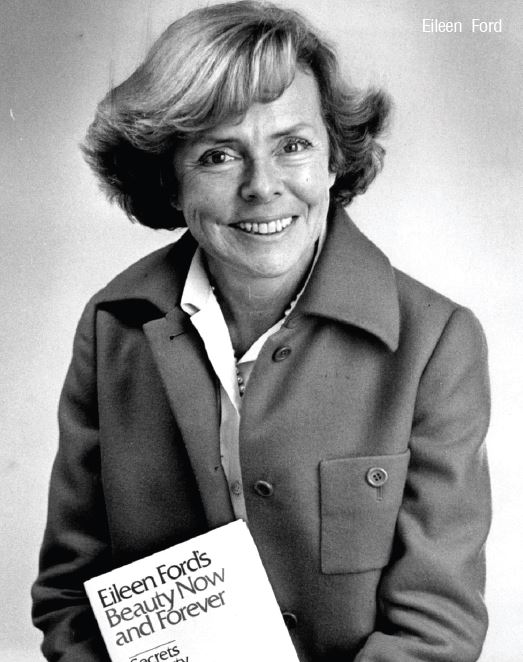
In their first year, the Ford’s accumulated over 250 thousand dollars and by 1966 Forbes reported they were making an average of 100 thousand dollars per week, becoming the most successful agency in the business. That did not happen by chance. Ford had introduced the voucher system, which would guarantee models their earnings even if the client hadn’t yet paid the agency. Models at that time were paid by the hour, at very low fees. Eileen argued that models should earn their paychecks per day, type of work and according to the extent their images were exploited by the clients. This new practice was the page turner, influencing the way advertising works and remains today the lifeline of the business.
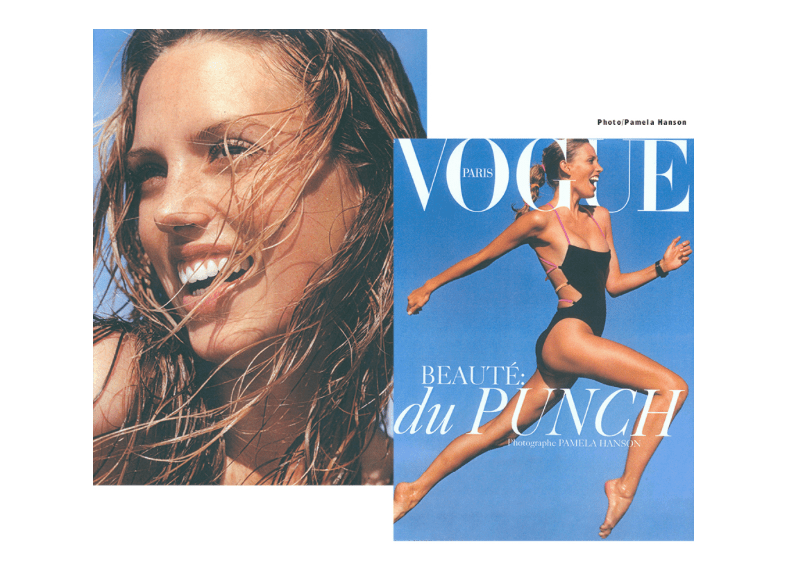
The typical Ford model was tall, thin and predominantly blond, with wide-set eyes, beautiful eyebrows and long neck. Very rarely her girls were shorter than 5’7 a cut-off height which luckily included the gap-toothed Lauren Hutton. Ms. Hutton became the highest paid model in the 70’s and alongside Evelyn Kuhn, one of the first two Revlon contract models. In a recent interview with Eileen, she corrected me: “That was not the first contract”! She was firm, and sharp, referring to Yardley’s of London. That was the first ever exclusive contract, designed by Eileen and Jerry so that a model, in this case the iconic Jean Shrimpton, would exclusively represent and endorse a specific brand, securing higher fees and better exposure.

Beauty however, was not everything. Ford demanded the highest level of professionalism from her models, putting them on strict diets and firing those with a taste for partying. Eileen famously used to say “Models are a business, and they have to treat themselves as a business.” Mrs. Ford took models in to live with her and her family, in her home and was adamant about having all the girls sit with the family at the dining table. Models were required to do chores around the house and go to bed at specific times in order to learn about professionalism and respect. “It was my first experience with a dishwasher” Monique adds, “I had no idea how much soap to use, it ended up in disaster, the foam reached all the way to the dining room” she completes with giggles. Anne Anka, then known Anne de Zogheb, recalls how disapproving Eileen was of her relationship with the singer Paul Anka, who she was married with for 38 years. “She thought, ‘Show business, that’s trouble’, but I think she eventually came around.”

Eileen’s hospitality was the first sign of model housing, now largely established for every agency across the world. At the time however, it was a way for her to keep a closer watch at her girls and make sure they were behaving according to good moral standards and staying away from harms way. Supermodel Renee Simonsen recalls “They took me in and made me a part of their family, and I know that the protection of Eileen saved me a lot of [bad] experiences in the modeling business, she was a tough lady with high moral standards, but she had a big heart”.

Ford reigned the industry alone until the late seventies, when the ‘model wars’ ensued with the insurgence of John Casablanca’s Elite and Wilhelmina Models. These were some of the agencies that came on strong, attacking and luring away some of Ford’s top talents. Eileen would not stand and let her business be taken from her. To her defectors, Mrs. Ford would send copies of the bible with passages about Judas highlighted in red.

It was again, time to innovate. She opened offices across the globe, from Europe to Brazil and soon enough established the first worldwide model search. The ‘Ford Supermodel of the World’, became the largest scouting network and modeling competition, making Ford the biggest agency on the planet.

With that, the supermodel factor was born and many successful models owe their careers to this model search. Victoria’s Secret Angels Adriana Lima and Chanel Iman as well as the actress Malin Ackerman and top models Elsa Benitez and Liliane Ferrarezi are probably the most recognizable names from that group. This vast scouting network helped Ford to branch out and establish a more global look.

Mrs. Ford might have been tough as nails, as some will say, but all who worked for her share their memories with fondness. “They were so nice and decent, like a big family; we shared our good times and also went through difficult times together” explains Patty Sicular, who worked for the Fords as an agent for over three decades and currently runs the Legends board at Trump Models, current agency to most of those iconic Ford models who left with Patty after Eileen departed the business for retirement in 1995. “If you worked with Eileen and Jerry you were on your toes, and as hard as we worked, Eileen and Jerry always worked harder, they were in the office when we arrived and still there when we left.” Concludes Mrs. Sicular. “Eileen wielded her power towards the electrician that came in to repair a light switch to the CEO of General Motors” recalls Ms. Beverly Johnson, “I had never seen a woman with that much power and it was intoxicating to my young mind. Eileen is responsible for shaping me into the celebrated fashion model and savvy business woman I am today.” Concludes Ms. Johnson, the first African American model to appear on the cover of American Vogue, in 1974, and today owner of a hair care line.

Ms. Johnson’s first interview with Eileen did not go well. “’Too fat’, those were the two first words Mrs. Ford said to me.” But Ms. Johnson was determined to join the most powerful modeling agency of the time and came back two weeks later, this time she was in. Eileen however didn’t always made the right choices. Among names that were rejected throughout the years, Marisa Berenson and Grace Kelly stand out – she admitted publicly later that not signing the future Princess of Monaco was her biggest professional failure.

This article appeared originally in Vogue Brazil, September 2014

According to Law & Order

All I knew about Brooklyn when I moved to New York from Brazil six years ago was that Brooklyn was, according to “Law & Order”, a dangerous part of town with shootings and bodies dumped in the river. I also knew that Miranda (yes, from Sex and the City) once had to make the painful decision to move there in order to afford a better lifestyle for her child. Apparently, real estate was booming, she could buy an entire house for the price of a Manhattan shoe box and the neighborhood was really blossoming. That was what I knew, the little information that television had fed me.

That was certainly not what I found when I actually crossed the river for the first time. Let’s face it, Brooklyn could be a scary place if you don’t know your way around. “Could” being the operative word. What many people fail to realize is that Brooklyn is not a neighborhood, it’s a borough, and it’s an enormous one. Williamsburg alone is the most densely populated neighborhood in New York city, with over 135 thousand people. And that is only a small part of Brooklyn. This borough didn’t used to be a part of New York City, Brooklyn was its own entity up until a century or so ago. If Brooklyn was still an independent city, it would most likely be one of the largest in the United States. 

The most gentrified portions of this borough look like Anywhere-Else, Manhattan; if you ask me, except with a very, very young and artsy crowd. This is not to set anyone apart, it’s just a fact. After SoHo and the East Village kicked out their young artists due to rising real estate prices (lofts turned into luxurious apartments, among other things), this is where they came to rest. So yes, Brooklyn, or at least parts of it, became a refuge for New York newcomers, young families and artists of all different cultural walks of life.

And so it is, Williamsburg, being the closest neighborhood, right off the first stop of the L train, becomes expensive and gentrified and people once again flee further. Dumbo, Bed-Stuy, Park Slope, Greenpoint, Carroll Gardens are all other names that have become as regular as SoHo and Chelsea in day to day conversations. It’s the nature of the beast, the never ending evolution of the city that never sleeps. All along Bedford Avenue, Havemeyer, Metropolitan and Roebling you see the signs of change. From one month to the next, the store front that was empty gives place to a 16 Handles, a Walgreens or a bespoke tailor shop. The thing about Brooklyn though, is that somehow years later, it still retains some of it’s original character. Whether it’s the old cobble stone streets in which Truman Capote used to take walks on, in Brooklyn Heights or the ever changing skyline of Manhattan, once depicted so brilliantly in “Moonstruck”; it’s all still there.

The place in which Barbra Streisand was born now may be the home for Winona Ryder, Mary Louise Parker or Maggie Gylenhall. The same streets in which Woody Allen have walked on have evolved and are now home to fancy restaurants which attract Manhattanites who would normally never be caught in another borough unless it was to go to the airport. The latest in a string of many, is the Italian nuveau cousine Antica Pesa, which has been known to attract Madonna and Harvey Weinstein. Roebling Tea Room is however, still one of the gems of the area; great food, proper portions, fair price and all of it in a very chilled out setting. But don’t be fooled, there are many other restaurants to explore. 

If your taste is for farm to table, organic, gluten free (very specific) pizza, then Wild is your spot, and it does not disappoint. If all you need is a sandwich to kick starvation, then run to the newly opened The Sandwich Shop; there, the Tokyo Breakfast Sandwich or The Mexican are quite popular. At Reynard, the fabulous food is hosted in a great room that includes an indoor/outdoor garden with an option for a communal table. If you thought this proposition could not be cooler, think again. Reynard is a part of the super hip Whythe Hotel, with rooms that have some of the most beautiful views of New York City and a rooftop bar that really lights up at dusk.

The lively local scene is not only on swanky hotel rooftops. Not too far from the edge of the neighborhood is Brooklyn Brewery; Brooklyn’s own beer brand, and a very popular too. Easy to find in almost any tap all across New York. If you’re feeling adventurous, why not take a tour of their facilities and drink a pint with your friends at the end? From there, a great way to continue the night exploration is to head to one of the local music venues. Williamsburg Music Hall, Union Hall and The Rock Shop are some of the main venues in Brooklyn that have launched many bands into stardom, including Grizzly Bear, Tanlines and Sleigh Bells.

The Nitehawk Cinema is the place I look for when I am craving a midnight session of classics like Scarface or Trainspotting on the big screen. All that movie action takes place while chomping down some food and drinks, served by a friendly wait staff. That’s cool, and you can only find it in Brooklyn. What’s also cool is going to Brooklyn Bowl, to bowl and drink and listen to quality live music, which depending on the day, could be salsa, or classical; you take your pick.

Another local specialty gem is the Mast Brothers Chocolate factory. This local staple makes delicious dark chocolate unlike anything you’ve tasted before. Exported to hundreds of Manhattan retailers who crave their beautifully wrapped delicacies, some of the most popular flavors include Sea Salt Chocolate and Spicy Chocolate.

It was also in Brooklyn that I rediscovered one of my favorite daytime activities: the flea market. That’s one thing I “knew” before I moved here; I knew Brooklyn had great flea markets. But where to find them? Well, my favorite outdoor choices are the Fort Greene Flea, or once the spring hits, I like to head over to the Williamsburg Waterfront to enjoy the Williamsburg Flea Market on Sundays. At that same spot however, you can enjoy the taste-bud tantalizing “open air restaurant” concept of the Smorgasburg on Saturdays, which honestly, is a top weekend choice.

My idea of Brooklyn thankfully has evolved. Since I moved here I have come to see Brooklyn as it really is. Here is a place filled with diversity and options for entertainment. And if the Central Park is the lung of Manhattan, then here you will find the breathtaking lusciousness of Prospect Park. The island of Manhattan exists gigantic in its microcosmos, while Brooklyn vibrates in constant and unexpected evolution. My vision of Brooklyn is no longer that limited idea created by television. My source of information today comes from my own experiences, in which every corner, every week, equals the opportunity to encounter a world of new possibilities.

Article appeared in Onne Magazine, October 2014

Pioneering an Industry

Many things have been said about modeling agencies over the years, but what most people don’t know is that it took one woman to create an entire industry. Eileen Ford, who passed away last July at the height of well lived 92 years, created along with her husband, the late Jerry Ford, the modern day modeling agency. Mrs. Ford’s modeling agency went on to become the biggest modeling agency in the world, representing a roster populated by some of the most famous and recognizable women in the world. Cheryl Tiegs, Christy Turlington, Kristen McMenamy, Jerry Hall, Verushka, Naomi Campbell, Twiggy and Christie Brinkley were only a few in that lucky list. Many of Eileen’s creations, whether they were models, beauty standards or forms of conducting business, remain in practice today. “Eileen Ford always made me think of the Queen of England… The fashion business was her Royal Court.” Shares Veronica Webb, one of Ford’s most successful models; who adds “She was a great businesswoman who created a dynasty.”

And the dynasty commenced when Eileen was Pregnant and unable to find employmemt. Mrs. Ford began assisting some of her friends who were models in the mid-40’s as their secretary. Eileen organized their schedules, negotiated jobs, chased after payments and by word of mouth became an agency, at a time when modeling agencies weren’t really established. “There were model agencies, but one of the owners would go to jail, and I thought a different kind of agency was needed – one you could trust” She told an interviewer in 1988. In the 40’s modeling wasn’t viewed as a serious profession and Eileen Ford helped evolve modeling from a mostly part-time, poorly paid hobby into one of the world’s most glamorous occupations, turning girls-next-door into celebrity supermodels. When Eileen’s husband, Jerry Ford, returned from war and resume his studies for business at Columbia University he found great potential in what his wife was doing. Jerry formalized the agency and took care of the business while Eileen managed and scouted the girls.

By 1966 Forbes reported they were making an average of 100 thousand dollars per week, becoming the most successful agency in the business. Ford introduced the voucher system, which would guarantee models their earnings even if the client hadn’t yet paid the agency. Girls were getting paid within sixty days after their jobs now, when before, they would not see their money until sometimes a year later, if they were lucky.

At that time girls were paid by the hour, at very low fees. Eileen argued that models should earn their paychecks per day, type of work and according to the extent their images were exploited by the clients. This new practice was the page turner, influencing the way advertising works and remains today the lifeline of the business.

Eileen Ford had an eye for what the industry clamored for. Ford Model Sheila Finn explains “When I walked in the [Ford] office for the first time, Eileen told me that in six months I would make enough money to pay for a Jaguar in cash”. And Mrs. Ford was right, as Ms. Finn went to become one of the most successful models in the 60’s. Eileen had the uncanny ability to see beyond the pretty girl who stood in front her and envision a star, it was her part to turn the plain girl into that phenomenon she envisioned. And she always did. She defined what the standards of beauty should be like based on what she believed to be the best form for a model. The typical Ford model was tall, thin and predominantly blond, with wide-set eyes, beautiful eyebrows and long neck. Evelyn Kuhn, one of the first two exclusive Revlon contract models, alongside Lauren Hutton is proof of that vision. “This contract changed and educated the whole industry” claims Ms. Kuhn. However, Revlon was not the first contract ever created; that was Yardley’s of London, created so that a model could exclusively represent and endorse a specific brand, securing higher fees and better exposure. Those contracts, created by the Fords, became and remain the most sought after deals in the industry by any model. The Revlon’s of today can be found in established brands such as Estee Lauder, Lancome, L’Oreal and most famously, the lingerie behemoth Victoria’s Secret. If you are a model and have a contract, you know you made it.

Eileen Ford demanded the highest level of professionalism from her models, putting them on strict diets and firing those with a taste for partying. Mrs. Ford took models in to live with her and her family at her home and was adamant about having all the girls sit with the family at the dining table. Models were required to do chores around the house and go to bed at specific times in order to learn about professionalism and respect. “It was my first experience with a dishwasher” Monique Chevallier explains, “I had no idea how much soap to use, it ended up in disaster, the foam reached all the way to the dining room” she completes with giggles.

Eileen’s hospitality was the first sign of model housing, now largely established for every agency across the world. At the time however, it was a way for her to keep a closer watch at her girls and make sure they were behaving according to good moral standards and staying away from harms way. Supermodel Renee Simonsen recalls “They took me in and made me a part of their family, and I know that the protection of Eileen saved me a lot of [bad] experiences in the modeling business, she was a tough lady with high moral standards, but she had a big heart”.

For several decades Eileen Ford represented the world’s most prominent models and raised the profile of the business, which also became a recruiting ground for Hollywood. Since the 50’s with Suzy Parker all the way through the 90’s, Ford launched the careers of some of the most successful actresses of today. Kim Basinger, Rene Russo, Brooke Shields, Sharon Stone and Ali MacGraw are some of the most successful cases, in which high profile modeling careers leveraged an even greater acting career.

Ford reigned the industry alone until the late seventies, when the ‘model wars’ ensued with the insurgence of John Casablanca’s Elite and Wilhelmina Models. These were some of the agencies that came on strong, attacking and luring away some of Ford’s top talents. Eileen would not stand and let her business be taken from her. It was again, time to innovate. She opened offices across the globe, from Europe to Brazil and soon enough established the first worldwide model search. The ‘Ford Supermodel of the World’, became the largest scouting network and modeling competition, making Ford the biggest agency on the planet.

With that, the supermodel factor was born and many successful models owe their careers to this model search. Victoria’s Secret Angels Adriana Lima and Chanel Iman as well as the actress Malin Ackerman are probably the most recognizable names from that group. This vast scouting network helped Ford to branch out and establish a more global look. Before that time there were only a shy few models that stood out, including Naomi Sims, Dalma Callado and Beverly Johnson, who became the first African American on the cover of Vogue. Ms. Johnson used to spend most of her time in between castings at the Ford office, observing everything. “I had never seen a woman with that much power and it was intoxicating to my young mind. Eileen is responsible for shaping me into the celebrated fashion model and savy business woman I am today” Ms. Johnson explains.

All who worked for Eileen share their memories with fondness. “They were so nice and decent, like a big family; we shared our good times and also went through difficult times together” explains Patty Sicular, who worked for the Fords as an agent for over three decades and currently runs the Legends board at Trump Models, current agency to most of those iconic Ford models who left with Patty after Eileen departed the business for retirement in 1995. “If you worked with Eileen and Jerry you were on your toes, and as hard as we worked, Eileen and Jerry always worked harder, they were in the office when we arrived and still there when we left.” Concludes Mrs. Sicular.

“They always say, ‘How did you make it as a woman?’” Eileen shared in an interview to the newspaper Women’s Wear Daily in 2010. “I never had any trouble doing anything as a woman. I did it because I had to, and it worked.”

Originally published in Harper’s Bazaar Thailand, September 2014

Ladies & Gents: Interview with Leilani Bishop

Leilani Bishop is a household name in the modeling industry. In the nineties she became known as that healthy, smiley, surfer girl that had the all American look which the all American designers had been looking for, for so long. She became a hit in campaigns for brands such as Tommy Hilfiger and graced the pages and covers of magazines such as Vogue and Allure. The model broke boundaries and even graced the cover of the top selling record Live Through This, by the grunge band Hole, fronted by none other than Courtney Love.

After enjoying years in the spotlight, traveling around the world and collecting experiences as a model, Leilani moved back home, to her native Hawaii, where she had the bright and unique idea of starting her own line of fragrances. Unlike most famed models, Leilani took the longer route, built the company from scratch, over much work and investigation.

Leilani Bishop Fragrances is now an established and unique business in a somewhat overcrowded industry. But that doesn’t seem to worry the model turned fragrance “designer”, she’s as calm about her business as she’s always been about her career as a model. Bishop tackles one task at a time, with an ease that can only be credited to a Hawaiian upbringing. Here, the entrepreneur shares a little of her story with us.

What brought you to the idea of creating your own fragrance line, versus putting your name on a mass-produced product, like most top models and celebrities have been doing lately?

I wanted to own and create something, I love to be involved and like being able to have a say in every aspect; control freak or entrepreneur, it is a fine line! I also wanted to capitalize on my own image and persona instead of yet again representing someone else’s company, and wanted to do it on my terms so if it worked I could build a company around the line.

How complicated was it to get from the idea to the actual development of a product? 

    It took longer then I thought it would. I also learned a lot about myself and the way I operate. I have streamlined myself quite a lot from the minute I started this project 8 years ago. I am much more efficient, but still was not easy breaking into a world that is very traditional in the way it operates.

I did some research on oil fragrances and it doesn’t seem like there are many, if any, of known brand options available, most known brands opt for alcohol based, spray fragrances. The companies that do make oil scents don’t have an appealing image and seem to try to mimic other known brand scents. Even though the idea to use oil as a fragrance is not a new concept; your entire concept is certainly innovative. From the bottle, to the roll-on, to the idea of making oil fragrances a more appealing and elegant item. Did you feel that lacking I mentioned and did those factors contribute in your decision making?

     Yes! All of those aspects were a huge part of what motivated me in my decision-making. I am slightly obsessed with the Victorian age, every little thing they used down to toothpicks were elegant and made of beautiful materials. I wanted a woman to have an experience not only with the scent but with the entire image the item represents, from the beauty of the package to the sensation of rolling it on and the clean light scent of the oil.

How extensive was your research when putting together the concepts for your company and about how much time did it take you from the first time you had the idea to your actual first bottle of your own fragrance?

    It was an extensive process that spanned from start to launch seven years. I was living in Hawaii when I conceptualized the idea and so that was probably why it had a slow start. It took a while to break into the trade side of everything as it is a small industry and not many cater to small companies. I did not do much research as to what was wanted or needed though; only research on how things were executed.

In your website you teach the customer how to apply your fragrance. One would think that wearing perfume would not require instructions, but after reading the points you make in the website we wonder how could we have gone all these years without that knowledge. Where did you learn such information and was this an important differential fact you wanted to offer your customers?

    It was a conversation that came about between me and a girl that was working with me, Piper. We were discussing the differences of oil versus spray, pros and cons, and the act of rubbing your wrist together came up. Piper has extensive perfume background and has worked at big perfume houses and she enlightened me on that myth; “rubbing it in” is really destroying the fragrance. It got me interested and so we thought the consumer should be enlightened as well have a sensibility about the elegance of wearing fragrance and how, if applied incorrectly can ruin the experience entirely!  Also if applied correctly can provide fun and intrigue from start to finish!

I know you took inspiration from sensorial memory to create these three scents. Are you interested in releasing more scents in the future and perhaps even expand to men’s fragrances too?

    Yes, I will be releasing more scents, these too will have sensorial memory but of a different vein, and yes I would love to develop a men’s scent. My husband keeps bugging me so it will happen for sure, I’m just not sure when.

Being a top model I am sure you are always aware of the latest fashion trends and how those ebb and flow over the years. Are there “fragrance trends”? And if so, would you be influenced by them in your business?

    Yes, there are definitely fragrance trends and since I am always reading and curious about other businesses and want to know what is working, I am sure I am probably influenced. Yet, I have in my mind several ideas for future products and do not really care if they are “on trend” as I am confident in my Brand.

You are currently working with single note scents; have you given thought to adding elements to those or combining new ingredients for future products? Or is the single note an important part of your company’s mission statement?  

    Single not scents are not part of my mission statement, yet they are the foundation of the company, I believe. I will definitely be mixing scents though and actually am doing a project that will be out next fall, which will combine a couple of my favorite scents.

Can you give us a hint of what that project entails?

This is a candle/scent project I am doing for a new boutique hotel in South Beach, which will be opening in the Fall of 2014.

What do you feel, differentiates you the most from the other major fragrance lines? What makes you proud about your product?

    It is a niche product that feels more like a high end fragrance brand, I love that it stands on it’s own and does not feel mass produced, it has a unique quality that intrigues people before they even get to the scent as well as being Made in America. I could go on…I am so proud of my product.

How did your modeling career influence your business?

    Do you mean did the contacts I made help??  For sure, I love being able to work within my industry and be supported by those I admire. [It is] such an amazing feeling. Also being self-employed all my life gave me the hustle I needed to start my own business.

Would you consider “designing” a fragrance for a big name brand in your own standards of making perfume?

    Absolutely…would be great to have those resources to work with!

Where would you like to see your company in ten years from now?

    I would like to have expanded my fragrance line to include more oils and high-end fragrances that include special projects and collaborations with artists as well as adding a line of skin/beauty products including candles and perhaps even a small capsule collection to go with each season. Ten percent of the net will go towards supporting women and special projects.

The Cultural Omnivore, 2014

IN CONVERSATION WITH MODEL MANAGER GABRIEL RUAS SANTOS ROCHA

A journalist by trade, Gabriel Santos-Rocha’s foray into the world of fashion was fortuitous. From his hometown in Brazil to New York City, Gabriel’s path to being a model manager at Trump Model Management was long but incredibly rewarding. I caught up with him as he talked about his journey, what it takes to make it as a model and his continued passion for writing.

You studied journalism in your hometown of Porte Alegre, Brazil. How did you transition into scouting models for Marilyn?

That’s actually a funny story. One of my best girl friends was approached by Simone Lopes, who was a director at Marilyn in Brazil when we were out one night at a Madonna themed party. My friend asked me to come with her to the appointment. I knew nothing about the modeling industry. I was really into movies and music at that time, so I came, not thinking anything of it. A couple of weeks later my friend called me to say that Simone had asked her for my number, which we both thought was strange. It turned out that Simone had seen me around at parties and social functions and decided, for whatever reason, that I could be a good scout for them. So, I went in and realized that Marilyn was a fabulous opportunity and Simone and Zeca de Abreu, their President at the time in Sao Paulo, were unbelievably great people. We had a great time working together, they taught me so much, and still do. My girl-friend though, you might wonder, decided modeling wasn’t for her and is now a successful lawyer. She just visited me in New York last week.

After a successful run at Marilyn your talents caught the attention of Ford Models which eventually led to your position as Model Manager at Trump. Tell us about that journey.

You know, moving from Marilyn to Ford was one of the hardest things I ever did. I really felt like a part of a family at Marilyn, but making that move also meant growing up and taking actions toward building a career. At Ford I was given freedom to build something really cool with a very talented group of individuals, some of which ended up at other New York agencies like me and remain close friends and others have become very successful artists, like Andre Azevedo, etc. After a long run in Brazil, I owned my own company and was very successful in what I did there and that reflected a lot in my relationships in New York and Paris particularly, so it was only natural for me to make that move. I always wanted to live in New York, so I came here, and I had three very good offers, but the one I really wanted, which was Elite, was taking forever to get back to me. I went through a lot of my savings because I wanted to wait for them and had to pay the bills and I am glad I did. Elite was a phenomenal experience; I was able to work with some of the top agents in my field and learn many important lessons. Trump is an established company with a very experienced team of agents and somehow manages to maintain a family feel to it, which I love. We work hard here to build and nourish long-term careers and we are very selective with who we represent because we are smaller and we like it that way; we love that the girls walk in and feel like this can be an extension of their home.

What does a typical day look like for you?

There are many phone and email conversations and negotiations all day long. A typical day at the office is not nearly as exciting as one would imagine. We have a lot of interaction with the models who are constantly in and out of the office. Sometimes we go to their photo shoots. Many times we take clients or models out for lunches and dinners. If we’re lucky we get to go to a fun industry event after work every now and then, but trust me, we have a desk job like most people, it only involves a much more animated crowd with music playing in the background. And snacks, lots of snacks.

Modeling requires a certain physicality but beyond that what makes a great model?

A great model has to have a great personality, there’s no way around it. Some of the most successful models in the world are the ones who are playful, who understand fashion, art, etc. The girls who understand that they are a part of the creative process and make the best of their ability to collaborate in that process are the ones who succeed.

Tell us about the process of scouting a model to developing them to launching them.

Generally the scouting is all done by a specific team of people, in our case at Trump, Duane Gazi spearheads that team. Once he finds talent that he believes in and understands would be a great addition to our roster there is a process of development in which we work with the assets the girl already has from physicality to personality, to create a career plan and a path for each girl individually. Everyone is different and careers evolve according to each individual’s journey, that’s the fun part of the process. Sometimes girls need assistance in putting together their wardrobe, need a change in haircut or need English lessons, etc. Many times they don’t and it’s only a matter of tweaking their personal style to meet what the market is asking for at that particular moment. The team works together diligently to make sure that it all comes together for the time when the girl is put in front of the client; sometimes one chance is all they get.

How do you feel about criticism leveled at the fashion industry that there’s a lack of diversity?

I believe there could be more diversity, but I don’t believe that is only for the fashion industry, it happens across the board in the entertainment industry. Look at what just happened recently at Saturday Night Live. Yes, there needs to be more diversity in the fashion industry, but let’s not be mistaken, all ethnicities are represented and hopefully that won’t diminish and only grow; our fashion campaigns, runways and editorials should reflect the world we live in.

What advice would you offer someone thinking of embarking on a modeling career?

I would advise them to be patient and to not give up easily. I’ve seen some of the biggest careers happen after years of struggle and rejection; it happens when the time is right. Oh, and always listen to your agents, of course!

​The Internet has contributed to the democratization of fashion and helped demystify the industry.  Do you feel this has helped or hindered fashion?

It has made fashion more accessible to the masses and it has helped build bigger stars faster with the use of social media, but it has also played a negative role. Printed material is becoming extinct, and with that those types of rates and usages. The industry hasn’t evolved quickly enough to keep up with the velocity of the Internet unfortunately and it’s a fight we have to pick daily in every agency. We understand the value behind the work that is shot for the Internet and it has been a struggle to convey that message to clients. That’s how models make a living, from their image. Internet used to be an afterthought years ago and today is a major part of our business.

What are your short-term and long-term plans?

God, what does that even mean? My short-term plans are getting girls ready for the next season. My long-term plans include a home on a beach somewhere and feet in the sand, but I don’t think I will ever be able to stop working, my mind is restless and needs a good outlet.

What would people be surprised to learn about you?

Probably that one of my biggest passions in life is to write and that I love movies more than I love fashion (sorry!).

Follow him at @GabrielRSRocha and on Instagram

You can read the original post here.

Leilani Bishop And The Art of Fragrance

Leilani Bishop is a household name in the modeling industry. In the 1990s, she became famous as the radiant, sun-kissed surfer girl with the all-American look designers had spent years searching for. She went on to star in campaigns for brands like Tommy Hilfiger and Polo Ralph Lauren, graced the covers and pages of Vogue and Allure, and even appeared on the iconic cover of Hole’s hit album Live Through This, fronted by Courtney Love.

After years in the spotlight, traveling the world, Leilani moved back home to Hawaii to start her own fragrance line. Unlike many famous models who simply license their names, she chose the road less traveled—building the company entirely from scratch through deep research and hands-on dedication.

Today, Leilani Bishop Fragrances is an established, standout brand in a crowded market. That doesn’t seem to faze the model-turned-founder; she approaches entrepreneurship with the same grounded calm that defined her modeling career, tackling challenges with the easy grace of her Hawaiian roots. Here, she shares a bit of her story with us.

What inspired you to build your own fragrance line from scratch instead of just licensing your name to a mass-produced product?

I wanted to create and truly own something. I love being hands-on and having a say in every detail—there’s a fine line between entrepreneur and control freak! I also wanted to build equity in my own name rather than represent someone else’s brand yet again, and I wanted to do it on my terms so that if it worked, I could build a lasting business around the line.

How challenging was the transition from initial concept to a finished product on the shelves?

It took much longer than I expected, and I learned a lot about myself and how I operate. I’ve streamlined my process significantly since launching eight years ago. While I’m far more efficient now, it still wasn’t easy breaking into an industry with such traditional, rigid ways of doing business.

Most mainstream brands stick strictly to alcohol-based sprays, while existing oil-based scents often lack a modern aesthetic or just mimic popular perfumes. Even though perfume oils aren’t new, your approach—from the bottle to the roll-on applicator—feels elevated and innovative. Did you notice that gap in the market, and did it shape your vision?

Absolutely! All of those factors were a huge part of my motivation. I’m a bit obsessed with the Victorian era, where even the smallest everyday objects—down to toothpicks—were elegant and crafted from beautiful materials. I wanted women to experience not just the fragrance, but the entire ritual: the beauty of the packaging, the tactile sensation of rolling it on, and the light, clean profile of the oil.

How extensive was your research during the development phase, and how much time elapsed between your initial concept and holding the first finished bottle?

It was an extensive seven-year journey from concept to launch. Living in Hawaii when I first came up with the idea probably contributed to the slower start. It took time to break into the trade side of the business because it’s a tight-knit industry and few suppliers cater to small businesses. Interestingly, I didn’t do much market research on what was trending; my research focused entirely on execution and craftsmanship.

Your website includes a guide on how to properly apply fragrance—something most people assume doesn’t need instructions until they read your tips. Where did you learn about proper application, and why was sharing that knowledge important for your brand?

That actually came out of a conversation with Piper, who was working with me at the time. We were discussing the pros and cons of oils versus sprays, and the habit of rubbing wrists together came up. Piper has an extensive background working with major perfume houses and debunked that myth for me: rubbing your wrists actually crushes and destroys the fragrance notes. That fascinated me, and we realized consumers deserved to know, too. Fragrance should feel elevated, and applying it improperly can ruin the whole experience—whereas doing it correctly makes wearing scent engaging and delightful from start to finish!

Your current trio of scents is rooted in sensory memory. Are you planning to expand the collection with new scents or venture into men’s fragrances?

Yes, I will definitely be releasing more scents. They will also draw from sensory memories, just exploring different avenues. And I’d love to develop a men’s fragrance—my husband keeps asking for one, so it will definitely happen down the road!

As a top model, you’ve experienced how fast trends shift in fashion. Do you see similar trends in fragrance, and do they influence your creative process?

There are definitely fragrance trends. Because I’m naturally curious, read constantly, and follow what works in the market, I’m sure I absorb some of that influence subconsciously. That said, I have clear visions for future releases and don’t worry too much about chasing trends—I trust my brand and its identity.

Your current lineup focuses on single-note scents. Do you plan to introduce blended accords in the future, or are single notes core to your brand philosophy?

While single notes aren’t strictly part of our mission statement, they certainly form our foundation. I will definitely explore blended scents, though—in fact, I have a project launching next fall that combines a couple of my personal favorite notes.

Can you share a teaser about that upcoming project?

It’s a custom candle and scent project designed for a new boutique hotel in South Beach, opening in the fall of 2014.

What sets your brand apart from mainstream perfume houses, and what makes you most proud of what you’ve built?

It’s a true niche product with the sensibility of a high-end luxury perfume. It stands out on its own without feeling mass-produced, and the design intrigues people before they even smell the scent. Plus, everything is made in America. I could go on and on—I’m just incredibly proud of this line.

How did your background in modeling shape your entrepreneurial journey?

The industry network I built certainly helped—it’s an incredible feeling to work within my field and receive support from people I admire. More than that, being self-employed my entire adult life gave me the discipline and hustle required to build a business from the ground up.

Would you ever consider designing a scent for a major heritage brand if you could maintain your production standards?

Absolutely! Having access to that level of resources would be incredible.

Where do you envision the brand in ten years?

I’d love to see an expanded collection featuring more oils, bespoke luxury scents, artist collaborations, and an extended beauty line including candles and seasonal capsule collections. Giving back remains essential as well: 10% of net proceeds will continue supporting women and special community initiatives.

From Grit to Glam

Not that long ago the Meatpacking District, a web of cobble stoned streets, was the sole source of meat products for New York businesses – whole skinned cows and other animals literally hung from hooks on the streets.  Fueled by crack, in the evening the area became a lurid labyrinth of pathways and hiding places for transsexual prostitutes seeking an extra buck or two.  The merchandise of the morning wasn’t that different from what was available in the evening; meat in large quantities for a low rate.   Around that same time West Chelsea, a sea of empty warehouses and abandoned industrial businesses, had little but the Roxy, a drug-fueled gay disco, and dirty streets.  Then came the art galleries and real estate developers.  Then came Films, fashion shoots and TV shows, like Sex and the City, which made a walk through hookers and junkies to get to a lofty apartment seem rather glamorous.  Once again, fashion and film forge the founding of the latest hot neighborhoods.  

Since the early development of the High Line, the now famous park that occupies abandoned railroad tracks and that cuts through these two now visually striking neighborhoods, these   Summoning the expertise of the word-famous designers and architects; fancy hotels, galleries, residences and restaurants sprouted deep roots in the area. One after the other, block-by-block, cleaning up what was once a secluded and blighted area – a true real estate metamorphosis has occurred.    

The focal point of the area is the The Standard.  From the top of this sleek and sexy hotel, New York City looks like a playground.  You can sip drinks among Marc Jacobs, Alessandra Ambrosio, Lorenzo Martone and Anna Wintour, while gazing down at Diane Von Furstenberg’s glass-encased loft apartment – one that has become a New York landmark, much like the designer has become a fashion legend.  Rumor has it that in the morning you can spot Ms. Furstenberg having breakfast while still in her nightgown, sitting in her dining room, which stands underneath an impressive diamond shaped glass dome.   The Standard however, is not only famous for it’s penthouse bar, but also for its pool parties, which are now a second club, known as Le Bain.  There, you can simply undress and enjoy the evening while sipping drinks in the pool in the company of local luminaires like Terry Richardson and Paz de la Huerta.  

The seductive nightlife of the big apple is not complete however without two of the most popular nightclubs in town: Avenue and 1 Oak.  It was at Avenue that Lindsay Lohan allegedly got in a fight with the blonde Tiffanny Mitchell over The Wanted’s Max George. The brawl resulted in yet another arrest for Lindsay, who once again denied everything.  Lohan somehow managed to get herself back in that club even after being banned after some indiscreet tweets about Justin Timberlake.  At 1 Oak, the scene is less dramatic, but never less flashy.  Rihanna has been known to celebrate a couple of her album launches at the spot alongside fellow musicians like Jay-Z. It was also at 1 Oak that Donald Trump held a bash to celebrate his modeling agency’s fashion week success.  

With the rich and famous, fashion comes hand in hand, and the area does not disappoint.  From the Meatpacking District all the way up among the galleries, a cadre of some of the most exclusive designers in the world have set up shop in the vicinity. 

Balenciaga, Comme des Garcons, Alexander McQueen, Yigal Azrouel, Moschino, Helmuth Lang, Tory Burch, Christian Louboutin, Maison Martin Margiela and Carlos Miele are only a few of the shops worth visiting. For a unique experience, why not try the department store Jeffrey’s, which has one of the most renowned shoe departments in town.  Stop by a Scoop sale for fancy jeans and hip t-shirts.  After all, a good designer bargain is never a bad idea!  

Since most of the shopping is done by foot, a stop to refuel the energies seems more than called for.  Whether it’s for a lunch, a mid-day snack or a celebratory dinner, some of New York’s most celebrated restaurants are in the area; the menus here no doubt indulge any palate.  From a good steak at the biergarten of The Standard Grill to the innovative Thai Cuisine of Sea you can find it all.  At Pastis you can have French and at Buddakan you can have Chinese.  But if the mood is for some American contemporary all you got to do is take a walk up 10th Avenue to try the tasteful delights of The Cookshop. If a simple slice of pizza is what’s called for, don’t you worry, because Artichoke Pizza is right around the corner with its award winning pies.    

The most important part of this area remain – sometimes secreted – within the giant warehouse spaces, which once used to host heavy machinery, grains and pieces of meat and now have given room for multi-million dollar pieces of art.   The art galleries of the area remain the heart of the cultural trading life in this city. The Gagosian Gallery, David Zwirner and Pace Gallery are among some of the most important outposts for art in the world.  Representing artists like Jeff
Koons, Cindy Sherman, Cy Twombly, Francis Bacon, Julian Schnabel, Roe Ethridge, Dan Flavin, Chuck Close, Willem De Kooning, Pablo Picasso and Ed Ruscha, these galleries are an international force.  Put on your walking boots and allow yourself to go from door to door in every block between 9th and 11th avenues from 19th street all the way up to 27th and experience contemporary art, free of charge, like nowhere else.    

Even though this may not be the most celebrated neighborhood for its residences, some of the most famous people you know now reside here.  Whether it’s in the classic London Terrace or in the ultra modern glass buildings by Richard Meier, Jean Nouvel or Shigeru Ban; a fascinating residential occupation took place over the last decade. This neighborhood currently hosts names like Nicole Kidman, Julianne Moore, Hugh Jackman, Olivia Wilde and Katie Holmes, all of which can be seen calmly strolling around at any given time during the day or the night.  

The most remarkable and breathtaking feature this area still holds true – the Hudson River, which bathes the west side of Manhattan in full splendor.  To sit at a bench on the Highline and watch the sunset from above is one of the most rewarding and relaxing activities one can choose to do at the end of a day.  And believe me, many New Yorkers do, why don’t you give it a try too?

A Bite off the Big Apple

New York is a glamorous and gritty maze of dichotomy: from the Chanel-suit-wearing ladies of Park Avenue to the leather-wearing divas of downtown, there is huge gap.  The cultural (and financial) divide between the creative caldron that resides in Brooklyn and the refined and established richness of the West Village is increasingly apparent.  From Harlem to the Upper West Side, the distance is not long, but the differences are vast.  

This complex labyrinth of opposites actually propels the machinery of the city and is in fact, what makes New York City great.  New Yorkers remain creative, independent and powerful as always, continuously imbibed with the alchemy generated from its diverse population. This population, unlike any other I’ve seen, exudes camaraderie, compassion and colossal creativity.   Most New Yorkers have their favorite neighborhood and mine is SoHo. From my abode I can observe all the greatness of this cosmic collection of counter culture.

Thousands of tourists walk these streets daily, searching for bargains on products not found in their native land.  Locals, who vie for sidewalk space, have learned to live in the midst of chaos.  Adding to the mix, are street vendors, paparazzi and hundreds of celebrities who aim to remain incognito.   Before moving here, I always thought SoHo was an unbearably messy and pretentious neighborhood.  Over time, I began to realize the charm hidden in its cobblestone streets and the historic cast iron buildings, which once were the homes and studios of virtuosos like Keith Haring, Maripol, Andy Warhol, Donald Judd and Basquiat. These same buildings have evolved into something a little more mainstream and now house every major fashion brand. Prada, Chanel, Alexander Wang and Catherine Malandrino are only some of fashion giants that make of this neighborhood an economic gem of the fashion world.

Over time I have learned to navigate the side streets, away from the crowds, and to discover hidden treasures of the locals.  From restaurants to spas, from local brands to obscure cafes, everything here has a special feel and a unique story to tell.  Once again, opposites sit side by side, smiling – the tiny, family-owned Italian café is around the corner from the home of $1800 shoes and $6000 handbags.  I prefer the café – espresso anyone?  

Sadly, but no less exciting, my neighbors are no longer famous modern artists (most of whom are no longer with us), but young models, actors and singers.  Claire Danes, Justin Timberlake, Tyra Banks and Adam Sandler are just some of the people with whom I share my favorite spots.  At Café Café I make my daily stops in the morning to grab some iced tea.  At Ground Support I can’t pass on a grilled ham & cheese and a soy latte made to perfection.  At night, a stop by Butter or Indochine for a meal remains a sure bet.  There, an encounter with Anna Wintour, Madonna or Fran Leibovitz is a strong possibility.  

A recent addition to the neighborhood is the beauty clinic Erno Laszlo, named after the legendary dermatologist who is known for his miraculous lotions and potions. Dr. Laszlo had royal treatment during the 40’s, 50’s and 60’s – for it was in that time that he looked after the beauty of the queens of Hollywood’s silver screen.  Marilyn Monroe, Greta Garbo, Ava Gardner and Katherine Hepburn were part of a very select group to receive his attention.  For each of them he developed individual and secret formulas.  After nearly twenty years away from the public eye, the same team responsible for the celebrated Molton Brown has acquired the Erno Laszlo brand.  Inspired by Laszlo’s principles, this team hopes to restore the brand to what it used to be, a place in which its clients can expect the most exclusive treatment available anywhere, just like Marilyn did.  

Perhaps one of the most talked about and sought after shops in the area is Treasure & Bond, part of the portfolio of Nordstrom. The appeal is its luxury items available for affordable prices in two gigantic floors.  Selling furniture, housewares, books and clothes for all ages, this store reserves all its profit for charity.  To make sure the wealth is distributed equally to those who in need, the charities change every six months  

A stop for lunch is a must.  Along with 100 Acres and others, The Dutch is another new arrival and its American Cuisine doesn’t disappoint.  Starting with its freshly baked corn bread and onto fried chicken, every bite here feels like a little piece of heaven.   SoHo is also home to one of the cities most renowned and successful Japanese restaurants.  After more than twenty years, Blue Ribbon Sushi remains a favorite.  The absolute freshest fish make this highbrow restaurant one of the best.  Don’t be fooled by its discreet setting however, its permanence in this city is proof that the food is impeccable.  

From dusk till dawn, breakfast to dinner, SoHo is imbued with so many magical qualities.  I have grown to adore this neighborhood.  Everything I need is only a few steps away and the word “subway” has vanished from my vocabulary.  SoHo proves to be one of the most perfectly evolved areas in town, maintaining its original character and charm, even as masses of tourists and wealthy developers make their way through the historic cobblestone streets.    

This article was originally published in Portuguese in Parochi Magazine, in Brazil.

Art is Sacred

As the Tunisian youth rebelled against the system to fight for their rights and reclaim their country, one of their most beautiful and recognizable young faces was about to step into a public whirlwind of her own. Kenza Fourati would become the first Arab model ever to be featured in the bestselling Sports Illustrated Swimsuit Issue. The significance was immediately established by the magazine, which added a political quote to Kenza’s introductory page. The response from the media around the world, and especially from her own country, was immediate. In the process, Kenza became one of the faces of that young revolution.

Already an active participant in her country’s political struggles, Kenza now had enough influence with the media to spread the word and make more room for Tunisian issues across the planet. Bold and outspoken, the model was never discouraged by her critics, who often created negative Facebook groups or used internet forums to speak out against her and her message. Kenza’s goal was clear: she was going to use her success and public persona to benefit her country, raise awareness of what it has to offer the world, and bring attention to the arts and fashion.

While working relentlessly on putting together her fashion line called “By Kenz” (which launched in Tunisia during Tunis Fashion Week in 2013), the model discovered other ways to connect the dots and kill two birds with one stone. With a degree in French literature from the Sorbonne as well as extensive studies in filmmaking, Kenza has a lot more to share with the world than just her looks.

What led you to the idea of bringing Tunisian artists to America?

Pride, probably. No one ever talks about my tiny country, yet it is shaking the face of the world. And I’m not talking only about the Arab Spring. When I walked around the Occupy Wall Street movements, I noticed several slogans inspired by the Tunisian uprising. After the revocation of censorship, when speech suddenly became free, creativity erupted. New York is a crossroads for artists. I have a duty to help build the bridge and expose both of my worlds.

How do you expect to start bridging the gap between the East and the West?

The strongest weapon ever created is the internet. There is no real geography anymore, just cultures to share. So, I decided to launch a fashion blog this month that will also promote art and culture from both sides.

How do you think Tunisia can benefit from the work you’re doing?

Tunisia is on the edge; it is sculpting its destiny, its history, with Islamists trying to establish dogma everywhere. I want to expose people to new cultures, photography, and art.

Who are some of the artists who inspired you to start this work?

There are so many, but recently I met a young graffiti artist called MeenOne, who is truly fascinating. First, by the way he looks: he has dreadlocks. In Tunisia, it is very rare to allow yourself to look “marginal”. People aren’t used to it, and you are constantly confronted with harsh comments. Authorities will arrest you for questioning and so on. The irony is that it used to be people with long beards who looked suspicious.

Then there is also the fact that MeenOne grew up in a poor region of the country ruled by extremists. In fact, his brother is a Salafist (part of a Jihadist movement). MeenOne used to tag all over the country wearing a mask, but after the revolution, he showed his face and displayed his work in an exhibit last June. The exhibit was considered an insult to the sacred. Some fundamentalists called for his death, and it was his Salafist brother and the neighborhood he grew up in that ended up protecting him.

I didn’t know him personally at the time, but I was stunned by what happened. For me, freedom is sacred above everything, and so is art. So, I started looking for an artist to work on an “Art is Sacred” theme for my website and clothing line, and I came across MeenOne and found him to be extremely talented. I had no idea he was involved in the exhibit scandal at the time. I had already become obsessed with graffiti when I went to Rio de Janeiro in Brazil and discovered Panmela Castro’s work.

And how will you bring that work over to the West?

First through my online platform, and later on I hope to take it to another level and allow some awesome art to be physically shown here.

How involved were you during the Tunisian revolution?

When the turmoil intensified, I asked my family for permission to start publishing articles and videos connected to the subject, and they allowed me to do it. They really are the brave ones, because the danger was truly for them. I got even more involved when a friend of mine, who is an activist, was arrested and disappeared. His wife reached out to me right at the beginning, on January 6, 2011. I decided to stop everything I was doing and focus entirely on the history being made in my country.

What about the revolution made you happy?

I felt infinitely proud, but it was a kind of pride I had never felt before. Pride is normally a very individualistic feeling, but back then it was completely selfless—a collectively shared feeling of pride. I am deeply moved and amazed by it. This revolution belongs to all of us. We are the revolution.

Were you ever afraid of any negative religious or political backlash due to your participation in these movements?

At the time, yes; I was afraid of the political backlash my family could suffer. Religion wasn’t an issue at the time, but that problem came later and is very relevant today.

What do you still expect to see happening for your country?

Democracy is still unfolding. We are navigating what is accepted and what is not, and having Islamists in power doesn’t help.

Do you feel that being a model was or still could be a problem for you in your country?

Yes, it certainly is now, but it never used to be. I am extremely controversial in the country as it has been getting more and more conservative.

Is there anything you think you would do differently in your career?

Last year, I shot a cover for a magazine wearing a bikini, and my body was covered with a Victor Hugo poem. I loved the concept and the poem preaching love and tolerance, but the magazine edited it in an aggressively provocative way that delivered the wrong message. So yes, that would be the only thing I would do differently. I was too naive back then.

How about your clothing line? What are the links with Tunisia there?

First of all, I am manufacturing my entire collection locally. People may not know this, but many great fashion houses like Giorgio Armani and Zadig & Voltaire make their products in Tunisia. I will be using those same factories. Product quality is very important to me and remains my main priority. I will also be launching my first collection during Tunis Fashion Week in April 2013.

  • Originally published on Vaga Magazine.

Designing Woman

For my last Model Musing column with Look Books I had the opportunity to speak to one of China’s rising stars, Tian Yi. A smart girl, Tian studied fashion and hopes to take full advantage of her modeling career to eventually go into creating designs of her own.

Have a read and enjoy getting to know this lovely girl by clicking HERE or simply read below.

Model Musing: Tian Yi

  Tian Yi is one of those girls who seem to have luck on her side. She was discovered by her agency on the modeling website models.com by pictures she submitted. Since then her career path was paved with bookings for top fashion magazines and designers. 
From the established brand names, Vogue and Bazaar to the edgy i-D and 10 magazine; the editorial goes hand in hand with the work Tian has been showing on the runway. Valentino, Yves Saint Laurent, Prada and Marc by Marc Jacobs are counterbalanced by rising stars like Alexis Mabille, Phillip Lim, Dries Van Noten and Rad Hourani. Graced this season with the campaigns for Vera Wang and Sephora, Tian’s path in this industry seems to be heading in the right direction and one that will keep her in the center of what she loves the most: fashion. 
Tian has been given the opportunity to see from the inside how it is to create an entire collection and bring it to the runway, an experience that will surely be helpful since she would like to soon start focusing on launching a collection of her own.
Here Tian picks her favorite modeling image and tells us why it’s so special.
Why do you love this picture?
Because I was happy to be able to work with a great team and these fabulous girls!
Who were the other models in this shoot?
It was me and five other girls: Liu Wen, Xiao Wen, Lindsey, Marie and Daria. They were so nice to me and I has really happy to be able to work with them.
Who took it? Were you excited to work with this photographer?
Inez and Vinoodh . Of course, so excited and I had the opportunity to learn a lot from this shoot!
How long was this shoot?
A day and a half, because i had to leave early on the second day to finish my school exams.
What direction did the photographer give you?
They just let me be myself and were very nice.
What was it for?
It was for the cover of Vogue China’s September issue.
What were you wearing?
I was wearing Louis Vuitton and a huge hat on the cover. I also wore a beautiful skirt for the editorial inside the magazine, I loved it!
What about this profession makes you the happiest?
The opportunity to travel around world and see a lots of different cities and also I really enjoy the opportunities to make new friends, eat some delicious food that I never tried before, that’s the most fun and cool part!
What have you learned from your career that you consider truly valuable?
I learned to be patient. Sometimes you have to wait a long time for things to happen, but you have to be patient and you will have an opportunity to show yourself. You have to be patient about your career.
What advice would you give to aspiring models?
I would tell them to just be themselves and be confident, that is it; and welcome to fashion!
Do you see yourself doing something else in the future?
I love dressing up for the big fashion houses and I love fashion; in the future I would love to be a designer for one of those great brands. 
What were some of the challenges you conquered as a model? 
I’m more confident when I talk to people, I’ve also learned to be comfortable outside of my comfort zone. I actually love when I have challenges to face.
Tian Yi is represented by Fusion Model Management

From Tunisia, with Love.

This week find out more about the Tunisian model who is planning on turning the tables for some Tunisian artists in the New York art scene.

Follow the link or read below.

Model Musing: Kenza Fourati

A product of the world famous Elite Model Look competition, Kenza Fourati was the first Tunisian to enter the competition. Even though she comes from a very progressive family, Kenza’s parents had a hard time understanding how modeling could be an actual job and were afraid of what the future of her daughter could turn out like being in such a different cultural environment. After long hours of discussion it was finally agreed that Kenza would go to Paris to give it a try. 
From fashion publications like Vogue, L’Officiel, Elle and GQ to the top selling pages of Sports Illustrated, Kenza has climbed to the top echelons of the industry and has embraced the world with an open mind.
Currently living in New York city, Kenza is working on launching her own fashion label while working on her most bold and heartwarming project; an online community to bridge the cultural gap between the Middle East and the Western world through art.
Was modeling a dream for you or did it just happened by chance?
Well, it was so uncommon (in Tunisia) that I really never thought of it for half a second, it was all a happy accident.
What were your most remarkable experiences as a model?
All my “first times”; my first show, my first fashion week, my first casting, my first time in front of the camera, with the responsibility of a crew working around you. Then you understand it’s more than fun, it’s a job and you have to be the best you can.
Is there anything that bothers you in this business?
The lack of control; I’m a control freak, but this job is really like George Berkeley’s quote, “To be is to be perceived”, and that s very frustrating!
What have you learned from your career that you consider truly valuable?
At a young age I understood you have to be your very own knight in shining armor. I can be in an alien place alone and I can handle it with no fear. Thanks to modeling, I know now that I am a capable person.
What advice would you give to aspiring models?
Don’t loose sight of who you are. You will meet tons of people who will judge you and project all kinds of fantasies on you but at the end, you are the only one who truly knows who you are.
What were your biggest challenges as a model?
Coming from an Arab Muslim country with no real visibility of the future and as a model to keep it true to who I am.
What is you favorite modeling image?
A portrait taken by Cedric Buchet for Vogue Paris, I find it to be very powerful.
Were you excited to work with him?
I have always loved his work and I loved how he perceived me. Not only is he an awesome photographer but he is also a great guy.
Where was it taken?
We shot in the middle of the road in Chinatown in New York. I’m 5’11 and was wearing sky-high heels and a see-through top; let me tell you, there was a lot of staring happening!
Who was the stylist?
Julia Von Boehm. I work very often with her, she has the most incredible energy and speaks (what seems to be) two thousands languages.
Any wardrobe malfunctions in that shoot?
I was freezing, so that’s a malfunction to me!!
What was the theme of the shoot?
The diversity of faces in France: Black, White, Beur (North African origins), …

Illustrated Legacy

A Great Voyeur of 20th-Century Fashion: Illustrator Antonio Lopez Celebrated in Posthumous Monograph and Retrospective

Written by Gabriel Ruas Santos Rocha

Throughout the history of art and style, countless extraordinary fashion illustrators have left an indelible mark, though many have faded from public memory over time. Puerto Rican-born Antonio Lopez is undoubtedly among the most vital of these figures. After years of lingering in the background of mainstream fashion history, his legacy is being brought back into the spotlight. In a major tribute, publisher Rizzoli is releasing Antonio: Fashion, Art, Sex & Disco, inviting readers into the glamorous, kinetic world of the supreme chronicler of fashion’s golden era between the 1960s and 1980s.

Across his drawings and photographs, Lopez captured the most magnetic personalities and sharpest minds of his era—from designer Halston and Pop Art icon Andy Warhol to supermodel Pat Cleveland. All were framed through the visionary lens of an artistic partnership: behind Antonio’s signature was his lifelong creative collaborator, Juan Ramos. It was Ramos who anchored their creative output, steered art direction, and ensured their work commanded maximum cultural resonance.

That enduring cultural footprint forms the core of this 304-page volume, curated by brothers Mauricio and Roger Padilha—the creators behind the 2009 best-seller The Stephen Sprouse Book. “Both of us were deeply inspired by Antonio’s work, and we hope future generations can experience the magic of his vision,” Mauricio notes.

Lopez, who passed away in 1987, saw his illustrations grace the covers of leading magazines, define major advertising campaigns, shape editorial layouts, and influence runway concepts. His visual language inspired designers ranging from Anna Sui and Norma Kamali to his close friend Karl Lagerfeld. In fact, it was through Lopez that Lagerfeld found the creative momentum to emerge from the shadow of contemporary Yves Saint Laurent and solidify his reputation in Paris.

Antonio: Fashion, Art, Sex & Disco does more than chronicle Lopez’s life; it places the reader directly inside the duo’s creative epicenter. Lopez and Ramos were constantly surrounded by a dynamic circle of muses and confidants—including Jerry Hall, Jessica Lange, and Grace Jones—turning everyday life into an ongoing artistic salon.

Over three decades, their work transcended static page spreads, embedding itself in the collective visual culture of the era. “I don’t believe anyone else has surpassed his ability to capture and translate the social climate of his time through illustration,” Roger Padilha observes.

Lopez’s influence on menswear was equally transformative. The integration of bold color palettes, luxurious textures, and flamboyant silhouettes into men’s fashion owes a significant debt to his daring personal style. Flamboyant and uncompromising, his peacocking drew constant press attention and helped spur the rise of men’s lifestyle and fashion publications tailored to an audience eager to emulate his look.

“He continues to influence the fashion industry today—and he certainly influences us,” say the Padilha brothers, founders of New York creative agency MAO. “Antonio lived his work; to him, there was no division between art and life. We strive to operate with that same philosophy.”

New York audiences will also have the chance to experience Lopez’s legacy in person. Through October 6, the exhibition Antonio’s World is on view at The Suzanne Geiss Company in SoHo. Spanning three decades of illustration, photography, and mixed media, the show presents an immersive installation as bold and dynamic as the artist himself.

Article originally featured in Harper’s Bazaar Brazil, September 2012.

The Best There Ever Was

Here is my latest article for Look Books, on the superb book Antonio – Fashion, Art, Sex & Disco. The book was edited by Mauricio and Roger Padilha, of MAO PR, for Rizzoli and is a must read. Read below or view the original by clicking here.

Antonio Lopez

Antonio Lopez’s name may sound foreign to you, or it may ring a bell or two, but you still won’t be able to place it. Maybe you won’t have heard of it at all. The brothers Mauricio and Roger Padilha hope to set the record straight with their book, Antonio – Fashion, Art, Sex & Disco (Rizzoli, 2012).
Antonio Lopez is one of, if not the most, famous and influential fashion illustrator to ever cross the earth. His world was inhabited by some of the world’s most brilliant and seductive creatures; from Halston, Karl Lagerfeld and Andy Warhol to Pat Cleveland, Jessica Lange and Jerry Hall. They were all struck by the innovative eye of Antonio Lopez. Alongside his lifelong creative partner, Juan Ramos, Antonio was able to give flight to his dreams and visions of beauty. Juan made it all possible, he put order to Antonio’s passion and gave it direction.
The importance and influence of this creative duo in the fashion and the art worlds, lives on and cannot be denied. For over three decades the work of Lopez and Ramos had transcended medias and hadn’t lived only on paper but in the collective conscience and daily life of fashionistas throughout the globe. Antonio and Juan put art and fashion side by side for the first time through the innovative and bold approach in their work, and soon enough there wouldn’t be a single living being who wasn’t touched by the end result of their creative efforts.
Antonio’s illustrations were featured on magazine covers, fashion editorials, advertising campaigns and even came to life on the runway, as clothes. Their visionary influence touched the likes of Anna Sui, Norma Kamali and Karl Lagerfeld. Those who crossed their paths would not leave their side and every day was treated as if it was an opening night at the most seductive club in town; life for these beautiful children of the world was a cabaret.
After creating the best selling art book of 2009, The Stephen Sprouse Book, the brothers Padilha took time to work in this remarkable book, that will transport you to a place in which everything that is beautiful, is possible. Here is what they have to say about their book.
How do you choose your subjects among so many interesting and enticing things to write about in fashion? 
Mauricio: Our motivation for the book, as with our previous tome on Stephen Sprouse, was to acknowledge and credit the work of an influential artist who seems to have been forgotten over the years. Antonio Lopez was one of the most famous and influential artists in the fashion world during the 60s, 70s, and 80s but it seemed that while his influence is still around, knowledge of him or his life was not prevalent.
Is this book also an homage to Juan Ramos, seeing as he was so present in Antonio’s life and work?
Roger: Absolutely. In the first chapter of the book, we very clearly state that “Antonio” was actually the work of two men working side by side. Antonio Lopez and Juan Ramos met at F.I.T and worked together for 25 years. While Antonio was the genius illustrator, Juan was the one who directed the drawings and worked on the business end of things. Juan Ramos was integral to Antonio’s success and they both made a decision early on to just publicize Antonio solely, but everything really was a collaboration between the two of them.
What do you hope to achieve with this book?
Mauricio: Growing up, we were both so inspired and awed by Antonio’s work and we hope that future generations will get to experience the magic of his art. 
Roger: We also wanted to showcase Antonio as an artist and not just as a commercial illustrator. Aside from the illustrations, Antonio was a master photographer, a stylist, and also responsible for discovering many of the world’s most famous faces such as Jerry Hall, Grace Jones, and Jessica Lange. He influenced many designers such  as Karl Lagerfeld and Norma Kamali and his influence is still being felt today.
Were there ever any difficulties when doing research for this book? I can imagine there was pretty vast material available…
Roger: Not too many. We were lucky to befriend Paul Caranicas who holds the rights to the Antonio Archives many years ago and he trusted us and knew that we were going to be respectful of the truth. Also, Juan Ramos outlived Antonio for 8 years and during this time he (among other things) organized the archives so we didn’t have too much trouble identifying subjects or finding the most iconic images. The one difficulty was the vast amount of materials available to us. Everything Antonio did from a finished work to a doodle on a napkin was exquisite so it was difficult to edit down what we wanted to put in a book. We had 304 pages which we jam-packed with images but honestly we could do 10 books with the amazing work that is in the archives!
Does Antonio have any influence in your daily work?
Mauricio: Yes. Antonio lived his work. There was no real separation between his social life, personal life, and work life–it was all one and the same. And we to a certain extent behave the same; when you love what you do, you don’t want it to end after you leave the office!
There was a fearless and daring quality to Antonio’s work, who in your opinion has been doing the same thing over the past fifteen years?
Roger: There are so many talented people such as Marc Jacobs, Karl Lagerfeld, Rick Owens, the women behind Rodarte, Carine Roitfeld, Steven Klein; but they are all very specific and working within one field. There doesn’t seem to be so many people who work in various medias doing the same thing. Maybe Madonna…
By breaking boundaries and pushing the envelope with his work, do you believe that Antonio was also a strong influencer in fashion and a trend setter?
Both: Absolutely! You tell us after seeing the book!

Biologic Clock

Who could ever imagine that the same model who was once featured on more than 40 covers of Cosmopolitan magazine would turn into a biologist? I certainly couldn’t, but in this week’s Model Musing I had the opportunity to chat with the stunning Fabiana Tambosi to find out what’s so attractive about genes and cells.

Follow the link for the original post or simply read below.

Model Musing: Fabiana Tambosi

Born and raised in a small town in the countryside of Brazil, Fabiana Tambosi wanted to go to school to study biology. While going to etiquette classes when she was fourteen, Fabiana was spotted by the same scouter who discovered Gisele Bundchen and Alessandra Ambrosio, so the outcome could only be one.
With a modeling career that spans more than 12 years, she has become one of the most sought after beauty models in the industry, signing contracts with every major brand in the world: L’Oreal Paris, Elizabeth Arden, Clarins, Garnier, Revlon, Almay and Clairol, to name a few.
Her Brazilian beauty caught the eye of great photography masters like Mario Testino Raphael Mazucco and Ellen Von Unwerth who have shot her for prestigious jobs such as the Victoria’s Secret catalog and campaigns for Tommy Hilfiger, Guess by Marciano and Alfred Dunhill Fragrance. Tambosi has graced the covers of top selling magazines such as Vogue, Elle and Marie Claire in several different countries, but probably one of her most remarkable achievements is having appeared on more Cosmopolitan magazine covers than any other model.
Today, Fabiana pursues her dream of becoming a biologist and proves through very hard work, that it is possible to hold the highest grades in her class and still maintain a successful and fruitful career as one of the world’s top models.
So modeling wasn’t really in your radar?
Not at all, I wanted to be a biologist, but my sisters kept telling me that it would be a great opportunity to travel the world and get to know other cultures and learn other languages as well as making money and becoming a more responsible and independent person, because I was very over protected at home.
How did your parents react when you told them about the opportunity to model?
They didn’t want me to do it at all, but my older sisters reminded them that if I were to go to school for biology I would have to leave home anyway. They gave me a year to try modeling and I started working from the moment I stepped into Sao Paulo.
What have you learned since you embraced your modeling career?
I’ve learned that I have to be in charge of my own life. You have to pick goals and work very hard towards achieving them without ever losing sight of what you want. I love the person I have become, I had financial freedom from a young age and became very responsible early on. Traveling the world has taught me a lot, but above all, it has taught me to be disciplined  because without discipline things don’t always work out. 
Is there a job you absolutely would not do?
I would not be photographed naked, I would feel weird about my family seeing it.
What advice would you give to aspiring models?
I would tell them they should know what they want, they need to be disciplined and have a lot of patience to achieve it.
What is your favorite image from your modeling career?
The cover of Vogue Greece, shot in Rio de Janeiro in 2001.
Why do you love it?
Because it was shot in Rio, with beautiful natural light and no retouching.
Who took it?
Thanassis Kaloyannis 
What were you thinking when the picture was taken? 
I was thinking I wanted to look gorgeous for the magazine to sell a lot! (laughs)

Fabiana is represented by Elite Model Management in the United States and Ten Model Management in Brazil.

Full Frontal

This week, Model Musing would be giving full frontal if the website wasn’t G-rated. I took the liberty of posting the actual picture which Samuel de Cubber was talking about, here in my blog. He is really proud of it and I didn’t want to keep any of you from seeing why.

Follow the link for the original interview on Look Books or read below.

Model Musing: Samuel de Cubber

Nudity in the modeling industry has always been a big topic for discussion, but for Samuel de Cubber, it is nothing but his proudest moment. His big career break came in the form of a campaign for an Yves Saint Laurent fragrance, in which he was asked to pose wearing nothing but fragrance. 

Samuel knows the ins and outs of the modeling career and believes it’s a blessed one; “If you are a very successful male model you work three to four times a week at the most, so there’s plenty of time to enjoy life!” says de Cubber.
The top male model, who has traveled the world shooting with some of the most beautiful girls in paradisiac locations now takes from all the experience and networking he gathered through the years  and is applying it to another end of the industry.  Today Samuel works as a model scout for one of France’s leading modeling agencies, New Madison. Looking ahead, Samuel contemplates the possibility of working in the health and fitness industry: “I want to open up gyms, promoting boxing and Taekwondo as the best way to lead a healthy and happy life.” – And if he continues to take advantage of his body like he did in his modeling career, we don’t see any reason why his gyms wouldn’t be packed.
Once you were discovered, did you have support from your family?
I didn’t need anyone’ s approval or support, growing up in Marseille you take every opportunity  you get to improve your life.
Was modeling a dream for you or did it just happened by chance?
I had no idea  guys could be models, I got lucky. 
What have you learned from your career that you consider truly valuable?
I learned that I am my own business, therefore I became the greatest sales person ever! (laughs) In that respect I am the product and this not only can be applied to modeling but also to my every day life. I have also  learned a great deal about myself, I  learned to recognize my good and bad sides, and that ability, I owe to the modeling business.
What advice would you give to aspiring models?
Don’t believe everything people say, learn to listen and make your own opinion, be patient and organized  and also, save money when you are lucky enough to make some!
Do you love fashion?
Not really, I wear T-shirts and jeans all the time, nothing else. 
What was your biggest challenge as a model? 
Not much of a challenge there, I always get very upset when I hear models complaining about their job; no one is forcing them to do this and if they had any other job in their life before modeling they would realize how easy they got it compared to anyone else.  
Why do you love that fragrance campaign?
Because I’m naked on it, and there’s nothing better than being naked (laughs)! No, seriously, it profoundly changed my life, I don’t know of many pictures that were able to change someone’s life so much, I had no idea what I was stepping into when I took that job. 
Who took it? Were you excited to work with that photographer?
Solve Sundsbo took it, but I had no idea who he was.
Who else was in the crew?
From what I recall it was Tom Ford , Solve and his assistants, Sam McKnight and Thomas Lenthal on the set. 
What direction did the photographer give you?
Solve is really cool, we spoke a lot the day before the shoot and he showed me pictures of Greek statues and similar references, so once we were on the shoot we just went with the flow and tried a few different things, until Tom, Solve and Thomas where happy with it. 
What was it for?
The fragrance M7 by Yves Saint Laurent.

A Love Affair in Tiffany Blue

I have once again interviewed the artist Danny Roberts. This time we talked about his collaboration with the iconic jewelry brand Tiffany & Co. Have a look at the original after the jump or below.

Tiffany & Co.’s Love Affair with Art

When Tiffany & Co. decided to settle in a new location in the heart of SoHo, they also came with a set of fresh ideas, in a concept that attracts attention to their upcoming store without advertising it, in low key and elegant manner, like the brand itself. Tiffany commissioned  four artists to paint their massive store front on 97 Greene street: Danielle Dimston, Ellis Gallagher, Danny Roberts and Natasha Law; each creating something in their own vision and style. The first three artists showed between July 16th and August 17th; and Natasha Law, is showing between August 18th and 27th. On Fashion’s Night Out the artists  will mix with the usual hurly-burly of fashion when videos and photos of all of the artistic productions will be displayed at the store.
The only requirement for the artists was that they showed their interpretation of what love is and that the iconic color “Tiffany Blue” should be incorporated in their work. Love is not a theme that is foreign to the company, which is probably the brand that is more associated with romance than any other in its field.  As for the color requirement; well, ask any woman how they’d feel if they got a box in Tiffany Blue as a gift and there will be your answer. For the moment though, see what Danny Roberts has to say about his collaboration.
How did you come up with the concept for this mural?
Since the theme of Love is an essential part of the Tiffany and Co. brand, they wanted the theme to be my interpretation of love. My first thought was of a guy and a girl in love, and the girl wearing a dress in Tiffany Blue. From there, the picture began to center around things I love. Since I love painting, couture and high fashion collections, I thought to incorporate that into the composition. The guys clothes were inspired by 1837 which was the year Tiffany’s was founded. Also, I love castles and old architecture, so I decided to set the picture in a palace.  
Were you nervous about producing something in such a large scale?
Yes, definitely, but it’s something that I am a little used to. Whenever I try something different, there is a nervous excitement that comes with it, but it’s a feeling I actually love.
Are any of the characters in your painting inspired by people in your life?
Yes, not all of them, but a few. The guys, for the most part, were referenced off of me, just because it was the most convenient. Some of the girls were inspired by Lily Cole, Ali Michael, and Sophie and Gemma Ward. I chose them because they are girls I am used to drawing, and I really enjoy drawing them.
Anything curious happened while you were working on it?
Not really, except that the brand had asked me to sign my name in the mural in the back of the store, where the two other artists had already signed too and the whole wall was tagged by graffiti artists, so I had to climb all the way to the top to sign. I think they saw Ellis’s signature (which resembles a tag) and felt inspired. (laughs)
You can also follow Danny Roberts and Igor & Andre on Twitter.

Light Blue

The Model Musing column this week features Daniela Lopes and her memorable ad for Dolce & Gabbana’s fragrance Light Blue, shot by none other than Mario Testino.

Have a read after the jump or below.

Model Musing: Daniela Lopes

Daniela Lopes had never imagined she could be a model. In fact, Daniela wasn’t even aware of what models did or who they were so, naturally, when she was approached on the street by the mother of a model and invited to join a modeling agency she set out to do some research on the subject. As a fourteen year old she was taken by a teenage magazine and immediately swept away by the images in those pages. That was it, a love affair of more than fifteen years with fashion had begun.
With campaigns such as Roberto Cavalli, Alberta Ferretti, D&G and L’Oreal under her belt as well as covers for the top selling magazines like Vogue, W and Elle, Daniela continues to work steadily in an industry that can be ruthless about age. With an appetite for the new, Daniela has also explored possibilities in the fields of interior design and acting, while she works on making time to fully dedicate herself to her true dream: journalism.
Here we explore some of Daniela’s modeling memories and have a look at her favorite image from a long and successful career.
Did you have support from you family?
All the way, my mother especially, she was always there, even when I was miles away, oceans apart, she was there, and the entire family celebrated every new job, a new magazine editorial or an ad.
What about this profession makes you the happiest?
The opportunities I have had so far,  I learned new languages, traveled all over the world, met different people; great people! It has been great to understand and live with different cultures and keep an open mind. It’s a huge opportunity for a girl from Brazil. I also learned a lot about taking care of myself physically and mentally; being away from home for so long can be really hard on us. The financial  side of this profession is also great as it allows me to help my family. But at the end of the day what makes me the happiest is a job well done. 
And the most disappointed?
That even though we travel to the most amazing places in the world, we are always on our own. I wish I could have a loved one with me to share the beauty and experience of those places.
What were your most remarkable experiences as a model?
I can’t pin point a specific job or anything like that, but what the modeling career has provided me. I have to say living in New York and enjoying the practical, fast paced lifestyle that I adore has been fantastic. I have also lived in Paris several years ago, and that was just remarkable, I will always have those years in my heart, forever.
What have you learned from your career that you consider truly valuable?
A sense of fashion? (laughing) Just kidding, but yes that too! But truly, I’ve learned to be humble, always.
What advice would you give to aspiring models?
Do your homework when searching for a modeling agency. Plus, really look into the business you’re getting into in order to find out what it really is like, as it is not for everyone. Can you picture yourself wearing a heavy winter coat on the most hot and humid day of the summer for a shoot? Or being away from your family for months? Being a model is not only what you see in the magazines, there is a lot of hard work behind it, and if you do want to be a model, be yourself, believe in yourself, and always remember where you came from. The world is waiting for you.
What’s your biggest challenge as a model? 
To make time for myself.
So tell me, why do you love this picture?
Because even though it was for a fragrance campaign, it doesn’t look like a fragrance ad. Also, there is just me, my face nude and clean, nothing else to embellish.
Who was the photographer?
Mario Testino was the photographer, and even though I had previously worked with him for V magazine, I was as excited and nervous as the first time.
How long did this shoot last?
The shoot was done in less then  three  hours!
What direction did the photographer give you?
“Think of your boyfriend, think that you are seducing him…”  Or something like that… (laughs)
What was it for?
A new fragrance from Dolce & Gabbana that was coming out, called “Light Blue”
What were you wearing?
My jeans and a bra from D&G. I also had a lot of Vaseline on my face and upper body and my hair kept getting caught on it all the time.
What was the theme of the shoot?
I don’t think there was a theme, I can’t remember, but even if there was one I wouldn’t have known, my English was so limited back then and Mario’s Portuguese too…
Daniela Lopes is represented by Elite Model Management.

The Pig and the Muse

This week’s Model Musing involves a pig and a lot of laughter. Have a look at what the model-photographer Zuzana Lettrichova has to say after the jump, or below.

Model Musing: Zuzana Lettrichova
Being tall and skinny can be a torture for many teenagers, as Zuzana Lettrichova puts it, “it wasn’t exactly one of the beauty standards when growing up”; so modeling was definitely not in her radar. When she was approached by a model scout while roaming the streets of her home town in Slovakia she was surprised, but the support of her family played a big role in making the final decision to embrace this opportunity.
As Zuzana took off to explore the world, the only thing she absolutely could not forget to do every day was to call her mother, “to make sure her little daughter was ok and alive” as she reminisces.
Currently, Zuzana spends most of her time between Paris and Manhattan, where she calls home and explores more of her artistic side by taking photographs and making collages, a craft that she has grown to love.
Here we have an opportunity to find what Zuzana’s favorite modeling image is and why.
Why do you love this picture?
Because it’s a photo of a spontaneous and real moment; even now when I look at it, it makes me smile.
Who took it? Were you excited to work with this photographer?
Danish photographer Torkil Gudnason and some of the photos from this shoot ended up in his book “Torkil Gudnason – Selected Photographs 2005-2010”
What was so curious about this shoot in particular?
The presence of a 3 weeks old baby pig! It was a really fun job, it doesn’t happen so often that I shoot with animals, it brings a different vibe to the whole shoot and you never know what will happen because you can’t really control them.
Who else was in the crew?
Muriel VanCauwen for hair and Anne-Caroline Ayotfor make up.
What were you thinking when it was taken?
“Do not  drop him!”;  he was moving a lot and every time he was uncomfortable he started squealing super loud.
What direction did the photographer give you?
He said I should bring lots of energy and expressions, but he also gave me freedom to do my thing. I don’t think too much direction is necessarily a good thing.
What was it for?
French Marie Claire
Who was the stylist?
Laurence Alexandre
What were you wearing?
Victor & Rolf dress
What has modeling taught you about the fashion world that you didn’t know?
That as fun and glamorous as this industry looks like, it’s still a business!
What have you learned from your career that you consider truly valuable?
Being independent, confident and open minded.
What advice would you give to aspiring models?
Always have something else going on,  it is a very up and down kind of business so its important to have other activities and do something valuable with your spare time.
What would be your ultimate modeling job?
A big cosmetic contract or perfume campaign.
Is there a job that you absolutely would not do?
I can’t say what I would never do because it all depends on the situation and circumstances of  the job…
To see Zuzana’s photography and art work check out her blog. Zuzana is represented by Trump Models.

Comb

How many people can say they had their pubic hair combed by Tom Ford? Not many, but the subject of this week’s Model Musing column certainly can. Have a read after the jump or below to find out more about Christopher Camplin.

Model Musing: Christopher Camplin

Christopher Camplin is your regular handsome English bloke, a web developer who lives in London, he is also the perfect tale of the accidental model. Approached by identical twins at an after hours club one night, he was asked whether he would like to be presented as an option for a shoot with Tom Ford. At the time it didn’t seem like a bad idea, and it turns out he was in fact chosen for the part. Being naked in GQ was not what he was thinking when he signed up for this gig, but after a few shots of vodka he was ready to have Tom Ford combing his body hair, and as Norma Desmond would say, he was ready for his close up.
With a modeling career that was kicked off with one of the biggest blessings in a very  exclusive industry, Christopher’s path was set. A collection of selective and high end bookings have followed since then, always in parallel with his work as a web developer, as well as stints as a DJ here and there. Here he picks his favorite picture as a model and tells us a little bit more about his thoughts on the industry.
Do you think modeling is perceived by society in a different way for men than it is for women?
Not specifically, I don’t think society’s perception of female and male models is particularly different, models often seem to be regarded as unintelligent regardless of their sex.
Was modeling ever a dream of yours?
It was never something I’d really considered, I was scouted purely by chance and it gradually snow balled from there. I never expected to get more work after each job in the beginning. I still wonder now!
What were your most remarkable experiences as a model?
I would have to say Tom Ford combing my pubic hair or walking down on an elevated travelator for Walter Van Beirendonck’s “Dream The World Awake” video for a retrospective of his work.
So why is this image your favorite?
This was a recent shoot I did , for Lee Paton’s latest collection. I mostly love it because I got to work with the Huskies, they were beautiful and really well behaved.
Who took it?
The photographer was Lee Roberts, always a pleasure to work with – a lovely man.
What were you thinking when this picture was being taken?
“I want to own some Huskies.”
Was there a theme for the shoot?
The theme of the collection was an arctic exhibition.
Is there any advice you would like to share with aspiring models?
I didn’t really make any effort to become a model so I can’t advise on that, but… learn to be comfortable in your own skin and accept yourself is the advice I would give.
Christopher is represented by Models 1.

In The Raw

When news broke that Supermodel Carol Alt was about to launch another of her raw dieting books, “Easy Sexy Raw” I remember thinking – “oh no,  here we go, yet another diet book from a celebrity!”. I also remember thinking that Carol looked pretty fabulous  in our last encounter a couple of weeks prior to that. I was left curious by the premise of her book and the fact that this was one of many in a line of best selling books about the same subject: living a lifestyle that incorporates raw foods to improve the quality of life.

It’s only natural to pay attention when you hear a certain book is a best-seller, but after three hits in a series, you must look closely. And so I did. Carol Alt’s books are not simply diets, like the Atkins or the South Beach, they truly are a way of living that has worked for hundreds of thousands around the globe and has found in Alt their biggest supporter and spokesperson. Adept of this intriguing principle of only eating raw foods for nearly twenty years, Carol’s excitement when talking about her books and her health is not for nothing. After being sent back home by a director in the midst of shooting her TV special “Carol Alt & Friends” at the age of 34, because her body wasn’t in swimsuit condition, this Sports Illustrated supermodel, known internationally for her beauty and sculptural body was shocked. How could the star of the show have let go of herself like that?

Supermodel of the World

This week’s Model Musing column on Look Books features the Brazilian stunner Liliane Ferrarezi.

Check it out by clicking here.

Model Musing: Liliane Ferrarezi

At the young age of fourteen, Liliane was instantly catapulted to fame in her native Brazil when she won (over 350,000 other contestants) her country’s round of the Ford Supermodel of the World contest in a televised event that aired on MTV. A position as the second runner up, out of 45 finalists, in the world’s final in Punta Cana followed, as well as an immediate contract with Ford Models worldwide. Talk about starting off with a bang. 
In the Big Apple, Liliane’s career rocketed to the top. Campaigns for Hermes, Calvin Klein, Burberry, Miu Miu and Michael Kors, among others followed; along with covers and editorials for some of the world’s most celebrated magazines like Vogue, W, L’Officiel, Allure, Elle, I-D and V – all shot by the industry’s top photographers. Liliane reached a top position in models.com’s coveted top 50 – place in which she stayed for more than three years in a row. 
Now married and back to the arms of her native Brazil, Liliane only comes out of her beach front home in Florianópolis for very special bookings. Macy’s was the most recent, in which she is the leading lady in an all things Brazil commercial that is an homage to the beauty of her native country. For this one, she didn’t have to go too far; the location was an iconic house designed by Brazil’s most renowned architect, Oscar Niemeyer, in Rio de Janeiro.
Here Liliane picks one among so many memorable images from her career and tells us why this one is particularly important to her.
Why do you love this picture?
This was one of my first bookings, I had to make different faces and poses and that was all new and challenging at the same time. I didn’t know how to model and I was surrounded by so many influential people in the fashion industry.
Who took it?
It was David Sims, he always asks us to make so many different poses and faces. (laughs)
What was it for?
W Magazine
Was this a long shoot given your level of experience?
I’m not sure how long, but it was a long, long shoot. I didn’t know how to model properly and having to pose in so many different ways was a little complicated at the time 
Was anyone else with you?
My mom; I was so embarrassed to shoot in front of her! (laughs) But she was always with me in the beginning, she gave me so much support in my career, and I was so young.
Was modeling always a dream of yours?
I wanted to be a model, but I wasn’t desperate about it.
What was your most remarkable experience as a model?
Winning the Supermodel of the World contest in Brazil, because in my head I never thought I would win, it really was a surprise!
What are some of the most valuable lessons you learned from being a model?
Giving value to my family, my country and learning different cultures from different countries are some important ones. I also learned to be more patient, because one of the qualities we have to exercise the most in this profession is patience 
What about this profession makes you happy?
Getting to know different people from different parts of the world. It made me grow up really fast, faster than all the other girls my age.
What’s your biggest challenge as a model?
I really wish a could live in Brazil full time and still get to work in the US and in Europe as much as I always did. This is my current challenge. I suppose this is what makes life fun and interesting, always having new challenges to conquer; I am sure pretty soon I will have a brand new one!
Can you give an advice to the young girls out there who dream of becoming models?
Trust your dream and pursue it. Never think it will be easy, because it really isn’t, but don’t give up, because it’s all worth it.
Liliane Ferrarezi is represented by IMG Models.

Legendary Johnson

Beverly Johnson is not a fearful woman, she knows what she wants out of life, and she takes it. From a very young age she decided she needed to help in her family’s income and so she went on to become a model. In her early career, Beverly was given the honor of having her face stamped in the cover of Vogue, the most prestigious magazine in the world. That alone would be an accomplishment for any model, but the year was 1974 and Ms. Johnson was the first woman of color to ever be featured in the cover of Vogue.

From that moment on, Beverly Johnson would never again be just a model, she had become legendary. A part of the newly formed division entitled Legends, at New York’s Trump Models, her placement there could not be more suited. At a time in which everyone is a supermodel, to be recognized as a legend is quite distinguishing, even more so, because Ms. Johnson is from an era in which the term “Supermodel” wasn’t even invented.

Legendary Beverly Johnson remains. In 2012 she has launched a reality TV show in Oprah Winfrey’s network, OWN, and the rise to success of her newborn endeavor in the world of cosmetics in a partnership with Target. The first ever “Modelpreneur” continues to amaze us.

After more than 40 years actively working in the entertainment industry, Beverly’s career has produced more than 500 magazine covers, advertising campaigns, beauty contracts, runway shows, two books, movies, tv shows and an extensive list of charity work. 

Ms. Johnson’s most important accomplishment however was not in front of any sort of cameras, but in the privacy of her home: her daughter Anansa, with whom she now shares a home alongside her granddaughter and son in law. Beverly’s Full House is not just the title of her television series, but a description of what her life has become; a life full of great accomplishments and happiness. Here Beverly tells us a little more about her full life. 

Published on Peninsula Magazine.

Proud Legend

Out today on Look Books is an interview I did with the legendary supermodel Beverly Johnson.

Have a read by clicking here.

Beverly Johnson: Proud to be a Legend

Many people are iconic but only a few are legendary and not many of these legends are alive to tell their stories. Today, Beverly Johnson is more active in her professional and personal life than ever. With a career that spans more than 40 years of history, Mrs. Johnson is a shining beacon of the modeling industry.
Being the first African American woman to be featured on the cover of Vogue, Beverly was given an opportunity to make a difference in the world not only for women of color, but to women in general. Proving that a successful modeling career goes beyond good looks, Beverly became the first “modelpreneur” launching books and a hair care and beauty line in partnership with Target. 
Most recently Beverly added to her credits her very own reality TV show, entitled “Beverly’s Full House”, in which the development of her company and the relationship with her daughter Anansa are open for public viewing in what has become OWN’s second most watched show of the season.
What drove you to do this docu-series on OWN?
It was the perfect opportunity to have my daughter around me. I knew that my daughter would never consent to going into therapy or any of the other things I had been involved with all these years, and she loves reality shows, she got me into reality TV, so she was thrilled with the whole idea, and that’s why I pitched  Oprah , it was a great way to get closer to my daughter and work in our relationship. 
So, now you are working on this docu-series on your life and company, but looking back on your career you have been in film, now you are on TV, you’ve done runway, you’ve done advertising and more. What are the mediums that you worked with throughout your career that excite you the most?
Today digital media is something that really excites me, I love the podcasts, I read several blogs, I tweet, I Facebook; it’s really about sharing your feelings with people and there is a connection there. I believe that the internet has really made us able to connect with each other like we never have before.
Can you point out a moment in your career in which you look back and you say “this is it, now I have everything I could have asked for and I am happy!”?
I knew that being the first woman of color in the cover of Vogue was something that nobody would ever be able to take away from me because I was the first and Vogue was and still is such an important media, not only in fashion but in the culture of America. So I always said that if I never get to do anything else, I have achieved a huge accomplishment! And that was in the beginning of my career, so it was all uphill from there.
How did it make you feel; were you blown away? Because when you went to shoot the editorial, did you know it was going to be a cover? 
No, in those days you never knew you would be the cover until you saw yourself in the stand. But I knew it was a big deal, it still is a big deal to be on the cover of Vogue, but I didn’t know what it meant to be the first woman of color on that cover, and what it meant for people of color around the world. I wasn’t prepared for that kind of responsibility to be thrust upon me at such a young age, but it gave me a purpose and kind of a road map of where I should go and how I should honor that achievement.
How do you feel about being called a legend, are you proud of the title?
What’s not to like!? It’s an honor to be acknowledged for your passion and work in life.
Beverly Johnson is represented by Trump Legends. 
Follow Beverly Johnson on twitter at @BeverlyJohnson1 and check out her website by clicking here

Influencer Of A Generation

The year was 1983, and the collaboration between Maripol and Madonna would go down in history as one of the era’s most iconic fashion partnerships. The punk-influenced look—composed mainly of rubber jewelry and crucifixes created by Maripol for Madonna’s Like a Virgin album cover and music video—became a global phenomenon. However, that was just one among many projects Maripol brought to life.

With a sharp eye for style and innovation, Maripol was not only styling looks but also generating original art and concepts. Working as the creative director for Fiorucci, she drove the buzz surrounding the brand’s legendary New York store, catapulting their designer jeans into the mainstream. “We brought in lamé jeans on Monday, and by Wednesday, we had none left. Even Calvin Klein said he was inspired by Fiorucci to design jeans,” the artist notes.

The innovative rubber jewelry worn by cultural icons like Madonna and Grace Jones was designed entirely by Maripol in the NoHo apartment where she still lives today. The pieces became a sensation: Maripol opened her own boutique and developed custom merchandise for Madonna’s tour. However, rising to prominence before robust copyright and patent protections existed ultimately led to the closure of her company.

“How can you survive when millions of people start making terrible knockoffs out of cheap plastic? Mine was genuine rubber. I had a factory in Hong Kong and wanted to support the rubber industry in Malaysia by creating ethical jobs. Nobody else cared about that—it was pure greed. Now I understand what it feels like for brands like Prada when their designs are copied everywhere.”

Though closing the business was a setback, it did not slow Maripol down. Positioned at the very heart of the downtown New York art scene alongside Andy Warhol, Jean-Michel Basquiat, Keith Haring, and Debbie Harry, she and her peers created whatever felt urgent and authentic.

She went on to produce and direct documentaries like Crack Is Wack and music videos for artists such as Elton John and Cher, continuing to experiment across different media. With the feature film Downtown 81—which she produced alongside Glenn O’Brien and Edo Bertoglio—she captured a definitive cultural artifact. Depicting a day in the life of a then-emerging Basquiat, the film stands as a vivid, honest portrait of their era.

Two constants have anchored Maripol’s career: relentless curiosity and a Polaroid camera. Widely recognized for her instant photography, her work has been exhibited in international museums and featured across leading art and fashion publications. In 2005, she released the monograph Maripolarama, followed in 2010 by Little Red Riding Hood(published by Damiani), which offered a comprehensive look into her extensive body of work.

Her journey with Polaroid photography and design remains ongoing. In 2010, inspired by an ’80s revival while compiling Little Red Riding Hood, Maripol partnered with Marc Jacobs on a capsule collection for Marc by Marc Jacobs, drawn to how his Bleecker Street boutique echoed the energy of Fiorucci. The 17-piece collection of jewelry and apparel introduced her distinct aesthetic to an entirely new generation.

Now focused on independently relaunching her namesake line, Maripol shows no signs of slowing down. Few artists can genuinely claim to have shaped the visual identity of a generation, but Maripol did exactly that.

  • Originally published on Lookbooks.

Model Designer

Last week I sat for a talk with Inga Savits, an accomplished model who recently started her own shoe brand out of Milan. Her love affair with designing for fashion dates from long before her modeling years and it’s interesting to see how she took advantage of her work as a model to pursue her dream of becoming a shoe designer; and a great one too.

Already in her third collection, Inga’s designs have been spotted in red carpets across the globe and in collaborations with emerging french designer Alexis Mabille.

Have a look at the full article here or read below.

Model Designer: Inga Savits

After a successful career in front of the camera, some models open up night clubs and restaurants, others launch their own fragrances and skincare lines and many of them work in collaboration with large brands to launch fashion collections with their names attached to it. When it comes to Inga Savits however, it goes the other way around.
At the age of 19, Inga was attending fashion school in Estonia, her home country, when she was approached by a model scout while shopping. Puzzled by the idea of having an opportunity to see how fashion was done from behind the scenes, the student took that chance and went to Paris. Inga’s first job was with Mr. Yves Saint Laurent, in 1998. Inga spent a few days with Mr. Saint Laurent in his atelier, hair coiffed and red lipstick on, while he worked on his collection. “My eyes were open to see how he was making his dresses, what kind of accessories he was pairing with them, pretty much everything!”. After walking YSL’s famous catwalk, Inga was thrown into the arms of the fashion industry, which embraced and still holds her dearly.
During the time spent as a model in Milan, Inga met the shoe designer Brian Atwood, who then lived there. In observing his passion for shoes, Inga realized that shoe making was what she wanted to pursue in fashion. With more than a decade of experience as a model, it was time to dive into her long time passion and for that, she moved permanently to the Italian city. She was delighted to be closer to the shoe factories she worked closely with as well as old friends who constantly inspire her to create her own namesake line, Inga Savits.
Still unsure of whether she should go back to school to study the craft of shoemaking or not, Inga took some time to research the industry. “I went to a friend of mine who works at Versace and asked his opinion. He said I had the best teachers in the world, from Mr. Yves Saint Laurent to Galliano and Donatella Versace, teachers that most students would never have a chance to meet in their lives. In his opinion I was better off with the experience I had gathered as a model. He said if I went to school for shoe design I would not allow my creativity to take flight and could be restrained by the practicalities.”
Inga’s designs are a reflection of her years on and off of the catwalk, and are inspired by her life. The main goal is to create designs that are stylish and feminine without having to compromise in comfort and versatility. “Unfortunately in fashion when you say comfortable people think about medical shoes, or ugly shoes, and my goal is to show that it is possible to create very feminine shoes that can be comfortable at the same time. I had to learn to walk in very uncomfortable shoes, so now I want to make the type of shoe you can feel good about and wear anywhere at any time of day, I don’t want women to be fashion victims when I can combine both things.” explains the designer.
Production costs may be a little steep, but Italy is where she brings her designs to life; her goal is to really establish her brand at the top, so she only works with the best factories. Entirely self-funded, Savits explains that her business is the size it was meant to be, her goal with her brand from the start was to begin small and build up from there.
Already in her third season, scheduled to debut during the September shows in Paris, the designer has gathered great compliments from her peers and has even managed to secure a collaboration between her brand and the emerging French designer Alexis Mabille for whom she is also developing a second collection for his show.
Knowing exactly what she wants for her brand, and when asked if she would ever consider going into clothing, the answer is immediate and firm: “No! I could maybe do some bags, but not clothes. I recently started looking at some bags and was really interested in them, it would be a good complement to my collection, but at the moment I am really focused in expanding my shoe collections and establishing my brand in the market.”
Inga Savits is available for sale in New York at Patron of the New in Tribeca and on line at Feminin Rascal.
You can follow the designer on twitter at @IngaSavits  and check out her website at www.ingasavits.com

Thank You Palm Springs

Dan Murphy is a bright young fella. A model, entrepreneur and hockey instructor, he is the kind of guy you can sit next to and have a chat about nothing for hours. It doesn’t hurt he’s good looking too.

I featured Dan in the latest Model Musing column for Look Books, and you can have a look at it here or read below.

Enjoy!

Model Musing: Dan Murphy

Dan Murphy is not your guy if you’re looking for a fairy tale story of the boy that was found by an agent and turned into a superstar. After a short-lived career playing hockey in Canada, Dan decided he wanted to go where the sun and the palm trees were. Palm Beach seemed to be the right choice to study business management. While in school his friends encouraged him to take a drive down to Miami and try his chances with the modeling agencies to make some extra money.  After being turned down by nearly every agency, he found a ‘yes’ in the last call he made. 
With a manager by his side, Dan started a career that led him to the four corners of the world. Working for the best magazines in the industry and designers like Abercrombie & Fitch and Armani, Dan has enough experiences to fill a book. From hanging out on a beach with Kate Moss while eating ice cream, to spending time at Bruce Weber’s home in Montauk, it all adds to the incredible journey that has taught Dan some of his most important life lessons.
With great support from his family, whether financial or emotional, Dan has successfully established himself in an industry that is fickle and looks to the future with excitement.  At the moment this male model is working on combining some of his passions, which include hockey and flying airplanes, with the knowledge from business school to put together a charity yet to be named. 
Why do you love this picture?
This was taken on a really emotional day for me not long ago – a pivotal moment in my life and career. Of course, the depth of the black and white that Tony (Duran) is known for is incredible. At the same time however, I look at this photo and I am immediately feeling what I felt that day.
Were you excited to work with this photographer?
I had been talking to Tony Duran for over two years while I was on the road; discussing everything from fashion to childhood memories of Minnesota winters. By the time I found myself in LA working with him on this shoot we were great friends, so I was extremely thrilled to be working with him.
What direction did Tony give you?
He kept making me do less: “Stop thinking, just be.”.
Was this a long shoot?
By the time we were done taking photos and discussing how to solve all of the world’s problems it was 7pm!
What do you think is the biggest challenge in the modeling career?
Becoming / staying relevant in such a high turnover industry. 
Do you think modeling is perceived by society in a different way for men than it is for women? 
For women, perhaps fashion is seen as an exclusive glamorous feminine profession and means to express their creativity and beauty. For men however it can be perceived as “un-manly”, for the lack of of physical labor or corporate structure, almost as if being a model required a zoolander-esque mental capacity. I think of what I do as an intricate part of the sales process, whether it is an advertising campaign for a fashion brand or a catalog for a department store. It has become essential to me to be conscious of the type of fabric or shape of the garment for example, and how I can show these attributes best to make the consumer understand what it is and want to purchase it.
Do you think that it is more difficult for men than it is for women in modeling?
One of the biggest differences between men and women in this industry is that there are less jobs overall for men and that we work for a much lower rate than our female colleagues. Sure, some would argue that there are more girls than boys in the industry, but proportionally, it’s hardly equal. That’s not exactly an apples to apples comparison though.
What have you learned from your experiences in the fashion industry?
I think it is clear that we all need to count our blessings and appreciate what we have in our own way, we need to give back in whatever way feels right. We weren’t doomed to go through life being stressed out.
What has made you the happiest in being a model?
You must be very clear on why you want to be a model. When I first started I thought I was going to make a ton of money immediately; it didn’t happen. Then I wanted to use modeling as a tool to travel, so I packed up and lived out of a suitcase around the world for a few years straight; but that gets mentally exhausting. So I moved back to New York, and just wanted to stay put for a while and enjoy being in my country. My reasons for why I model have changed a bunch of times, and each time I’ve been able to use modeling as vehicle to do something I really wanted and in turn bring me happiness. If my reason from day one never changed from “make money immediately”, I would have never been able to experience the world and make the friends that I have. Not to mention you kinda have to enjoy the creative process and being in front of the camera,  which I love.

Follow Dan Murphy on twitter at @DanMurphy30
Dan is represented by Ford Models and Nous.

More than Followers

Who knew male models could be so smart and interesting? I did!

For many years I’ve had to defend my male model friends, as people see the profession in a very dumb and marginalized way. The same doesn’t happen with female models. But why?

In an effort to show the true beauty of men, I have now started to include them in my bi-weekly Model Musing columns on Look Books. My goal is to show the beauty that these men carry inside them, and to show that being a model is not only about looking good in the picture or having perfect abs.

Enjoy.

Model Musing: Fabio Nunes

It was when Fabio found himself in front of a camera and had the photographer ask him to “smile with the eyes” that he realized what it was like to be a model. Fabio’s career didn’t start by chance, his sister always said he would be a model. The minute the boy turned 16 years old, she took him to an agency near their small home town, in Porto Alegre, Brazil, for a test shoot. From that first shoot on, Fabio has accumulated trips around the world, jobs with renowned photographers and designers and a smoking hot girlfriend that would not have been possible if it wasn’t for his job.
The owner of his own business alongside his loved one, the model Carolina Fontaneti, Fabio took some time from his busy schedule to tell us why this picture means so much to him.
Why do you love this picture?
Because it’s me and my girlfriend, working together for Vogue Brazil. I really admire my girlfriend’s career as a model, she is a constant source of inspiration. It was a great pleasure working with her.
Who took it? Were you excited to work with this photographer?
It was Renne Castrucci, who along with Fabio Delai also created a video editorial. I really admire their work, they are great in what they do. These two do their job from their hearts, and you can see it in the images.
What was the location for this shoot?
It was a 500 year old coffee farm from Brazil’s colonial times; it was a truly beautiful and inspiring setting.
Who was the stylist?
Giovanni Frasson, the fashion director of Vogue Brazil.
What were you wearing?
Calvin Klein underwear.
What was the direction given to you by the photographer?
“Act natural! Think that you are in your honeymoon with your wife!” – and that was easy, is there anything better than that?
Do you see yourself doing anything else besides modeling?
I do;  in fact I do several different things at the same time. I know that most people who like to cook seem to think they are great at it, and I also believe I am. I believe I am a great cook and I would love to have my own restaurant when I reach my 40’s. I have also been contemplating doing something in real estate as an investment, but currently I am invested in this clothing store that I have opened with my girlfriend back home and in which I sell exclusive products with the help from my close friends who are a part of my sales team.
Do you love fashion?
I do, and I respect it a lot too.
And what have you learned from your career as a model?
I’ve learned that life is what you make of it. You can’t separate your personal life from work but you can’t also make of this connection something bad, you have to find balance so that with each moment you can become better as a person and as a professional. I love  the chance to meet new people through work and with that to see the difference between the good and the bad ones and to learn to differentiate what I  want to be from what I shouldn’t be. I learned that having a friend is more important than having a thousand followers.
Fabio Nunes is represented by Way Model and you can follow him on twitter@F1Nunes