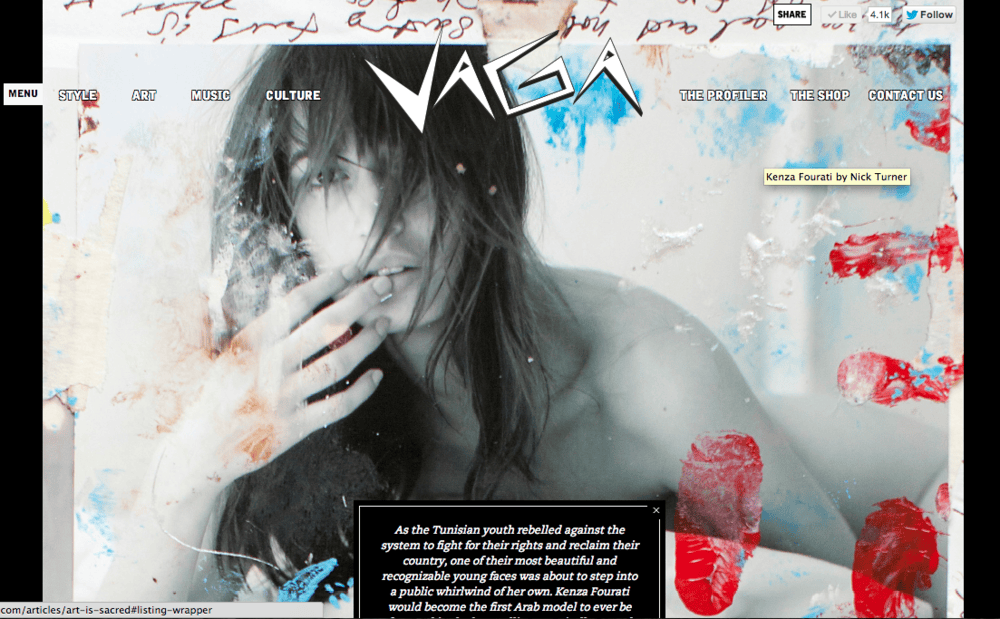
As the Tunisian youth rebelled against the system to fight for their rights and reclaim their country, one of their most beautiful and recognizable young faces was about to step into a public whirlwind of her own. Kenza Fourati would become the first Arab model ever to be featured in the bestselling Sports Illustrated Swimsuit Issue. The significance was immediately established by the magazine, which added a political quote to Kenza’s introductory page. The response from the media around the world, and especially from her own country, was immediate. In the process, Kenza became one of the faces of that young revolution.
Already an active participant in her country’s political struggles, Kenza now had enough influence with the media to spread the word and make more room for Tunisian issues across the planet. Bold and outspoken, the model was never discouraged by her critics, who often created negative Facebook groups or used internet forums to speak out against her and her message. Kenza’s goal was clear: she was going to use her success and public persona to benefit her country, raise awareness of what it has to offer the world, and bring attention to the arts and fashion.
While working relentlessly on putting together her fashion line called “By Kenz” (which launched in Tunisia during Tunis Fashion Week in 2013), the model discovered other ways to connect the dots and kill two birds with one stone. With a degree in French literature from the Sorbonne as well as extensive studies in filmmaking, Kenza has a lot more to share with the world than just her looks.
What led you to the idea of bringing Tunisian artists to America?
Pride, probably. No one ever talks about my tiny country, yet it is shaking the face of the world. And I’m not talking only about the Arab Spring. When I walked around the Occupy Wall Street movements, I noticed several slogans inspired by the Tunisian uprising. After the revocation of censorship, when speech suddenly became free, creativity erupted. New York is a crossroads for artists. I have a duty to help build the bridge and expose both of my worlds.
How do you expect to start bridging the gap between the East and the West?
The strongest weapon ever created is the internet. There is no real geography anymore, just cultures to share. So, I decided to launch a fashion blog this month that will also promote art and culture from both sides.
How do you think Tunisia can benefit from the work you’re doing?
Tunisia is on the edge; it is sculpting its destiny, its history, with Islamists trying to establish dogma everywhere. I want to expose people to new cultures, photography, and art.
Who are some of the artists who inspired you to start this work?
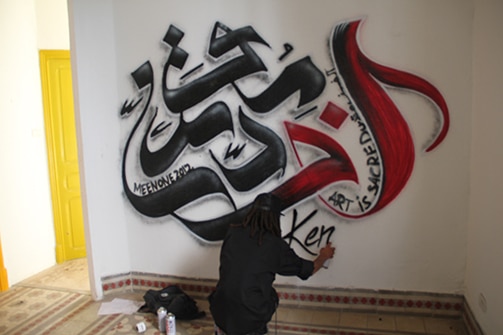
There are so many, but recently I met a young graffiti artist called MeenOne, who is truly fascinating. First, by the way he looks: he has dreadlocks. In Tunisia, it is very rare to allow yourself to look “marginal”. People aren’t used to it, and you are constantly confronted with harsh comments. Authorities will arrest you for questioning and so on. The irony is that it used to be people with long beards who looked suspicious.
Then there is also the fact that MeenOne grew up in a poor region of the country ruled by extremists. In fact, his brother is a Salafist (part of a Jihadist movement). MeenOne used to tag all over the country wearing a mask, but after the revolution, he showed his face and displayed his work in an exhibit last June. The exhibit was considered an insult to the sacred. Some fundamentalists called for his death, and it was his Salafist brother and the neighborhood he grew up in that ended up protecting him.
I didn’t know him personally at the time, but I was stunned by what happened. For me, freedom is sacred above everything, and so is art. So, I started looking for an artist to work on an “Art is Sacred” theme for my website and clothing line, and I came across MeenOne and found him to be extremely talented. I had no idea he was involved in the exhibit scandal at the time. I had already become obsessed with graffiti when I went to Rio de Janeiro in Brazil and discovered Panmela Castro’s work.
And how will you bring that work over to the West?
First through my online platform, and later on I hope to take it to another level and allow some awesome art to be physically shown here.
How involved were you during the Tunisian revolution?
When the turmoil intensified, I asked my family for permission to start publishing articles and videos connected to the subject, and they allowed me to do it. They really are the brave ones, because the danger was truly for them. I got even more involved when a friend of mine, who is an activist, was arrested and disappeared. His wife reached out to me right at the beginning, on January 6, 2011. I decided to stop everything I was doing and focus entirely on the history being made in my country.
What about the revolution made you happy?
I felt infinitely proud, but it was a kind of pride I had never felt before. Pride is normally a very individualistic feeling, but back then it was completely selfless—a collectively shared feeling of pride. I am deeply moved and amazed by it. This revolution belongs to all of us. We are the revolution.
Were you ever afraid of any negative religious or political backlash due to your participation in these movements?
At the time, yes; I was afraid of the political backlash my family could suffer. Religion wasn’t an issue at the time, but that problem came later and is very relevant today.
What do you still expect to see happening for your country?
Democracy is still unfolding. We are navigating what is accepted and what is not, and having Islamists in power doesn’t help.
Do you feel that being a model was or still could be a problem for you in your country?
Yes, it certainly is now, but it never used to be. I am extremely controversial in the country as it has been getting more and more conservative.
Is there anything you think you would do differently in your career?
Last year, I shot a cover for a magazine wearing a bikini, and my body was covered with a Victor Hugo poem. I loved the concept and the poem preaching love and tolerance, but the magazine edited it in an aggressively provocative way that delivered the wrong message. So yes, that would be the only thing I would do differently. I was too naive back then.
How about your clothing line? What are the links with Tunisia there?
First of all, I am manufacturing my entire collection locally. People may not know this, but many great fashion houses like Giorgio Armani and Zadig & Voltaire make their products in Tunisia. I will be using those same factories. Product quality is very important to me and remains my main priority. I will also be launching my first collection during Tunis Fashion Week in April 2013.
- Originally published on Vaga Magazine.

