On an evening when the art world had its eyes on the Armory Gala Benefit, Hauser & Wirth managed to draw a discerning crowd to the opening of Bharti Kher’s exhibition, The Hot Winds that Blow from the West, featuring five new works by the acclaimed London-born, Delhi-based artist.
Visitors are welcomed by A View of the Forest, a striking multi-toned green composition rendered in Kher’s signature bindis, before being ushered down the hallway to encounter A Line Through Space and Time. The piece—a standalone staircase leading to nowhere in an empty room—is meticulously covered in sperm-shaped bindis, offering a compelling visual meditation on fertility, time, and transition. Bindis, far more than decorative elements in Indian culture, have remained central to Kher’s practice since 1995. As the artist explains, they are “meant to represent a third eye—one that forges a link between the real and the spiritual-conceptual worlds.”
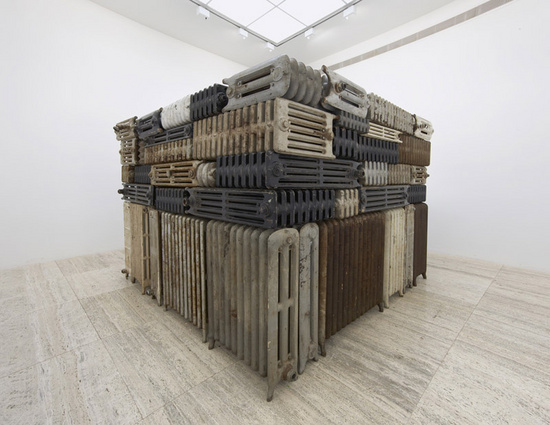
The exhibition’s heavyweight titular installation, The Hot Winds that Blow from the West, commands the rear gallery. Though it could easily occupy a larger space, the work remains astonishing in scale and intent. Over six years, Kher sourced 131 vintage cast-iron radiators from the United States (the West) and shipped them to India (the East) to be assembled into a monolithic, stacked grid.
The title references the Loo, the scorching, occasionally fatal summer winds that sweep across northern India and Pakistan. “We think of winds as harbingers of change, carrying voices of transformation,” Kher notes. “From where I sit, the winds blowing nowadays from the West—from the places that were the seats of power and authority throughout the 20th century—are no longer as strong or reliable as they were.” Stripped of their functional purpose during their journey east, these symbols of Western domestic comfort are re-contextualized: “I suppose I am sending them back to the West as messengers and, perhaps, warnings. Other voices are changing the landscape now, and political uncertainties have put the world in flux.”
On the second floor sits the exhibition’s most arresting work, Reveal the Secrets That You Seek, previously exhibited at the Centre Pompidou in Paris. Composed of 27 fractured, bindi-overlaid mirrors, the installation transforms the gallery into an immersive space of reflection. While broken mirrors traditionally signify misfortune, Kher binds the fractures together, demonstrating how broken fragments can yield beauty, coherence, and reconciliation.
The final work, The Messenger, commands the gallery on its own terms. Positioned in a striking yoga posture and balanced by its own weight, the fiberglass sculpture is described by Kher as “an urban witch, a woman of both mythology and everyday life—a hybrid.” Drawing upon the iconography of the Hindu goddess Dakini—the feminine manifestation of energy—the sculpture conjoins contradictions of gender, species, and role with a haunting, animalistic presence.
An impressive achievement for Hauser & Wirth, the exhibition stands as a powerful testament to Bharti Kher’s conceptual and sculptural vision.
- Originally published on Lookbooks.

