
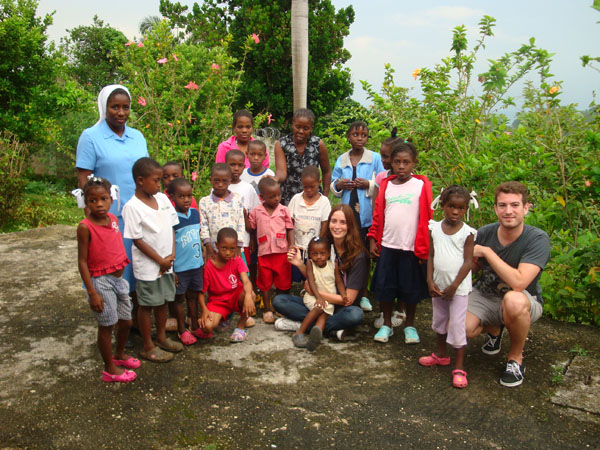
While the world has kept Haiti in its thoughts and hearts ever since the tragedy, only a select few individuals have had the opportunity to visit the country, witness the aftermath firsthand, and lend a helping hand. Elite agent Gabriel Ruas shared his experience in Haiti with Modelina just in time for the Lakay Pam event hosted by Coco Rocha tonight—to which you are all invited!
I have been working with the NGO Lakay Pam (“My House” in Creole) for a little over three years. The organization, founded by one of the models I manage, Carolina Bittencourt, has touched me from the start. Carolina, who traveled the world throughout her modeling career, had always felt the need to help, but she never believed that simply giving money away was the right approach. It was only when she met Haitian entrepreneur Cedrick Roche that she finally discovered her mission. With Cedrick by her side, she set off for Haiti to learn all about this Caribbean nation—so close to the modern world, yet so far from everyone’s mind.
Carolina and Cedrick set their sights on one particular orphanage. Their goal was to help the children of Haiti, many of whom had been abandoned by their parents, were unable to afford an education, or lacked even a grain of rice to eat at the end of the day. Today, Lakay Pam helps provide shelter, education, healthcare, and food for over 700 children in Haiti, but the number of those in need is far larger and continues to grow daily.
Following the earthquake in January of this year, I decided to finally make my way to the emerald shores of Haiti and get to work. Through an invitation from Lakay Pam and their local supporters, I arrived in Port-au-Prince feeling both excited and apprehensive; the reality of what I was about to encounter remained uncertain in my mind. After an easy, comfortable three-hour flight from New York, arriving at the airport was straightforward, yet the devastation was immediately evident: military helicopters and airplanes lined the partially destroyed tarmac, and the limited organization upon entry was entirely expected.
Once I settled in, I got into a car and headed toward downtown Port-au-Prince. Everywhere I looked, I saw destruction. From small houses to tall buildings, most of the city had collapsed to the ground—six floors of concrete pancaked on top of each other. As we approached the city center, the damage worsened. Several buildings still standing showed severe structural instability, forcing residents to live outside in makeshift tents.
The tent settlements are an entirely separate reality. Tents now fill what used to be beautiful public squares and monuments, stretching into the hills bordering the city alongside tons of debris and rubble. It is heartbreaking to see that in our modern age, people are still subjected to such hardship.
Yet not all is lost, as every Haitian citizen and visitor will tell you. The people of this island share an extraordinary quality: an unwavering will to survive paired with profound resilience. Haitians have endured brutal, corrupt leadership and ineffective public institutions, yet they have consistently persevered—and they continue to do so now.
Creativity flourishes across the country. Local artisans showcase remarkable talent through mosaics, stone sculptures, and intricate straw crafts. All of this work is created without formal training, demonstrating skills that design students in developed nations spend lifetimes trying to master.
While international aid is being distributed, the scale of destruction—combined with political bottlenecks—means that direct, on-the-ground action remains crucial. Whether the immediate need is cribs, X-ray machines, mattresses, bricks, or cement, providing direct assistance is essential. In a country where the majority of the population lacks running water or electricity, even one hundred dollars goes a long way.
There is another direct way to help that is both impactful and rewarding: consider visiting Haiti for your next Caribbean vacation. With some of the most stunning coastlines in the region, Haiti was once a premier travel destination. Destinations like Île-à-Vache, Port-Salut, and Cap-Haïtien offer exceptional hospitality surrounded by rich culture and history, presenting a completely different atmosphere from downtown Port-au-Prince. Furthermore, many who have taken Caribbean cruises have already visited Haitian shores at private resort ports without realizing it.
Tourism directly stimulates the local economy: increased visitor numbers support hotels, generate sustainable employment, and accelerate rebuilding efforts. This model has revitalized regions across Africa, South America, and Asia.
If you have read this far, you are already engaged. Support Haiti in whatever way you can—do not let this recovery lose momentum or fade from public attention. Together, we can help support a resilient nation working to overcome immense challenges.
*Originally published on Modelinia.

